







Question: Please show and explain the steps for your work. Consider the two tanks shown below. Tank 1 contains 20 gallons of water and initially has
Please show and explain the steps for your work.
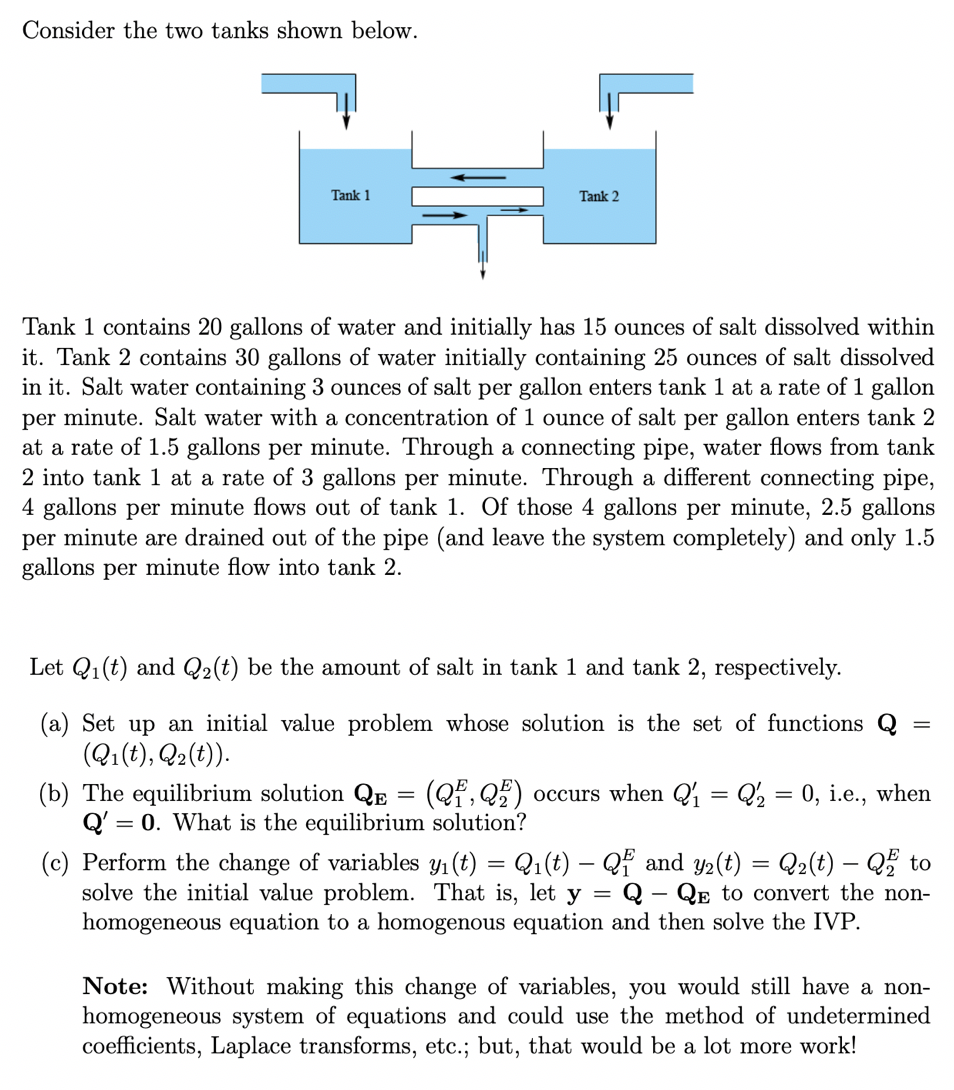
Consider the two tanks shown below. Tank 1 contains 20 gallons of water and initially has 15 ounces of salt dissolved within it. Tank 2 contains 30 gallons of water initially containing 25 ounces of salt dissolved in it. Salt water containing 3 ounces of salt per gallon enters tank 1 at a rate of 1 gallon per minute. Salt water with a concentration of 1 ounce of salt per gallon enters tank 2 at a rate of 1.5 gallons per minute. Through a connecting pipe, water ows from tank 2 into tank 1 at a rate of 3 gallons per minute. Through a different connecting pipe, 4 gallons per minute ows out of tank 1. Of those 4 gallons per minute, 2.5 gallons per minute are drained out of the pipe (and leave the system completely) and only 1.5 gallons per minute ow into tank 2. Let Q1(t) and Q26) be the amount of salt in tank 1 and tank 2, respectively. (a) Set up an initial value problem whose solution is the set of functions Q = (Q1(t)aQ2(t))' (b) The equilibrium solution QE = ((219,625) occurs when 621 = '2 = O, i.e., when Q' = 0. What is the equilibrium solution? (0) Perform the change of variables y1(t) = Q1(t) Q? and y2(t) = Q2(t) (2'; to solve the initial value problem. That is, let y = Q QE to convert the non- homogeneous equation to a homogenous equation and then solve the IVP. Note: Without making this change of variables, you would still have a non- homogeneous system of equations and could use the method of undetermined coeicients, Laplace transforms, etc.; but, that would be a lot more work
Step by Step Solution
There are 3 Steps involved in it

Get step-by-step solutions from verified subject matter experts
 Study Help