







Question: Please show decision tree do not copy & paste same answer from same question! Q1: Product rollouts Your firm has developed a new product aimed

Please show decision tree do not copy & paste same answer from same question!
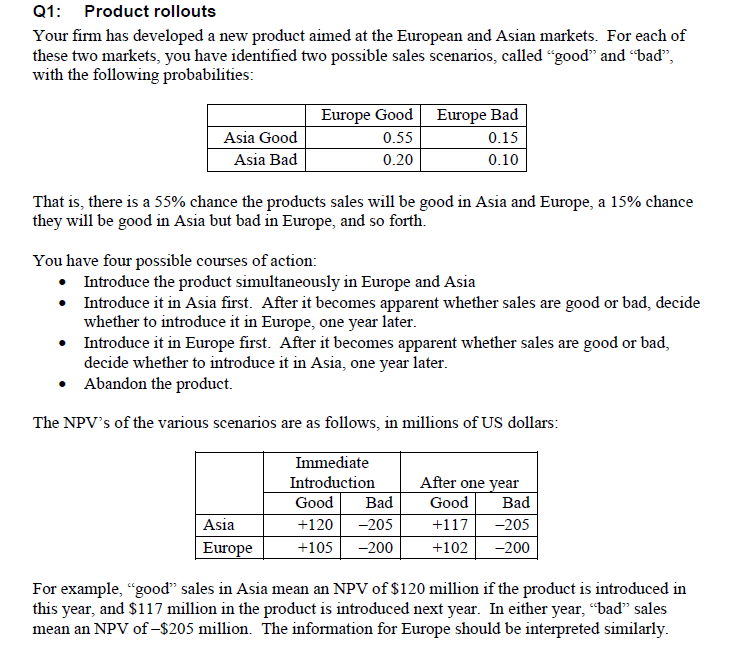
Q1: Product rollouts Your firm has developed a new product aimed at the European and Asian markets. For each of these two markets, you have identified two possible sales scenarios, called good and bad, with the following probabilities: Europe Bad Europe Good 0.55 0.20 Asia Good Asia Bad 0.15 0.10 That is, there is a 55% chance the products sales will be good in Asia and Europe, a 15% chance they will be good in Asia but bad in Europe, and so forth. You have four possible courses of action: Introduce the product simultaneously in Europe and Asia Introduce it in Asia first. After it becomes apparent whether sales are good or bad, decide whether to introduce it in Europe, one year later. Introduce it in Europe first. After it becomes apparent whether sales are good or bad, decide whether to introduce it in Asia, one year later. Abandon the product. The NPV's of the various scenarios are as follows, in millions of US dollars: Immediate Introduction Good Bad +120 -205 +105 -200 After one year Good Bad +117 -205 +102 -200 Asia Europe For example, "goo sales in Asia mean an NPV of $120 million if the product is introduced in this year, and $117 million in the product is introduced next year. In either year, bad sales mean an NPV of -$205 million. The information for Europe should be interpreted similarly. (b) Use a decision tree to determine the best introduction strategy for the product from the standpoint of EMV. State the optimal policy and its EMV. Q1: Product rollouts Your firm has developed a new product aimed at the European and Asian markets. For each of these two markets, you have identified two possible sales scenarios, called good and bad, with the following probabilities: Europe Bad Europe Good 0.55 0.20 Asia Good Asia Bad 0.15 0.10 That is, there is a 55% chance the products sales will be good in Asia and Europe, a 15% chance they will be good in Asia but bad in Europe, and so forth. You have four possible courses of action: Introduce the product simultaneously in Europe and Asia Introduce it in Asia first. After it becomes apparent whether sales are good or bad, decide whether to introduce it in Europe, one year later. Introduce it in Europe first. After it becomes apparent whether sales are good or bad, decide whether to introduce it in Asia, one year later. Abandon the product. The NPV's of the various scenarios are as follows, in millions of US dollars: Immediate Introduction Good Bad +120 -205 +105 -200 After one year Good Bad +117 -205 +102 -200 Asia Europe For example, "goo sales in Asia mean an NPV of $120 million if the product is introduced in this year, and $117 million in the product is introduced next year. In either year, bad sales mean an NPV of -$205 million. The information for Europe should be interpreted similarly. (b) Use a decision tree to determine the best introduction strategy for the product from the standpoint of EMV. State the optimal policy and its EMVStep by Step Solution
There are 3 Steps involved in it
1 Expert Approved Answer
Step: 1 Unlock

Question Has Been Solved by an Expert!
Get step-by-step solutions from verified subject matter experts
Step: 2 Unlock
Step: 3 Unlock
 Study Help