







Question: Please show formulas and work. Case 48 Dot Puff Project Selection The Department of Transportation, Public Utilities, and Facilities is affectionately known as DOTPUF. Its
Please show formulas and work.
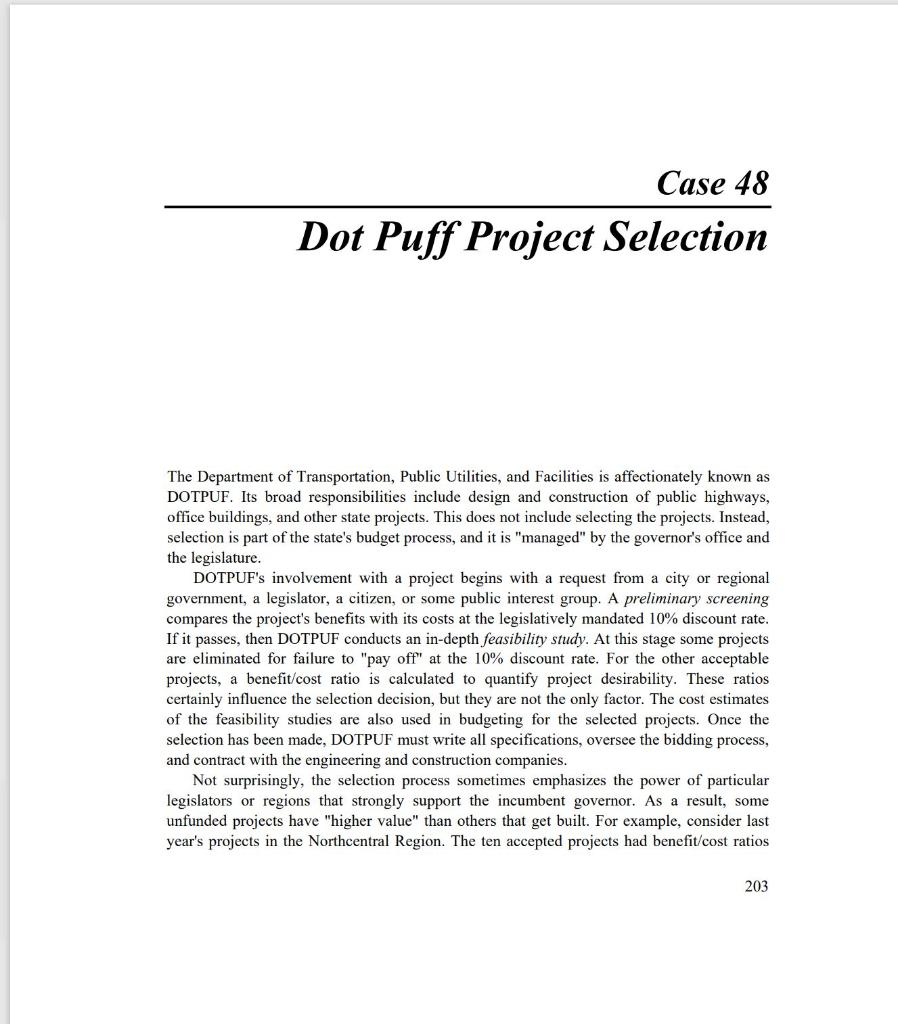
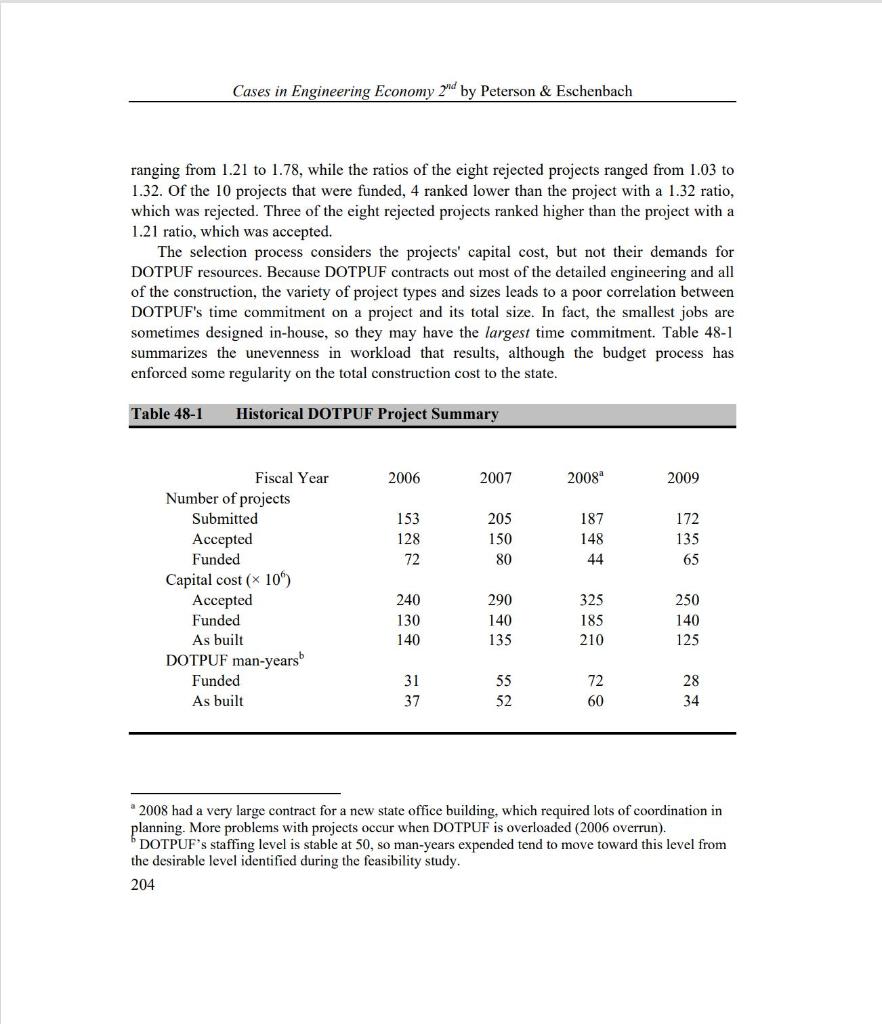
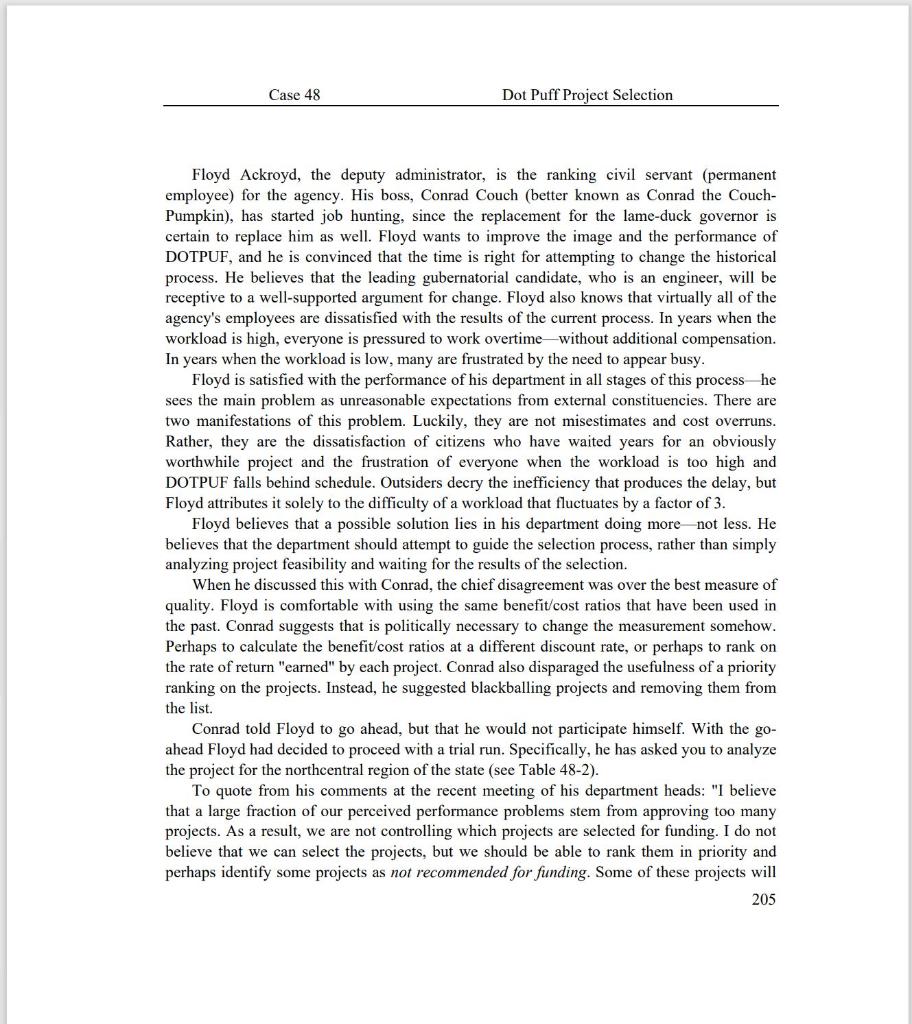
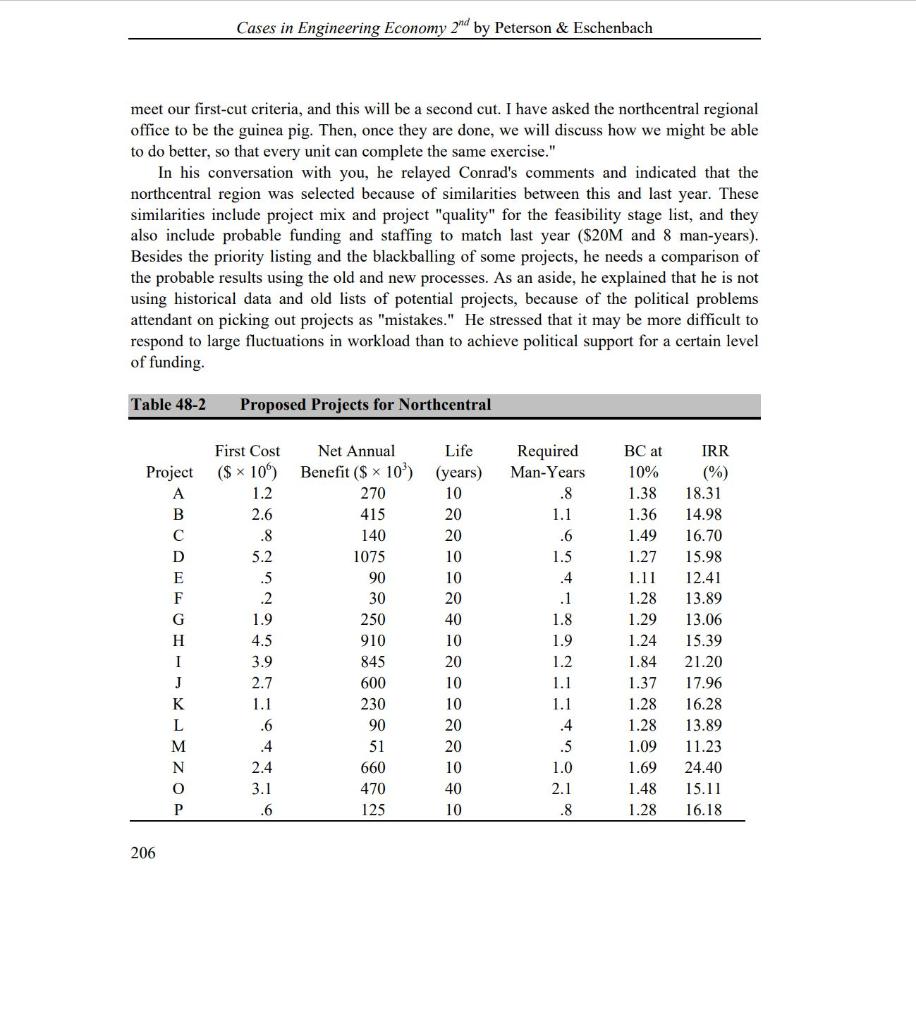
Case 48 Dot Puff Project Selection The Department of Transportation, Public Utilities, and Facilities is affectionately known as DOTPUF. Its broad responsibilities include design and construction of public highways, office buildings, and other state projects. This does not include selecting the projects. Instead, selection is part of the state's budget process, and it is "managed by the governor's office and the legislature. DOTPUF's involvement with a project begins with a request from a city or regional government, a legislator, a citizen, or some public interest group. A preliminary screening compares the project's benefits with its costs at the legislatively mandated 10% discount rate. If it passes, then DOTPUF conducts an in-depth feasibility study. At this stage some projects are eliminated for failure to "pay off" at the 10% discount rate. For the other acceptable projects, a benefit/cost ratio is calculated to quantify project desirability. These ratios certainly influence the selection decision, but they are not the only factor. The cost estimates of the feasibility studies are also used in budgeting for the selected projects. Once the selection has been made, DOTPUF must write all specifications, oversee the bidding process, and contract with the engineering and construction companies. Not surprisingly, the selection process sometimes emphasizes the power of particular legislators or regions that strongly support the incumbent governor. As a result, some unfunded projects have "higher value" than others that get built. For example, consider last year's projects in the Northcentral Region. The ten accepted projects had benefit/cost ratios 203 Cases in Engineering Economy 2nd by Peterson & Eschenbach ranging from 1.21 to 1.78, while the ratios of the eight rejected projects ranged from 1.03 to 1.32. Of the 10 projects that were funded, 4 ranked lower than the project with a 1.32 ratio, which was rejected. Three of the eight rejected projects ranked higher than the project with a 1.21 ratio, which was accepted. The selection process considers the projects' capital cost, but not their demands for DOTPUF resources. Because DOTPUF contracts out most of the detailed engineering and all of the construction, the variety of project types and sizes leads to a poor correlation between DOTPUF's time commitment on a project and its total size. In fact, the smallest jobs are sometimes designed in-house, so they may have the largest time commitment. Table 48-1 summarizes the unevenness in workload that results, although the budget process has enforced some regularity on the total construction cost to the state. Table 48-1 Historical DOTPUF Project Summary 2006 2007 2008a 2009 153 128 72 205 150 80 187 148 172 135 44 65 Fiscal Year Number of projects Submitted Accepted Funded Capital cost (* 10) Accepted Funded As built DOTPUF man-years Funded As built 240 130 140 290 140 135 325 185 210 250 140 125 31 37 55 52 72 60 28 34 * 2008 had a very large contract for a new state office building, which required lots of coordination in planning. More problems with projects occur when DOTPUF is overloaded (2006 overrun). DOTPUF's staffing level is stable at 50, so man-years expended tend to move toward this level from the desirable level identified during the feasibility study. 204 Case 48 Dot Puff Project Selection Floyd Ackroyd, the deputy administrator, is the ranking civil servant (permanent employee) for the agency. His boss, Conrad Couch (better known as Conrad the Couch- Pumpkin), has started job hunting, since the replacement for the lame-duck governor is certain to replace him as well. Floyd wants to improve the image and the performance of DOTPUF, and he is convinced that the time is right for attempting to change the historical process. He believes that the leading gubernatorial candidate, who is an engineer, will be receptive to a well-supported argument for change. Floyd also knows that virtually all of the agency's employees are dissatisfied with the results of the current process. In years when the workload is high, everyone is pressured to work overtime without additional compensation. In years when the workload is low, many are frustrated by the need to appear busy. Floyd is satisfied with the performance of his department in all stages of this process he sees the main problem as unreasonable expectations from external constituencies. There are two manifestations of this problem. Luckily, they are not misestimates and cost overruns. Rather, they are the dissatisfaction of citizens who have waited years for an obviously worthwhile project and the frustration of everyone when the workload is too high and DOTPUF falls behind schedule. Outsiders decry the inefficiency that produces the delay, but Floyd attributes it solely to the difficulty of a workload that fluctuates by a factor of 3. Floyd believes that a possible solution lies in his department doing more not less. He believes that the department should attempt to guide the selection process, rather than simply analyzing project feasibility and waiting for the results of the selection. When he discussed this with Conrad, the chief disagreement was over the best measure of quality. Floyd is comfortable with using the same benefit/cost ratios that have been used in the past. Conrad suggests that is politically necessary to change the measurement somehow. Perhaps to calculate the benefit/cost ratios at a different discount rate, or perhaps to rank on the rate of return "earned" by each project. Conrad also disparaged the usefulness of a priority ranking on the projects. Instead, he suggested blackballing projects and removing them from the list. Conrad told Floyd to go ahead, but that he would not participate himself. With the go- ahead Floyd had decided to proceed with a trial run. Specifically, he has asked you to analyze the project for the northcentral region of the state (see Table 48-2). To quote from his comments at the recent meeting of his department heads: "I believe that a large fraction of our perceived performance problems stem from approving too many projects. As a result, we are not controlling which projects are selected for funding. I do not believe that we can select the projects, but we should be able to rank them in priority and perhaps identify some projects as not recommended for funding. Some of these projects will 205 Cases in Engineering Economy 2nd by Peterson & Eschenbach meet our first-cut criteria, and this will be a second cut. I have asked the northcentral regional office to be the guinea pig. Then, once they are done, we will discuss how we might be able to do better, so that every unit can complete the same exercise." In his conversation with you, he relayed Conrad's comments and indicated that the northcentral region was selected because of similarities between this and last year. These similarities include project mix and project "quality" for the feasibility stage list, and they also include probable funding and staffing to match last year ($20M and 8 man-years). Besides the priority listing and the blackballing of some projects, he needs a comparison of the probable results using the old and new processes. As an aside, he explained that he is not using historical data and old lists of potential projects, because of the political problems attendant on picking out projects as "mistakes." He stressed that it may be more difficult to respond to large fluctuations in workload than to achieve political support for a certain level of funding Table 48-2 Proposed Projects for Northcentral Required Man-Years .8 1.1 .6 1.5 .4 First Cost Project ($ x 10) A 1.2 B 2.6 .8 D 5.2 E .5 F .2 G 1.9 H 4.5 I 3.9 J 2.7 K 1.1 L .6 M .4 N 2.4 0 3.1 .6 Net Annual Life Benefit ($ * 10) (years) 270 10 415 20 140 20 1075 10 90 10 30 20 250 40 910 10 845 20 600 10 230 10 90 20 51 20 660 10 470 40 125 10 1.8 1.9 1.2 1.1 1.1 .4 .5 1.0 2.1 .8 BC at 10% 1.38 1.36 1.49 1.27 1.11 1.28 1.29 1.24 1.84 1.37 1.28 1.28 1.09 1.69 1.48 1.28 IRR (%) 18.31 14.98 16.70 15.98 12.41 13.89 13.06 15.39 21.20 17.96 16.28 13.89 11.23 24.40 15.11 16.18 206Step by Step Solution
There are 3 Steps involved in it
1 Expert Approved Answer
Step: 1 Unlock

Question Has Been Solved by an Expert!
Get step-by-step solutions from verified subject matter experts
Step: 2 Unlock
Step: 3 Unlock
 Study Help