







Question: Please show full work. 2. (30 points) Markov chains: Consider the CSMA protocol. It operates very much like the ALOHA protocol discussed in the lectures.
Please show full work.
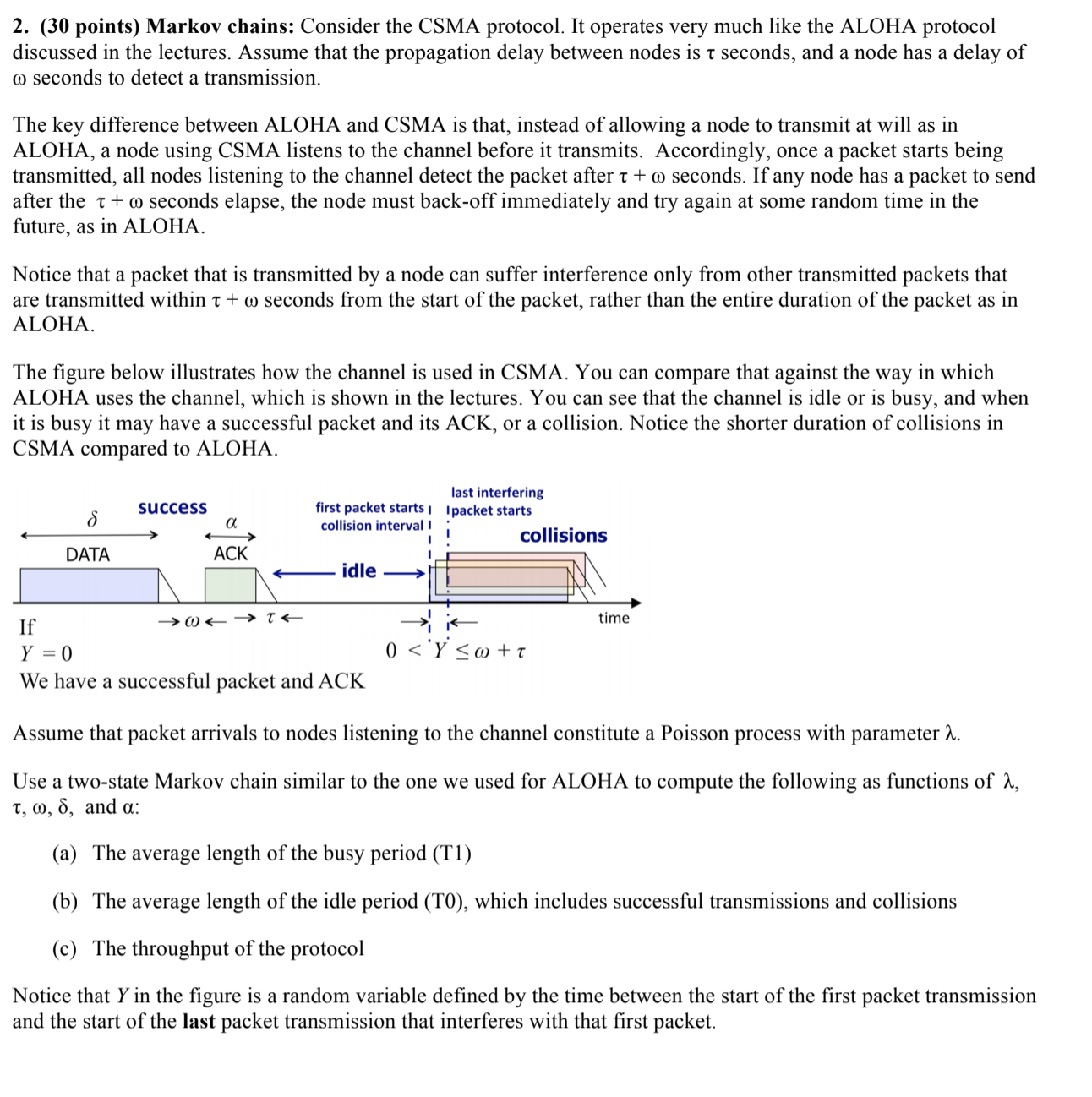
2. (30 points) Markov chains: Consider the CSMA protocol. It operates very much like the ALOHA protocol discussed in the lectures. Assume that the propagation delay between nodes is t seconds, and a node has a delay of w seconds to detect a transmission. The key difference between ALOHA and CSMA is that, instead of allowing a node to transmit at will as in ALOHA, a node using CSMA listens to the channel before it transmits. Accordingly, once a packet starts being transmitted, all nodes listening to the channel detect the packet after t + @ seconds. If any node has a packet to send after the t + w seconds elapse, the node must back-off immediately and try again at some random time in the future, as in ALOHA. Notice that a packet that is transmitted by a node can suffer interference only from other transmitted packets that are transmitted within t + w seconds from the start of the packet, rather than the entire duration of the packet as in ALOHA. The figure below illustrates how the channel is used in CSMA. You can compare that against the way in which ALOHA uses the channel, which is shown in the lectures. You can see that the channel is idle or is busy, and when it is busy it may have a successful packet and its ACK, or a collision. Notice the shorter duration of collisions in CSMA compared to ALOHA. success last interfering first packet starts | I packet starts collision interval I ACK collisions DATA - idle If ->
Step by Step Solution
There are 3 Steps involved in it

Get step-by-step solutions from verified subject matter experts
 Study Help