







Question: Please show me the solution without using Psychrometric chart, as shown in the following adiabatic saturation process example problem. Please explain the process (like why
 Please show me the solution without using Psychrometric chart, as shown in the following adiabatic saturation process example problem.
Please explain the process (like why you are using this number), with diagram.
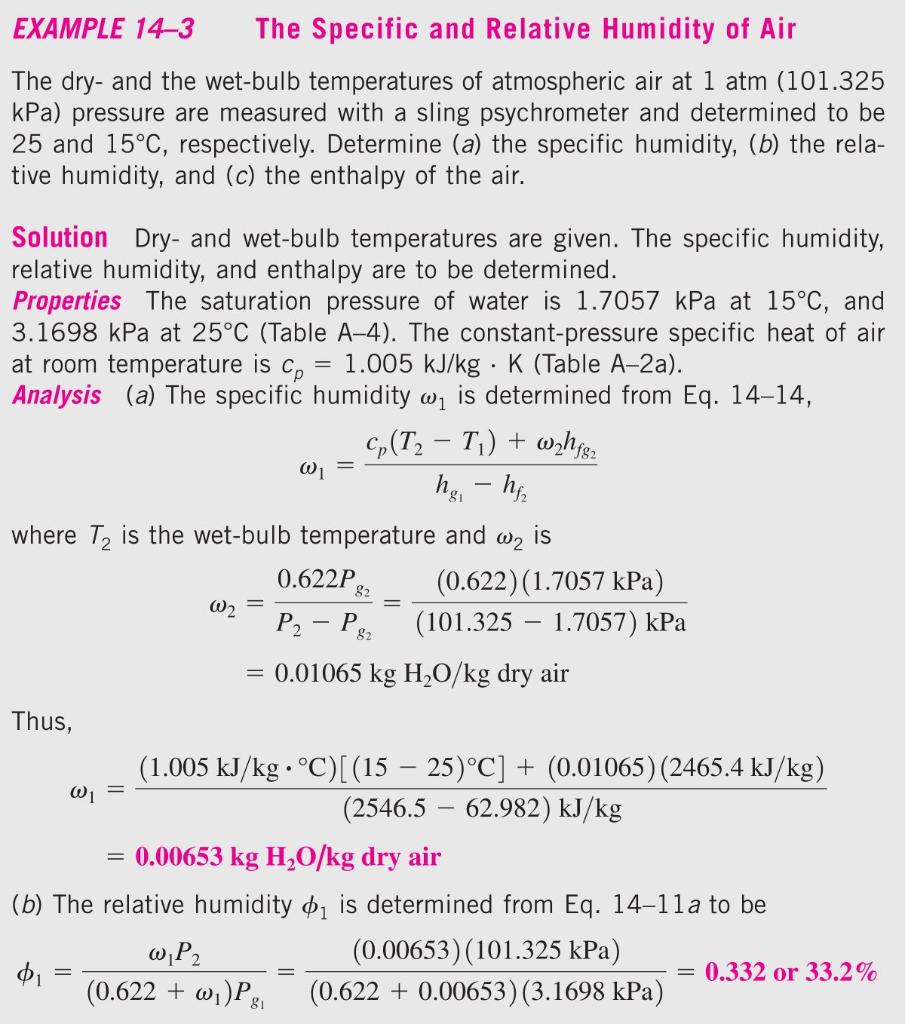
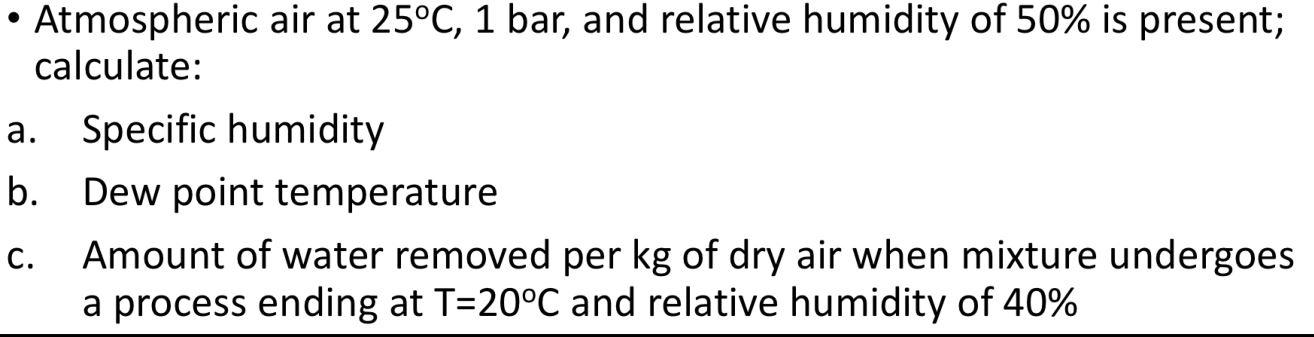
- Atmospheric air at 25C,1 bar, and relative humidity of 50% is present; calculate: a. Specific humidity b. Dew point temperature c. Amount of water removed per kg of dry air when mixture undergoes a process ending at T=20C and relative humidity of 40% The dry- and the wet-bulb temperatures of atmospheric air at 1atm(101.325 kPa) pressure are measured with a sling psychrometer and determined to be 25 and 15C, respectively. Determine (a) the specific humidity, (b) the relative humidity, and (c) the enthalpy of the air. Solution Dry- and wet-bulb temperatures are given. The specific humidity, relative humidity, and enthalpy are to be determined. Properties The saturation pressure of water is 1.7057kPa at 15C, and 3.1698kPa at 25C (Table A-4). The constant-pressure specific heat of air at room temperature is cp=1.005kJ/kgK (Table A2a). Analysis (a) The specific humidity 1 is determined from Eq. 14-14, 1=hg1hf2cp(T2T1)+2hfg2 where T2 is the wet-bulb temperature and 2 is 2=P2Pg20.622Pg2=(101.3251.7057)kPa(0.622)(1.7057kPa)=0.01065kgH2O/kgdryair Thus, 1=(2546.562.982)kJ/kg(1.005kJ/kgC)[(1525)C]+(0.01065)(2465.4kJ/kg)=0.00653kgH.O/kgdryair (b) The relative humidity 1 is determined from Eq. 14-11a to be
Step by Step Solution
There are 3 Steps involved in it

Get step-by-step solutions from verified subject matter experts
 Study Help