Question: PLEASE SHOW STEP BY STEP INSTRUCTIONS AND SHOW FORMULAS. MUST USE SOLVER. 39. A textile company produces shirts and pants. Each shirt requires three square

PLEASE SHOW STEP BY STEP INSTRUCTIONS AND SHOW FORMULAS. MUST USE SOLVER.
PLEASE SHOW STEP BY STEP INSTRUCTIONS AND SHOWPLEASE SHOW STEP BY STEP INSTRUCTIONS AND SHOWPLEASE SHOW STEP BY STEP INSTRUCTIONS AND SHOW

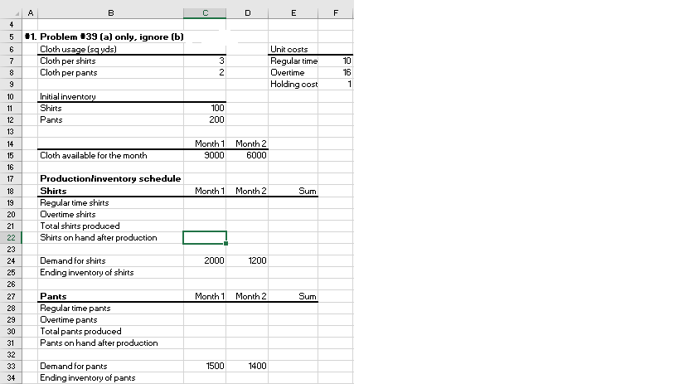
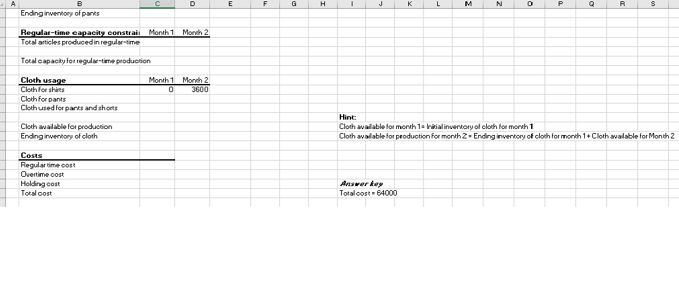
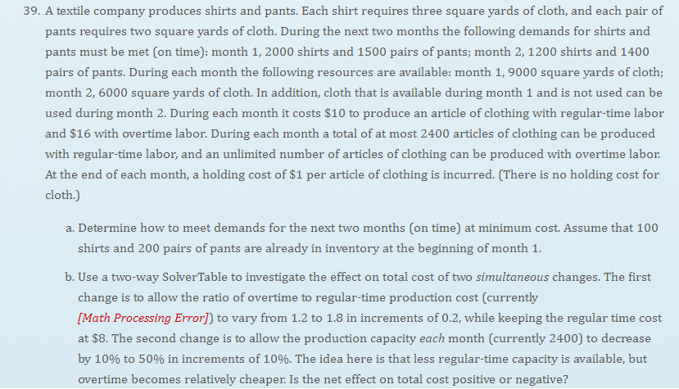
39. A textile company produces shirts and pants. Each shirt requires three square yards of cloth, and each pair of pants requires two square yards of cloth. During the next two months the following demands for shirts and pants must be met (on time): month 1, 2000 shirts and 1500 pairs of pants; month 2, 1200 shirts and 1400 pairs of pants. During each month the following resources are available: month 1, 9000 square yards of cloth; month 2, 6000 square yards of cloth. In addition, cloth that is available during month 1 and is not used can be used during month 2. During each month it costs $10 to produce an article of clothing with regular-time labor and $16 with overtime labor. During each month a total of at most 2400 articles of clothing can be produced with regular-time labor, and an unlimited number of articles of clothing can be produced with overtime labor. At the end of each month, a holding cost of $1 per article of clothing is incurred. (There is no holding cost for cloth.) a. Determine how to meet demands for the next two months (on time) at minimum cost. Assume that 100 shirts and 200 pairs of pants are already in inventory at the beginning of month 1. b. Use a two-way SolverTable to investigate the effect on total cost of two simultaneous changes. The first change is to allow the ratio of overtime to regular-time production cost (currently [Math Processing Error]) to vary from 1.2 to 1.8 in increments of 0.2, while keeping the regular time cost at $8. The second change is to allow the production capacity each month (currently 2400) to decrease by 10% to 50% in increments of 10%. The idea here is that less regular-time capacity is available, but overtime becomes relatively cheaper. Is the net effect on total cost positive or negative? C D E F 3 2 Unk costs Regular time Overtime Holding cost 10 16 1 100 200 Month 1 Month 2 9000 6000 Boa S2000 SB2120 Month 1 Month 2 B 4 5 61. Problem 139 (a) only, ignore (b) 6 Cloth usage (syds) 7 Cloth per shirts 8 Cloth per pants 9 10 Initialinventory 11 Shirts 12 Pants 13 14 15 Cloth available for the month 16 17 Production inventory schedule 18 Shirts 19 Regular time shirts 20 Overtime shirts 21 Total shirts produced 22 Shirts on hand after production 23 24 Demand for shirts 25 Ending inventory of shirts 26 27 Pants 28 Regular time pants 29 Overtime pants 30 Total pants produced 31 Pants on hand after production 32 33 Demand for pants 34 Ending inventory of panks Sum 2000 1200 Month 1 Month 2 Sum 1500 1400 A D F G H 1 J L M N o P R S Ending inventory of parks Month 2 Regular-time capacity constrait Month 1 Total articles produced in regular time Total capacity for regular-time production Month 1 Month 2 3600 Cloth usage Cloth for Cloth for pants Cloth used for pare and shorts Cloth available for production Ending inventory of cloth Hint Cloth available for month 1-nsalinventory of cloth for month 1 Cloth available for production for month 2 - Ending inventory of cloth for month 1+ Cloth available for Month 2 Costs Regular time cont Overtime cost Holding cost Toral cost Answer key Total cost - 64000

Step by Step Solution

There are 3 Steps involved in it

1 Expert Approved Answer
Step: 1 Unlock blur-text-image

Question Has Been Solved by an Expert!

Get step-by-step solutions from verified subject matter experts

Step: 2 Unlock
Step: 3 Unlock

Students Have Also Explored These Related General Management Questions!