







Question: Please show steps on how to solve these problems! 1. Suppose the CAPM holds. Suppose risk-free rate is 2% and market risk premium (E(Rm) t
Please show steps on how to solve these problems!
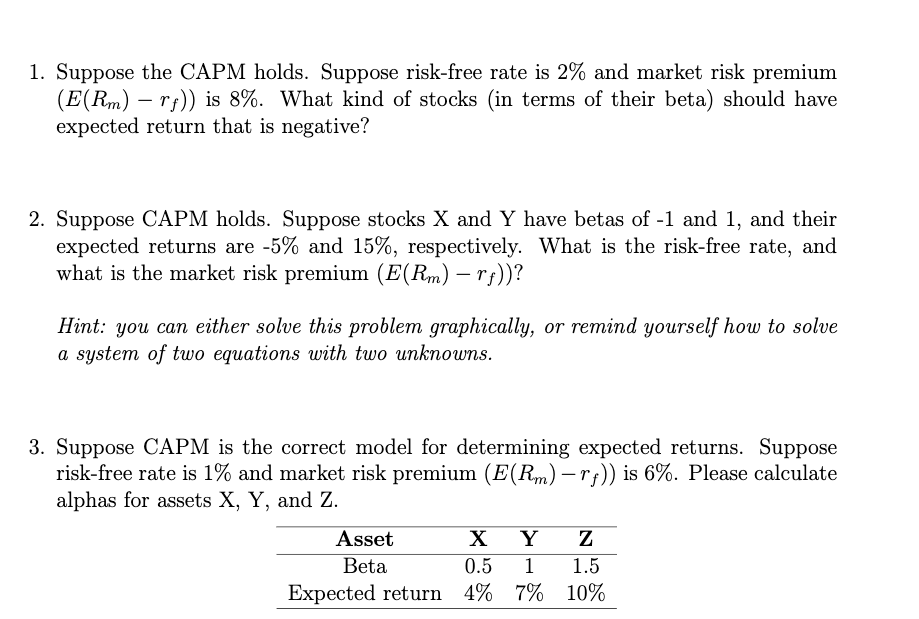
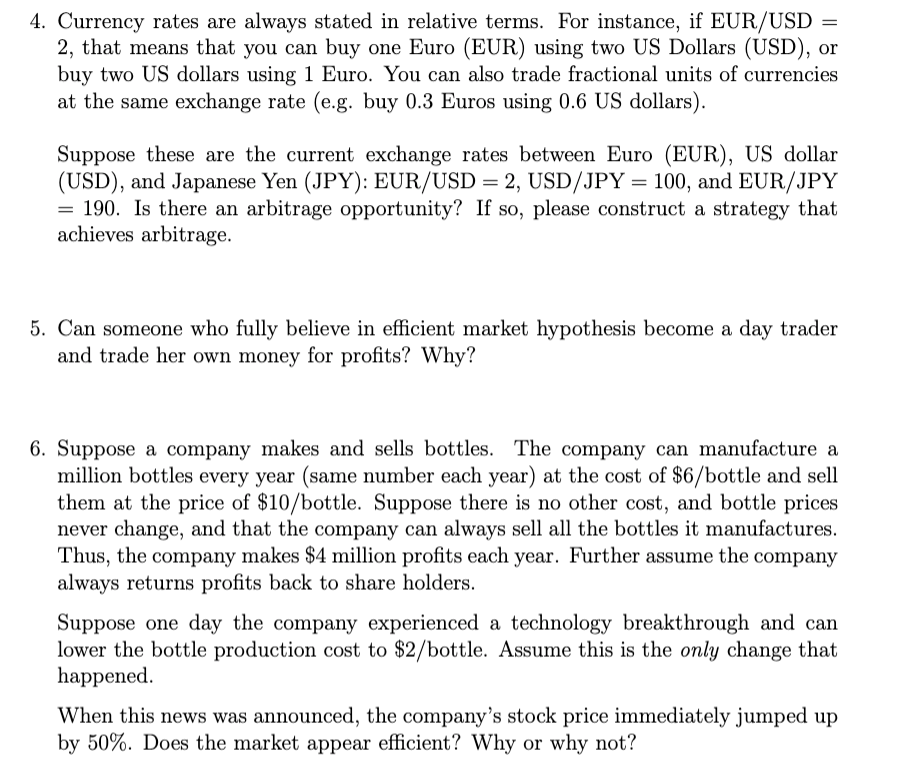
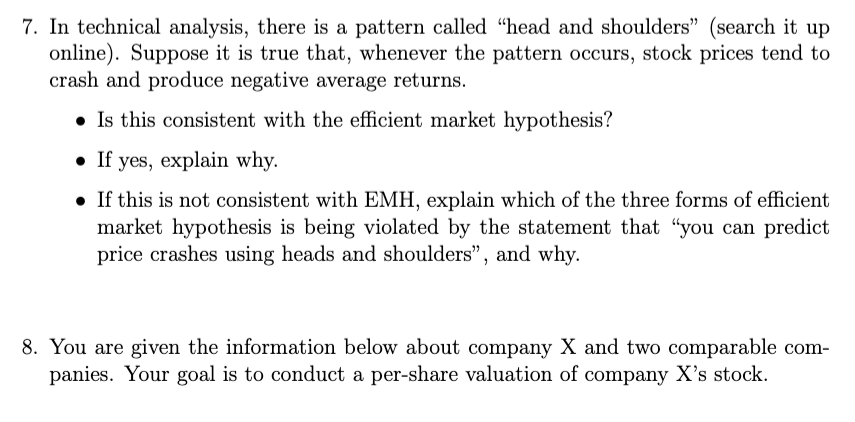
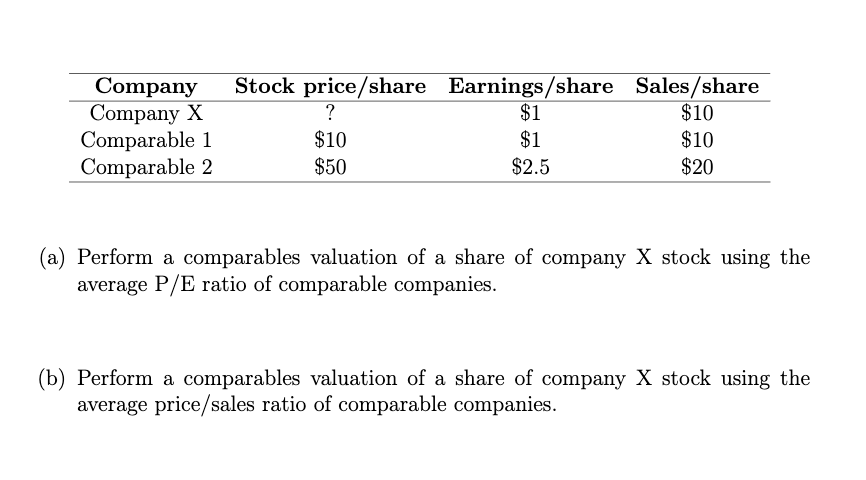
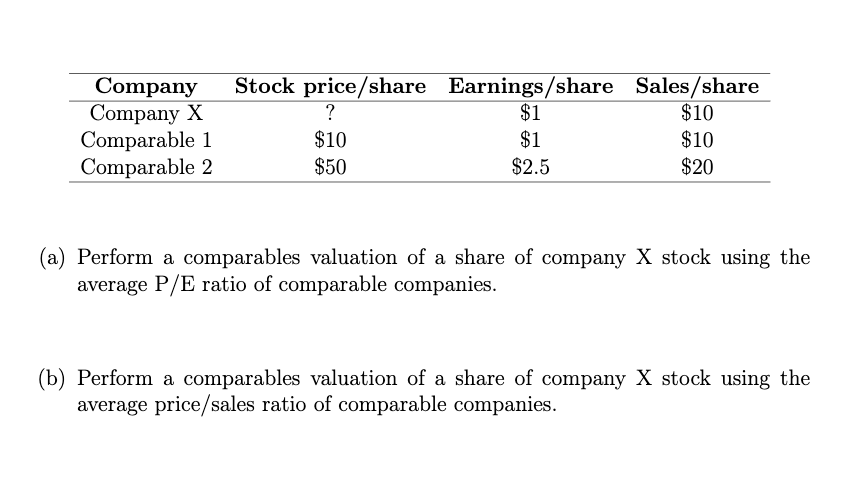
1. Suppose the CAPM holds. Suppose risk-free rate is 2% and market risk premium (E(Rm) t\" is 8%. What kind of stocks (in terms of their beta) should have expected return that is negative? 2. Suppose CAPM holds. Suppose stocks X and Y have betas of -1 and 1, and their expected returns are 5% and 15%, respectively. What is the risk-free rate1 and what is the market risk premium (E[Rm) TfD? Hint: you can either solve this pmbtem graphically, or remind yoursetf how to solve a system of two equations with two unknowns. 3. Suppose CAPM is the correct model for determining expected returns. Suppose risk-free rate is 1% and market risk premium (E(Rm) no is 6%. Please calculate alphas for assets X, Y, and Z. Asset X Y Z Beta 0.5 1 1.5 Expected return 4% 7% 10% 4. Currency rates are always stated in relative terms. For instance, if EUR/USD = 2, that means that you can buy one Euro (EUR) using two US Dollars (USD), or buy two US dollars using 1 Euro. You can also trade fractional units of currencies at the same exchange rate (e.g. buy 0.3 Euros using 0.6 US dollars). Suppose these are the current exchange rates between Euro (EUR), US dollar (USD), and Japanese Yen (JPY): EUR/USD = 2, USD/JPY = 100, and EUR/JPY = 190. Is there an arbitrage opportunity? If so, please construct a strategy that achieves arbitrage. 5. Can someone who fully believe in efcient market hypothesis become a day trader and trade her own money for prots? Why? 6. Suppose a company makes and sells bottles. The company can manufacture a million bottles every year (same number each year) at the cost of 36/ bottle and sell them at the price of $10/bottle. Suppose there is no other cost, and bottle prices never change, and that the company can always sell all the bottlu it manufactures. Thus, the company makes $4 million prots each year. Further assume the company always returns prots back to share holders. Suppose one day the company experienced a technology breakthrough and can lower the bottle production cost to $2/bottle. Assume this is the only change that happened. When this news was announced, the company's stock price immediately jumped up by 50%. Does the market appear efcient? Why or why not? 7. In technical analysis, there is a pattern called \"head and shoulders\" (search it up online). Suppose it is true that, whenever the pattern occurs, stock prices tend to crash and produce negative average returns. I Is this consistent with the efcient market hypothesis? I If yes1 explain why. u If this is not consistent with EMH, explain which of the three forms of efcient market hypothesis is being violated by the statement that \"you can predict price crashes using heads and shoulders\Company Stock price / share Earnings f share Sales / share Company X ? $1 $10 Comparable 1 $10 $1 $10 Comparable 2 $50 $2.5 $20 (a) Perform a comparablee valuation of a share of company X stock using the average P f E ratio of comparable companies. (b) Perform a comparablea valuation of a share of company X stock using the average price/ sales ratio of comparable companies
Step by Step Solution
There are 3 Steps involved in it

Get step-by-step solutions from verified subject matter experts
 Study Help