







Question: please show steps. Thanks . Implement Fibonacci Min-Heaps in your favorite language. Your program should take in a list of n integers. For every function

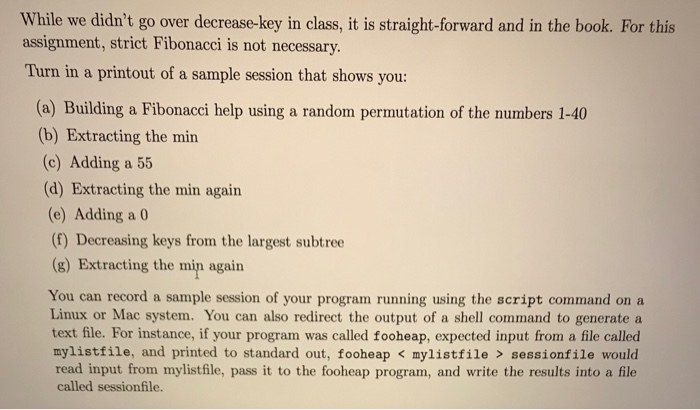
Implement Fibonacci Min-Heaps in your favorite language. Your program should take in a list of n integers. For every function of the Fibonacci min-heap (insert, extract-min, decrease- key*), print the min as well as a visualization of what the entire structure looks like. This can be as simple as printing a list of arrays, e. g. Min: 1, Fib-Heap: [2,5,7], [5], [11], [4,7,5,9,8,6,6), [1,2] While we didn't go over decrease-key in class, it is straight-forward and in the book. For this assignment, strict Fibonacci is not necessary. Turn in a printout of a sample session that shows you: (a) Building a Fibonacci help using a random permutation of the numbers 1-40 (b) Extracting the min (c) Adding a 55 (d) Extracting the min again (e) Adding a 0 (f) Decreasing keys from the largest subtree (g) Extracting the min again You can record a sample session of your program running using the script command on a Linux or Mac system. You can also redirect the output of a shell command to generate a text file. For instance, if your program was called fooheap, expected input from a file called mylistfile, and printed to standard out, fooheap sessionfile would read input from mylistfile, pass it to the fooheap program, and write the results into a file called sessionfile. Implement Fibonacci Min-Heaps in your favorite language. Your program should take in a list of n integers. For every function of the Fibonacci min-heap (insert, extract-min, decrease- key*), print the min as well as a visualization of what the entire structure looks like. This can be as simple as printing a list of arrays, e. g. Min: 1, Fib-Heap: [2,5,7], [5], [11], [4,7,5,9,8,6,6), [1,2] While we didn't go over decrease-key in class, it is straight-forward and in the book. For this assignment, strict Fibonacci is not necessary. Turn in a printout of a sample session that shows you: (a) Building a Fibonacci help using a random permutation of the numbers 1-40 (b) Extracting the min (c) Adding a 55 (d) Extracting the min again (e) Adding a 0 (f) Decreasing keys from the largest subtree (g) Extracting the min again You can record a sample session of your program running using the script command on a Linux or Mac system. You can also redirect the output of a shell command to generate a text file. For instance, if your program was called fooheap, expected input from a file called mylistfile, and printed to standard out, fooheap sessionfile would read input from mylistfile, pass it to the fooheap program, and write the results into a file called sessionfile
Step by Step Solution
There are 3 Steps involved in it

Get step-by-step solutions from verified subject matter experts
 Study Help