







Question: Please show the working out if possible Consider a small closed economy with two consumption goods: good 1 (meat) and good 2 (berries). There are
Please show the working out if possible
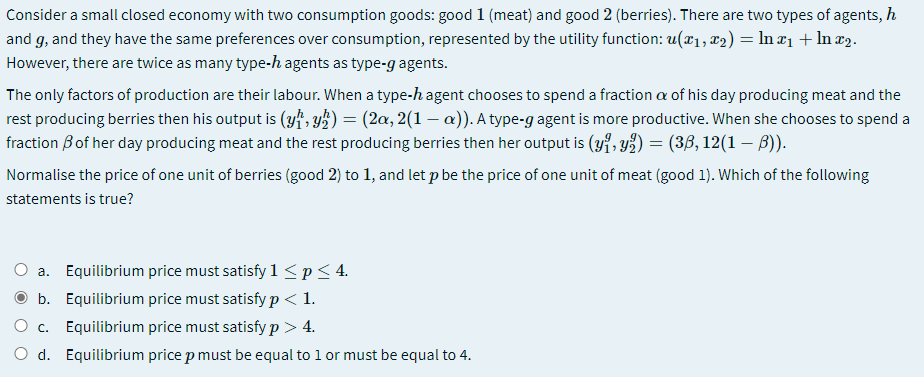

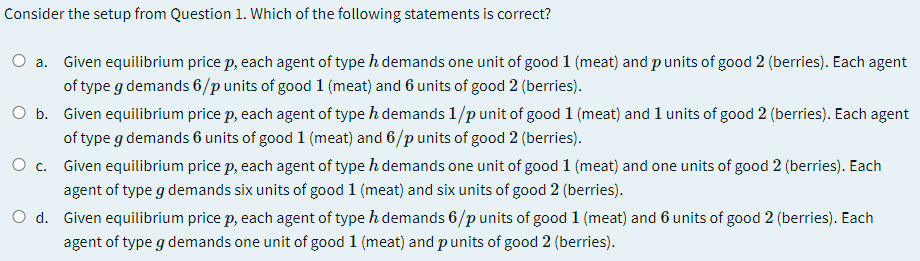
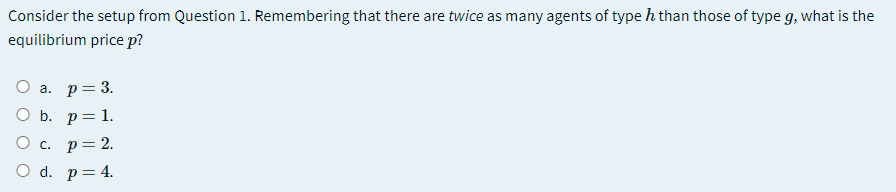
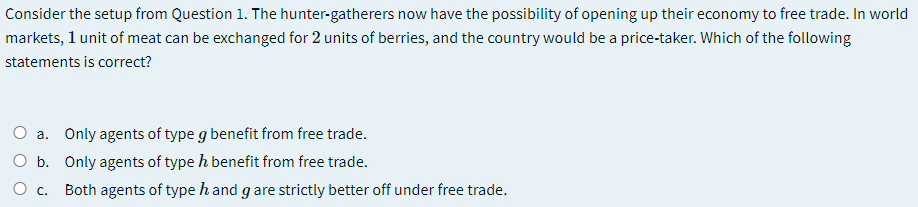
Consider a small closed economy with two consumption goods: good 1 (meat) and good 2 (berries). There are two types of agents, h and g, and they have the same preferences over consumption, represented by the utility function: u($1, x2) = Inc, + Inc2. However, there are twice as many type-h agents as type-g agents. The only factors of production are their labour. When a type-h agent chooses to spend a fraction o of his day producing meat and the rest producing berries then his output is (yf, y?) = (20, 2(1 - @)). A type-g agent is more productive. When she chooses to spend a fraction of her day producing meat and the rest producing berries then her output is (yj , y?) = (38, 12(1 - B)). Normalise the price of one unit of berries (good 2) to 1, and let p be the price of one unit of meat (good 1). Which of the following statements is true? O a. Equilibrium price must satisfy 1 4. O d. Equilibrium price p must be equal to 1 or must be equal to 4.Consider the setup from Question 1. Which of the following statements is correct? O a. In equilibrium, each agent of type h produces only meat, while each agent of type g produces only berries. O b. In equilibrium, it must be that each agent of type h produces only berries, while each agent of type g produces only meat. O c. In equilibrium, each agent of type h and g produces strictly positive amounts of meat and berries.Consider the setup from Question 1. Which of the following statements is correct? O a. Given equilibrium price p, each agent of type h demands one unit of good 1 (meat) and punits of good 2 (berries). Each agent of type g demands 6/p units of good 1 (meat) and 6 units of good 2 (berries). O b. Given equilibrium price p, each agent of type h demands 1/p unit of good 1 (meat) and 1 units of good 2 (berries). Each agent of type g demands 6 units of good 1 (meat) and 6/p units of good 2 (berries). O c. Given equilibrium price p, each agent of type h demands one unit of good 1 (meat) and one units of good 2 (berries). Each agent of type g demands six units of good 1 (meat) and six units of good 2 (berries). O d. Given equilibrium price p, each agent of type h demands 6/p units of good 1 (meat) and 6 units of good 2 (berries). Each agent of type g demands one unit of good 1 (meat) and punits of good 2 (berries).Consider the setup from Question 1. Remembering that there are twice as many agents of type h than those of type g, what is the equilibrium price p? O a. p= 3. Ob. p=1. O c. p = 2. O d. p=4.Consider the setup from Question 1. The hunter-gatherers now have the possibility of opening up their economy to free trade. In world markets, 1 unit of meat can be exchanged for 2 units of berries, and the country would be a price-taker. Which of the following statements is correct? O a. Only agents of type g benefit from free trade. O b. Only agents of type h benefit from free trade. O c. Both agents of type h and g are strictly better off under free trade
Step by Step Solution
There are 3 Steps involved in it

Get step-by-step solutions from verified subject matter experts
 Study Help