



Question: PLEASE SHOW WORK 1. Question 1 (corporate bond seniority). This question is an extension to lecture 7 and guides through a discussion about the role
PLEASE SHOW WORK
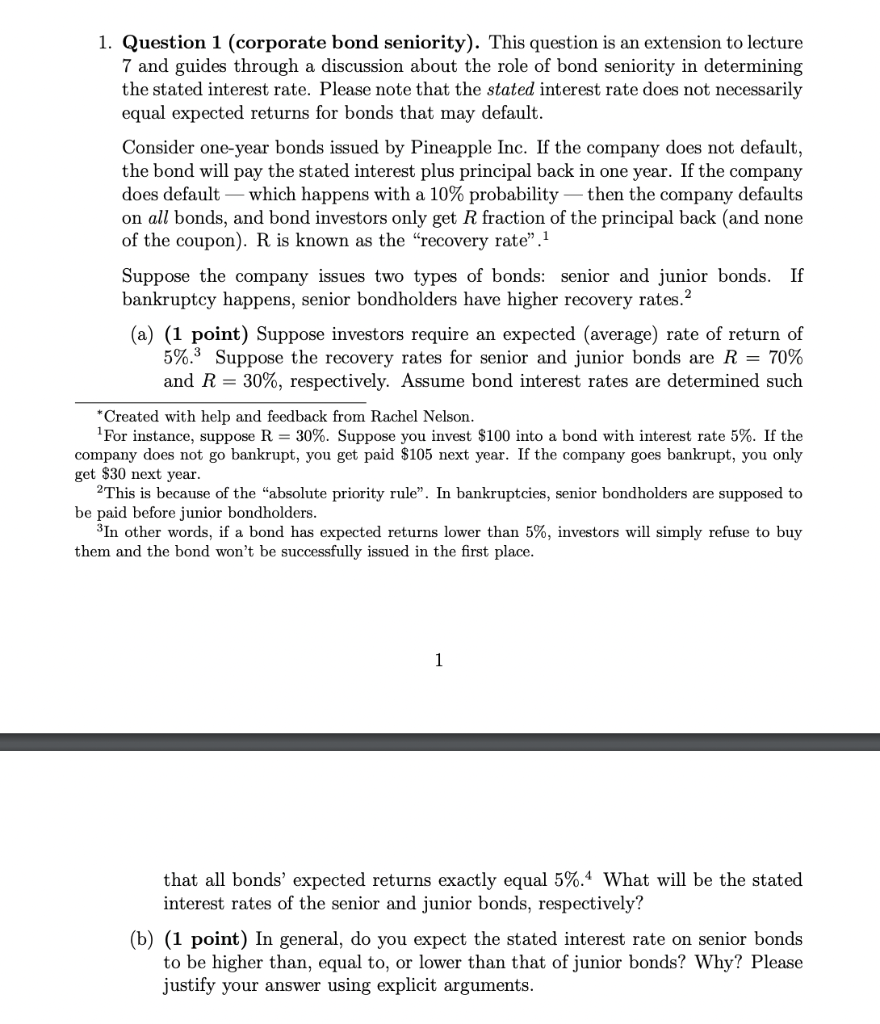
1. Question 1 (corporate bond seniority). This question is an extension to lecture 7 and guides through a discussion about the role of bond seniority in determining the stated interest rate. Please note that the stated interest rate does not necessarily equal expected returns for bonds that may default. Consider one-year bonds issued by Pineapple Inc. If the company does not default, the bond will pay the stated interest plus principal back in one year. If the company does default - which happens with a 10% probability - then the company defaults on all bonds, and bond investors only get R fraction of the principal back (and none of the coupon). R is known as the "recovery rate". 1 Suppose the company issues two types of bonds: senior and junior bonds. If bankruptcy happens, senior bondholders have higher recovery rates. 2 (a) (1 point) Suppose investors require an expected (average) rate of return of 5%.3 Suppose the recovery rates for senior and junior bonds are R=70% and R=30%, respectively. Assume bond interest rates are determined such Created with help and feedback from Rachel Nelson. 1 For instance, suppose R=30%. Suppose you invest $100 into a bond with interest rate 5%. If the ompany does not go bankrupt, you get paid $105 next year. If the company goes bankrupt, you only t $30 next year. 2 This is because of the "absolute priority rule". In bankruptcies, senior bondholders are supposed to e paid before junior bondholders. 3 In other words, if a bond has expected returns lower than 5%, investors will simply refuse to buy rem and the bond won't be successfully issued in the first place. 1 that all bonds' expected returns exactly equal 5%.4 What will be the stated interest rates of the senior and junior bonds, respectively? (b) (1 point) In general, do you expect the stated interest rate on senior bonds to be higher than, equal to, or lower than that of junior bonds? Why? Please justify your answer using explicit arguments. 1. Question 1 (corporate bond seniority). This question is an extension to lecture 7 and guides through a discussion about the role of bond seniority in determining the stated interest rate. Please note that the stated interest rate does not necessarily equal expected returns for bonds that may default. Consider one-year bonds issued by Pineapple Inc. If the company does not default, the bond will pay the stated interest plus principal back in one year. If the company does default - which happens with a 10% probability - then the company defaults on all bonds, and bond investors only get R fraction of the principal back (and none of the coupon). R is known as the "recovery rate". 1 Suppose the company issues two types of bonds: senior and junior bonds. If bankruptcy happens, senior bondholders have higher recovery rates. 2 (a) (1 point) Suppose investors require an expected (average) rate of return of 5%.3 Suppose the recovery rates for senior and junior bonds are R=70% and R=30%, respectively. Assume bond interest rates are determined such Created with help and feedback from Rachel Nelson. 1 For instance, suppose R=30%. Suppose you invest $100 into a bond with interest rate 5%. If the ompany does not go bankrupt, you get paid $105 next year. If the company goes bankrupt, you only t $30 next year. 2 This is because of the "absolute priority rule". In bankruptcies, senior bondholders are supposed to e paid before junior bondholders. 3 In other words, if a bond has expected returns lower than 5%, investors will simply refuse to buy rem and the bond won't be successfully issued in the first place. 1 that all bonds' expected returns exactly equal 5%.4 What will be the stated interest rates of the senior and junior bonds, respectively? (b) (1 point) In general, do you expect the stated interest rate on senior bonds to be higher than, equal to, or lower than that of junior bonds? Why? Please justify your answer using explicit arguments
Step by Step Solution
There are 3 Steps involved in it
To solve the problem we need to determine the stated interest rates of senior and junior bonds given the expected rate of return and the recovery rates Part a Lets assume the principal amount is 100 Expected Return Requirement The expected return on the bonds needs to be 5 Senior Bonds Probability of No Default 90 Probability of Default 10 Recovery Rate R 70 The expected value EV of the payoff for senior bonds can be calculated as EtextSenior Bond 09 times 100 textInterest from Senior Bond 01 times 100 times 07 Simplifying 09 times 100 textInterest from Senior Bond 01 times 70 105 90 09 times textInterest from Senior Bond 7 105 09 times textInterest from Senior Bond 8 textInterest from Senior Bond frac809 approx 889 So the stated interest rate for senior bonds is approximately 889 Junior Bonds Probability of No Default 90 Probability of Default 10 Recovery Rate R 30 The expected value EV of the payoff for junior bonds can be calculated as EtextJunior Bond 09 times 100 textInterest from Junior Bond 01 times 100 times 03 Simplifying 09 times 100 textInterest from Junior Bond 01 times 30 105 90 09 times textInterest from Junior Bond 3 105 09 times textInterest from Junior Bond 12 textInterest from Junior Bond frac1209 approx 1333 So the stated interest rate for junior bonds is approximately 1333 Part b Comparison Between Senior and Junior Bonds Risk and Recovery Rates Senior bonds have higher recovery rates implying less risk in the case of a default compared to junior bonds Therefore the expected loss in default is smaller for senior bonds Interest Rate Differences Due to the risk differential junior bonds which are riskier need to offer higher interest rates to attract investors balancing their higher default risk and lower recovery Conclusion The stated interest rate on senior bonds will generally be lower than that on junior bonds because senior bonds are less risky due to higher recovery rates Answer The stated interest rate for senior bonds is approximately 889 and for junior bonds it is 1333 The stated interest rate on senior bonds is expected to be lower due to their higher recovery rate ... View full answer

Get step-by-step solutions from verified subject matter experts