







Question: please show work for each question P1 has a production rate of 15 unitshour, P2=20 units/hour, P3=15 units per hour, P4=4 units/hour, P5=1 unA(s) per
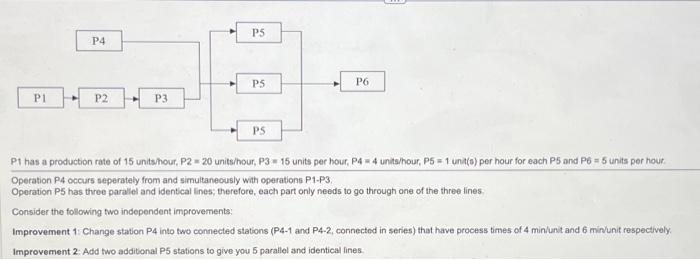
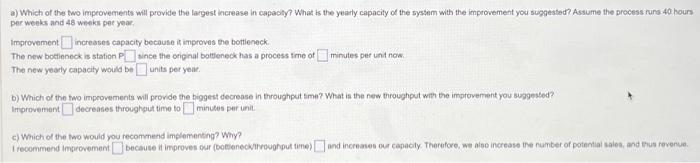
P1 has a production rate of 15 unitshour, P2=20 units/hour, P3=15 units per hour, P4=4 units/hour, P5=1 unA(s) per hour for each P5 and P6=5 units per hour. Operation P4 occurs seperately from and simultaneously with operations P1.P3, Operation P5 has three parallel and identical lines; therefore, each part only needs to go through one of the three lines Consider the following two independent improvements: Improvement 1: Change station P4 into two connected stations (P4-1 and P4-2, connected in series) that have process times of 4 minlunit and 6 min/unit respectively. Improvement 2: Add two additonal P5 stations to give you 5 parallel and identical fines. a) Which of the two improvements will provide the lacgest increase in capacip? What is the yearly capacity of the systam with the improvement you siogestad? Assume the process runs 40 hours per weeks and 48 weeks pet year. Improvement increases capacity because it improves the bottieneck. The new bottieneck is station P since the cripinal bottleneck has a process time of minutes per unit now. The new yearly capacity would be units per yeac. b) Which of the two improvements will provide the biggest decrease in throughput ime? What is the new throughput with the improvement you supgested? Improvement decreases throughout time to minutes per unit. c) Which of the two would you recommend implementing? Why
Step by Step Solution
There are 3 Steps involved in it

Get step-by-step solutions from verified subject matter experts
 Study Help