Question: Please show work for the solutions. Problem 2 This question builds on your knowledge of the LOQ murtel iv incorporate quantity discounts in fixed costs.
Please show work for the solutions.
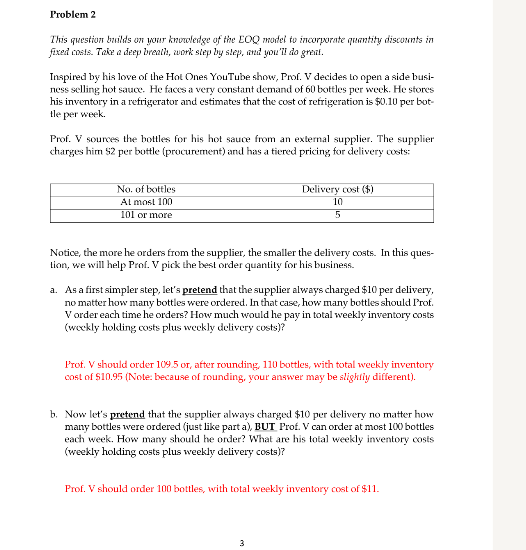
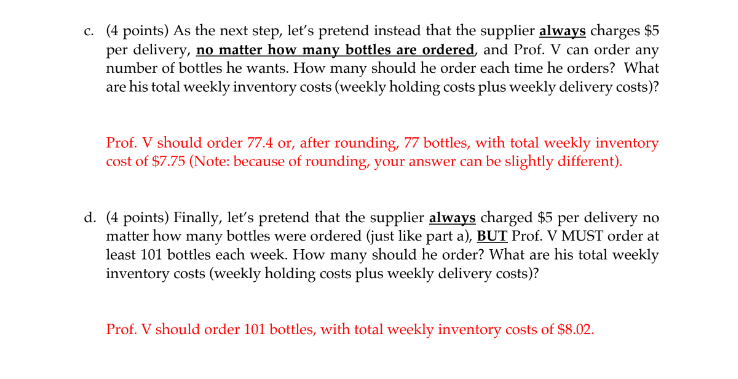
Problem 2 This question builds on your knowledge of the LOQ murtel iv incorporate quantity discounts in fixed costs. Take a deep breathe, work step by step, and you'll do great. Inspired by his love of the Hot Ones YouTube show, Pror. V decides to open a side busi- ness selling hot sauce. He faces a very constant demand of 60 bottles per week. He store's his inventory in a refrigerator and estimates that the cost of refrigeration is $0.10 per bot- tle per week. Prof. V sources the bottles for his hot sauce from an external supplier. The supplier charges him 52 per bottle (procurement) and has a tiered pricing for delivery costs: No. of bottles Almost 100 101 or more Delivery cost ($) 10 5 Notice, the more he orders from the supplier, the smaller the delivery costs. In this ques- tion, we will help Prof. V pick the best order quantity for his business. a. As a first simpler step, let's pretend that the supplier always charged $10 per delivery, no matter how many bottles were ordered. In that case, how many bottles should Prof. Vorder each time he orders? How much would he pay in total weekly inventory costs (weekly holding costs plus weekly delivery costs)? Prof. V should order 109.5 or, after rounding 110 bottles, with total weekly inventory Cost Of $10.95 (Note: because of rounding, your answer may be slightly different). b. Now let's pretend that the supplier always charged $10 per delivery no matter how many bottles were ordered (just like part a), BUT Prof. V can order at most 100 bottles each week. How many should he order? What are his total weekly inventory costs (weekly holding costs plus weekly delivery costs)? Prof. V should order 100 bottles, with total weekly inventory cost of $11. 3 c. (4 points) As the next step, let's pretend instead that the supplier always charges $5 per delivery, no matter how many bottles are ordered, and Prof. V can order any number of bottles he wants. How many should he order each time he orders? What are his total weekly inventory costs (weekly holding costs plus weekly delivery costs)? Prof. V should order 77.4 or, after rounding, 77 bottles, with total weekly inventory cost of $7.75 (Note: because of rounding, your answer can be slightly different). d. (4 points) Finally, let's pretend that the supplier always charged $5 per delivery no matter how many bottles were ordered (just like part a), BUT Prof. V MUST order at least 101 bottles each week. How many should he order? What are his total weekly inventory costs (weekly holding costs plus weekly delivery costs)? Prof. V should order 101 bottles, with total weekly inventory costs of $8.02









 Study Help