



Question: please show work if possible, Thank you nuclear radiation lab Report Submission - Nuclear Radiation (2pts) Nuclear Radiation How will you collect data for this
 please show work if possible, Thank you
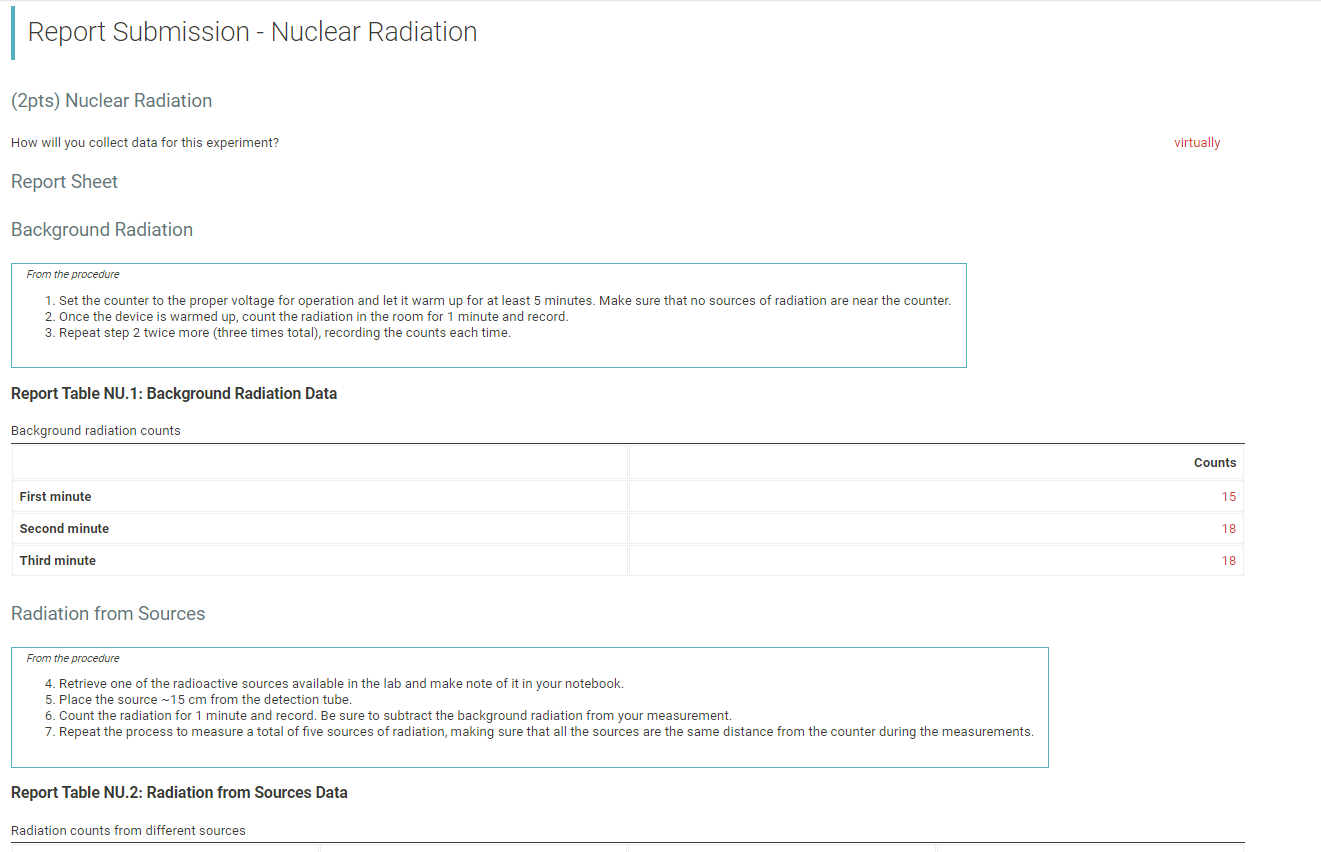
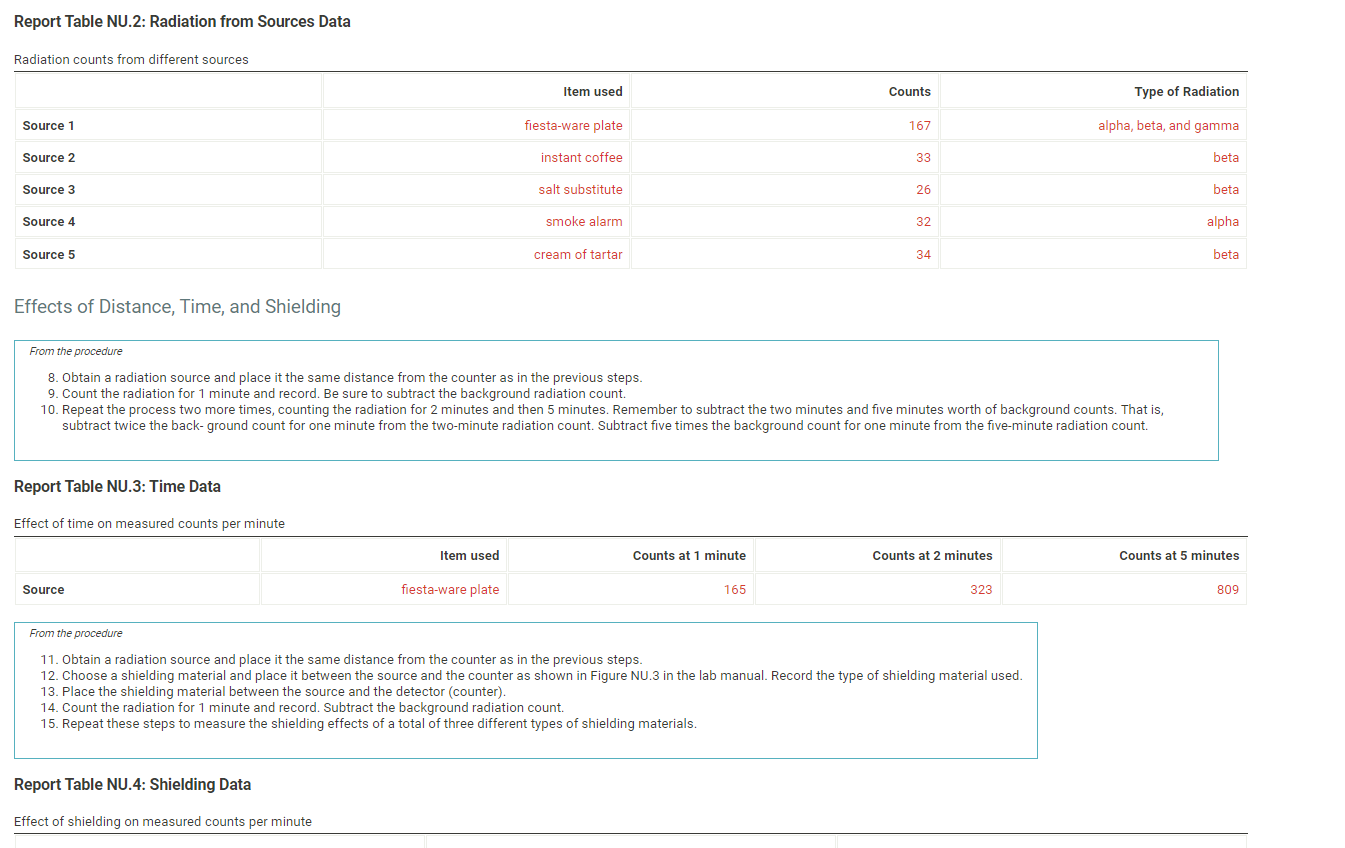
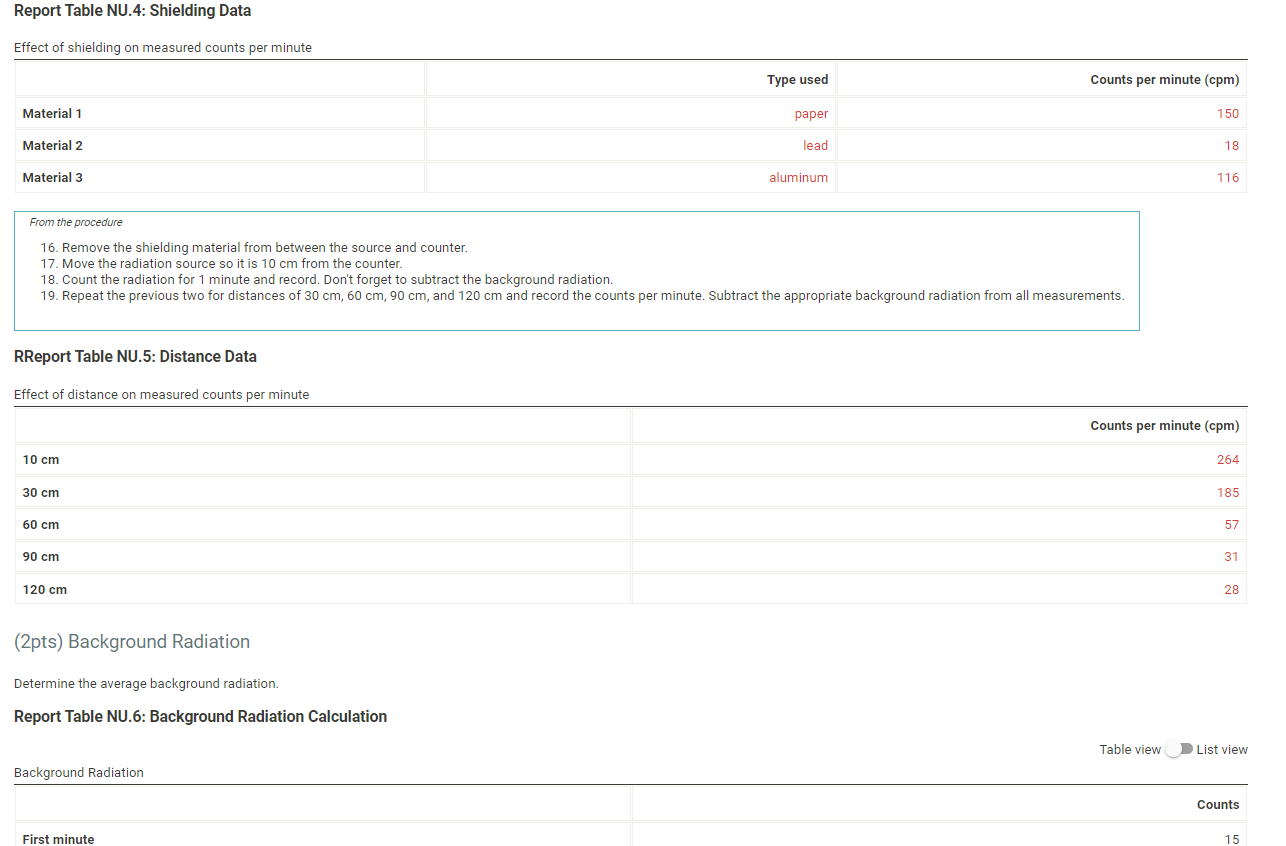
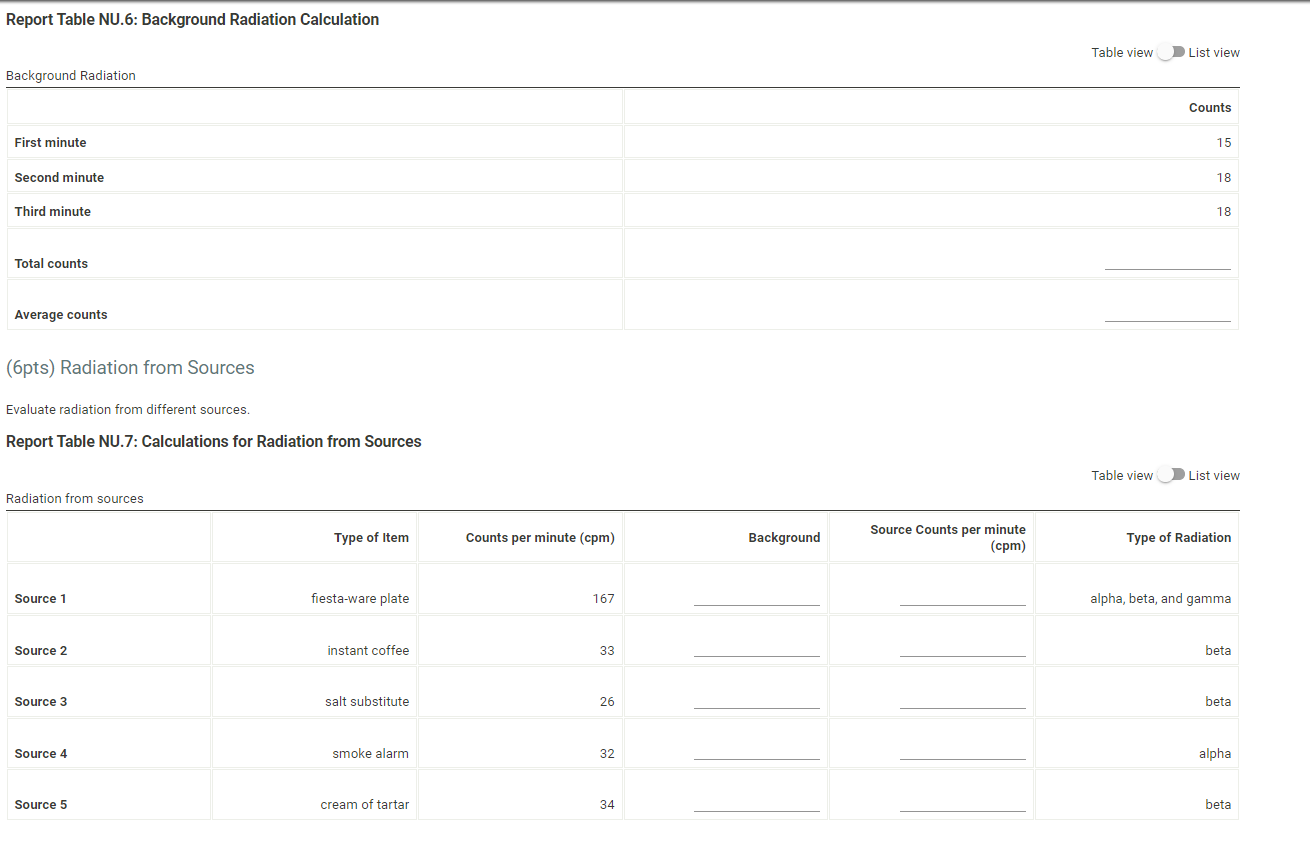
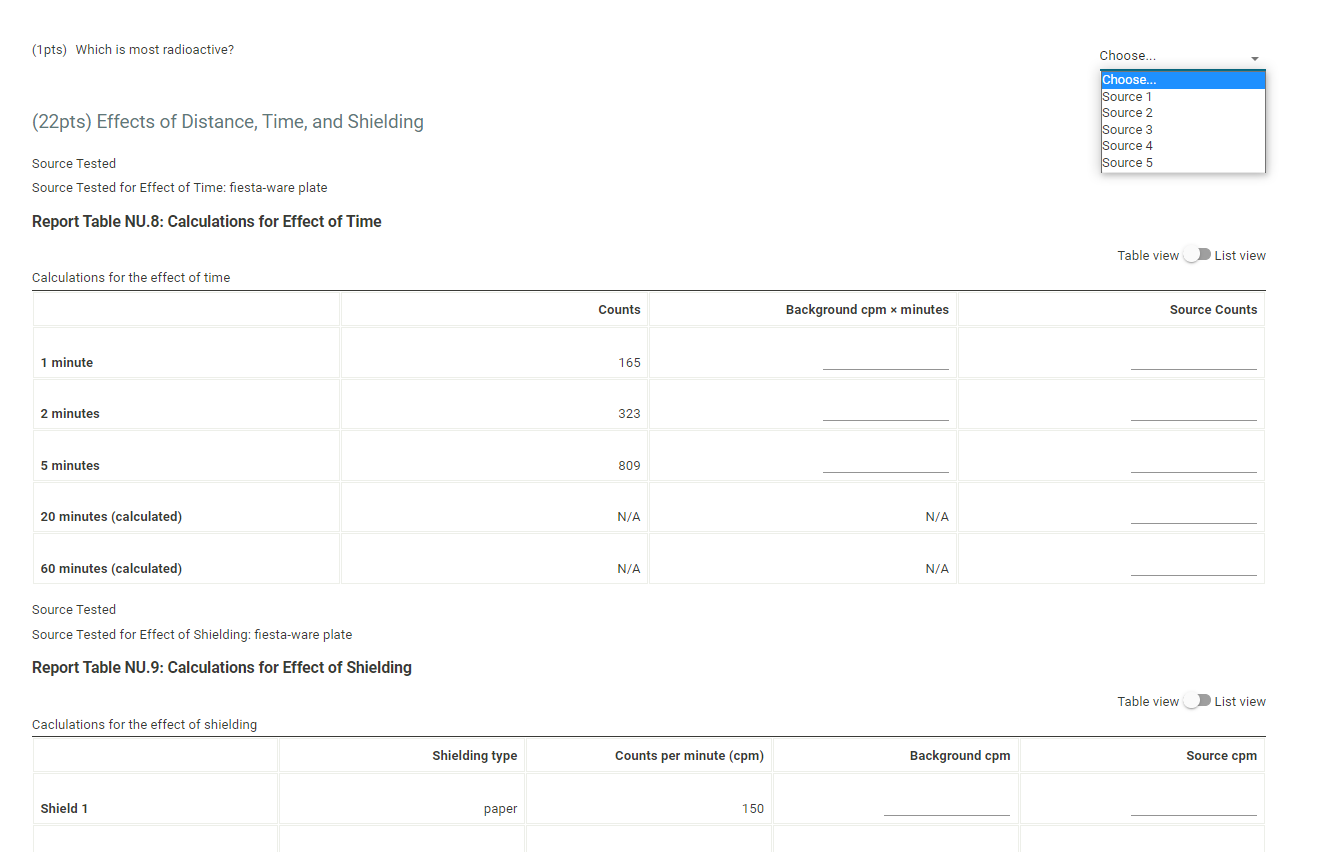
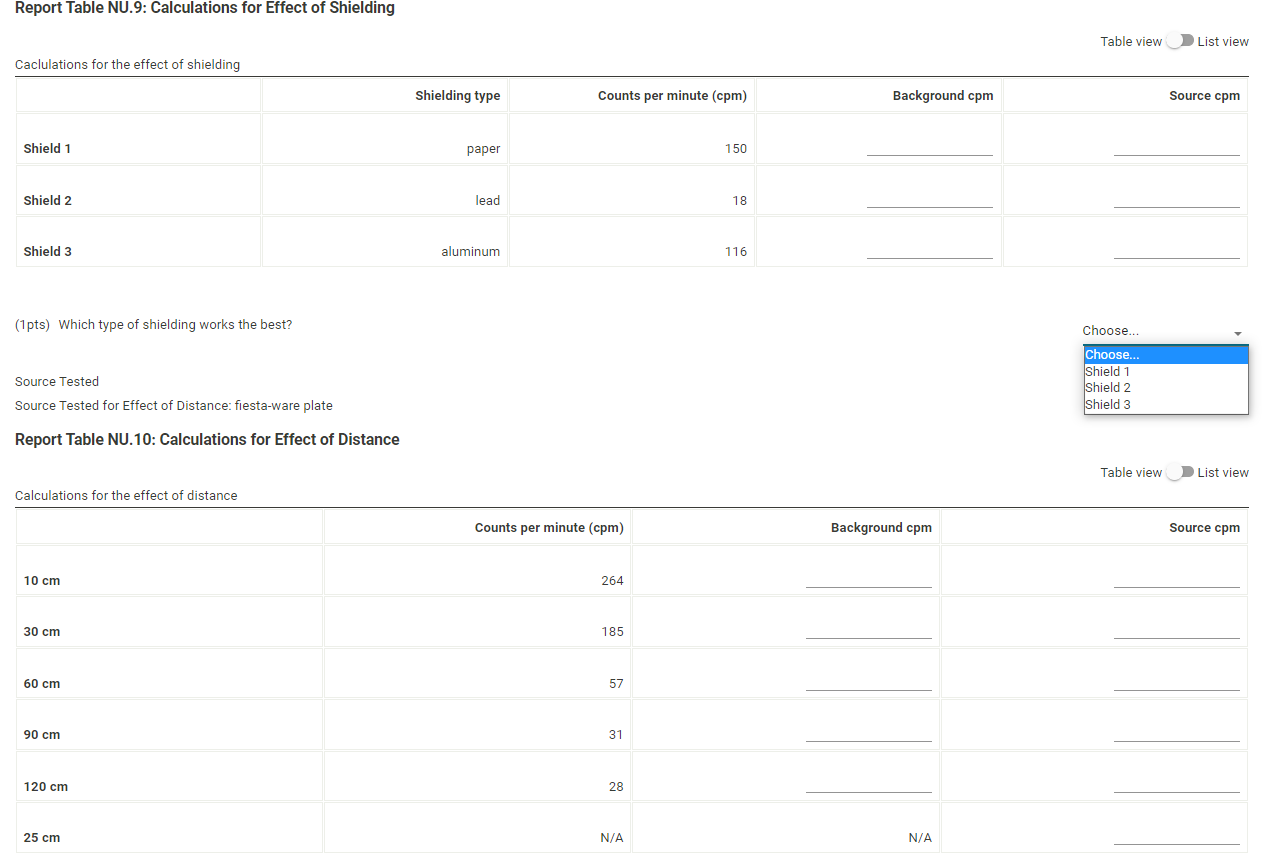
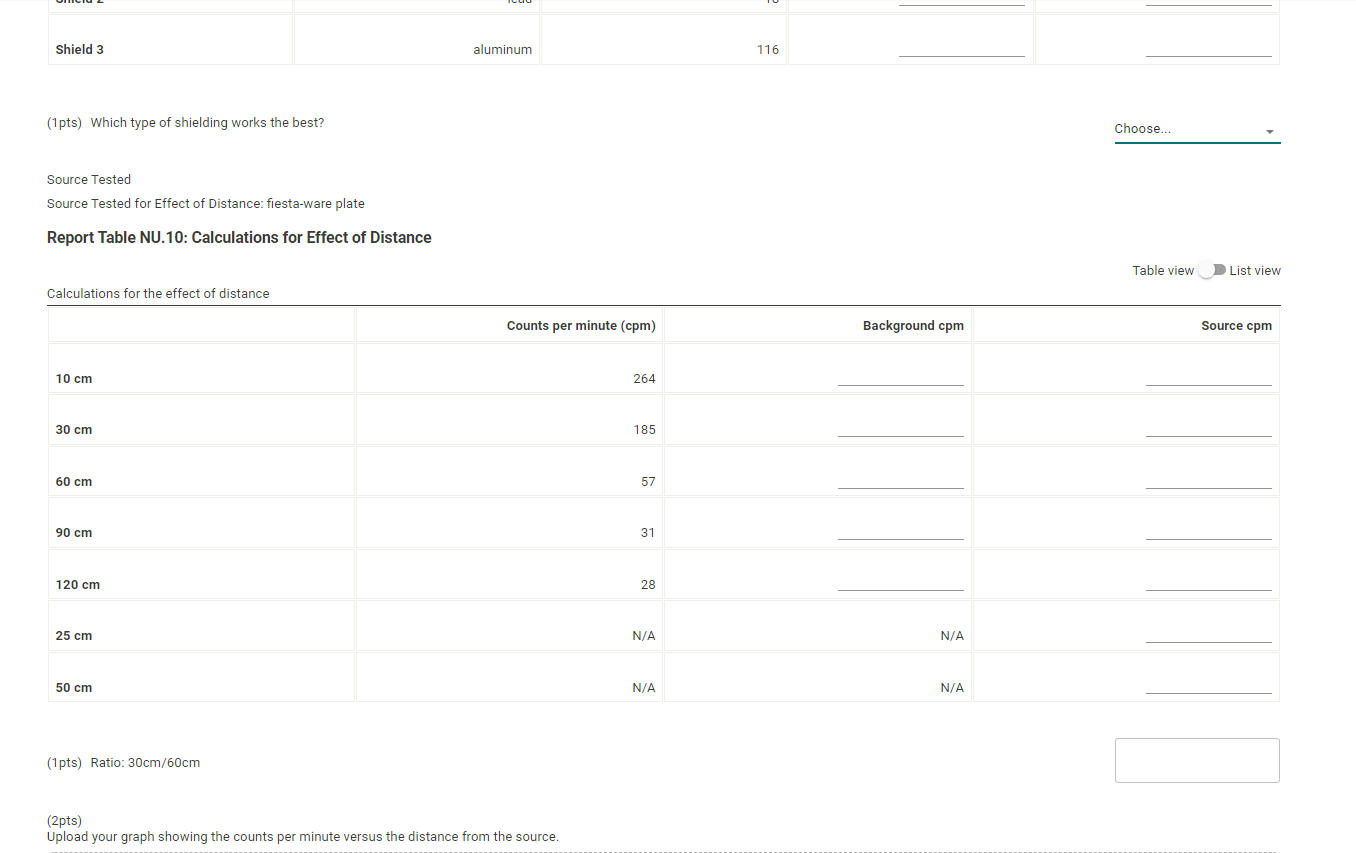
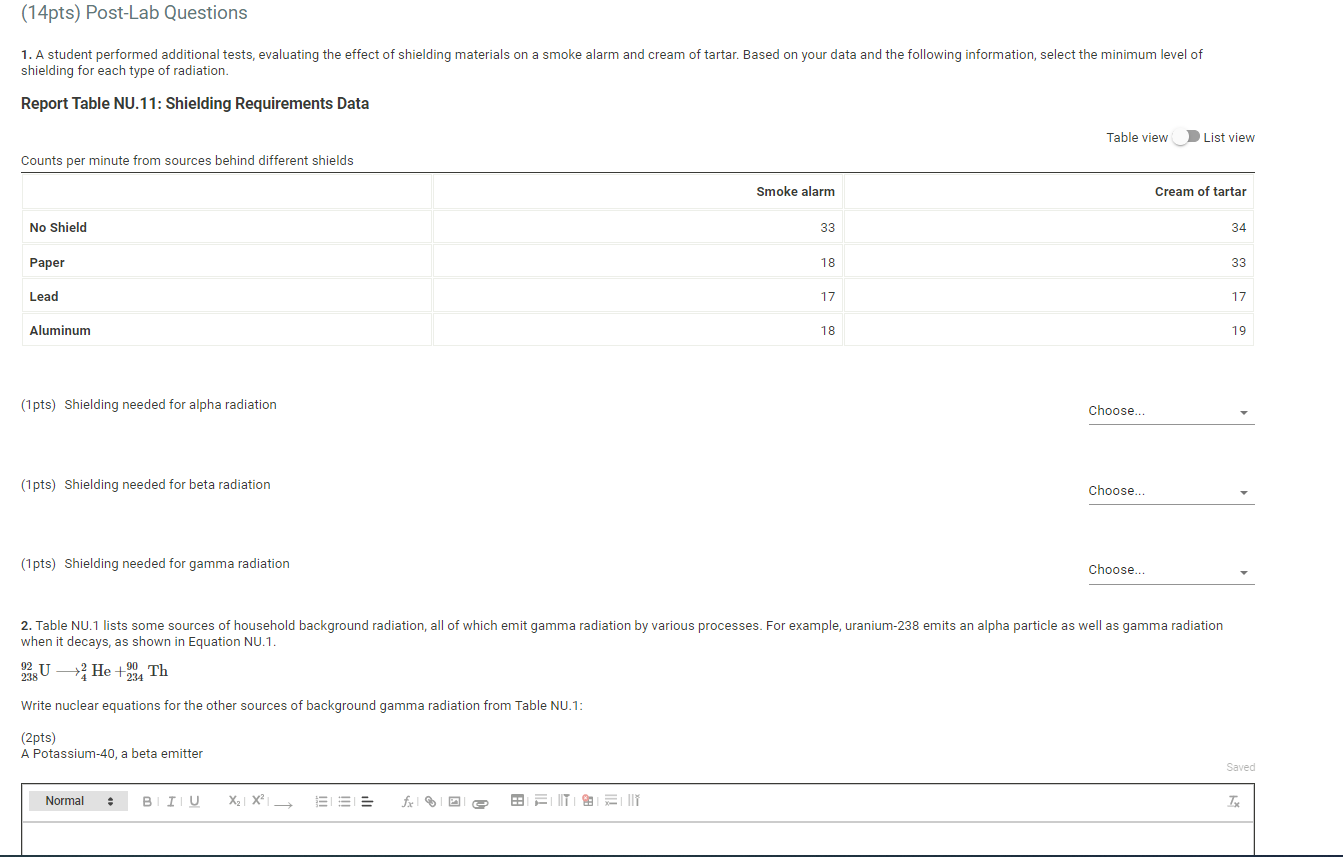
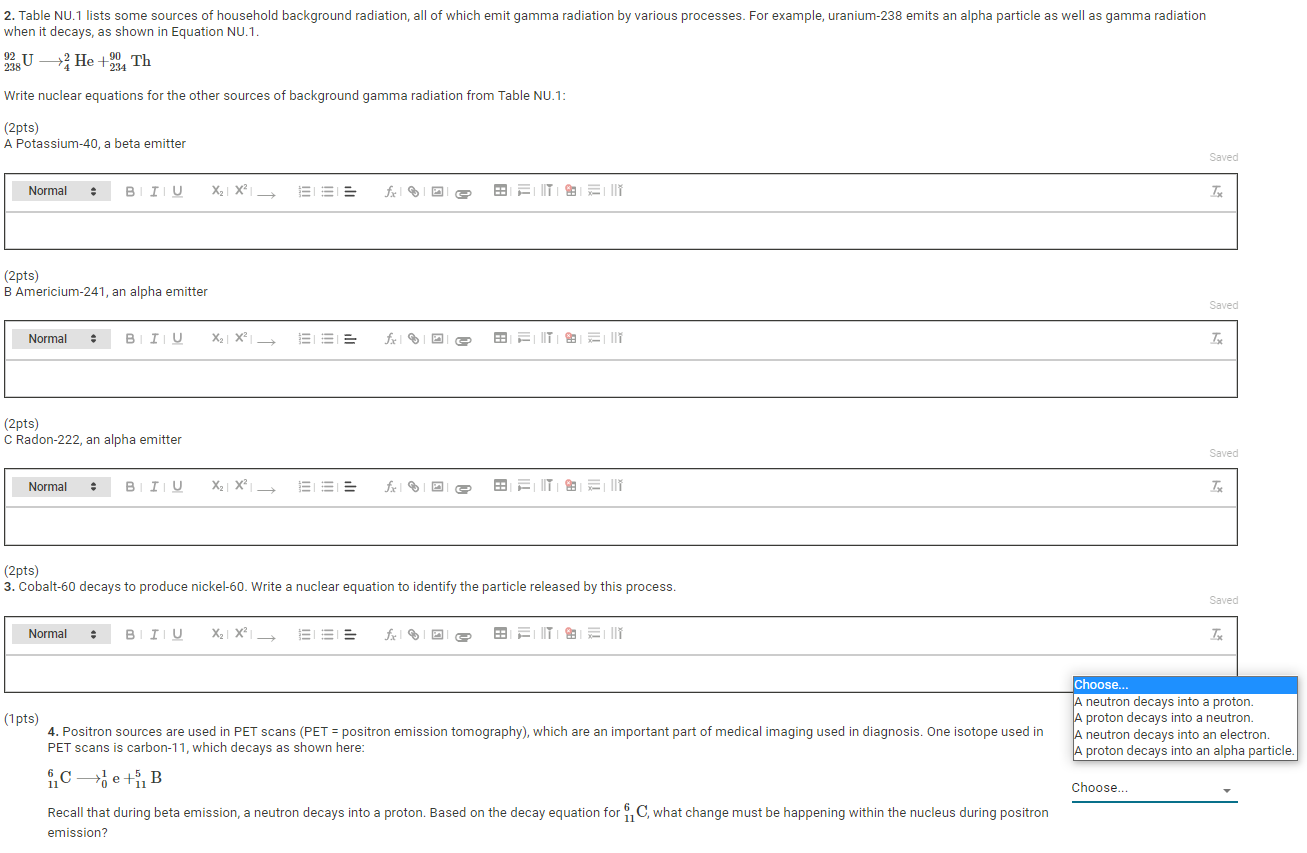
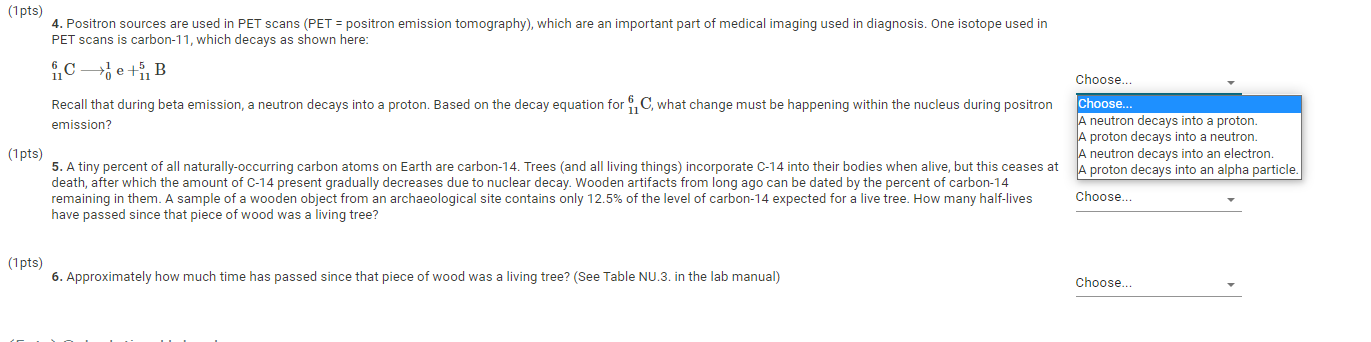
Report Submission - Nuclear Radiation (2pts) Nuclear Radiation How will you collect data for this experiment? virtually Report Sheet Background Radiation From the procedure 1. Set the counter to the proper voltage for operation and let it warm up for at least 5 minutes. Make sure that no sources of radiation are near the counter 2. Once the device is warmed up, count the radiation in the room for 1 minute and record. 3. Repeat step 2 twice more (three times total), recording the counts each time. Report Table NU.1: Background Radiation Data Background radiation counts Counts First minute 15 Second minute 18 Third minute 18 Radiation from Sources From the procedure 4. Retrieve one of the radioactive sources available in the lab and make note of it in your notebook. 5. Place the source -15 cm from the detection tube. 6. Count the radiation for 1 minute and record. Be sure to subtract the background radiation from your measurement 7. Repeat the process to measure a total of five sources of radiation, making sure that all the sources are the same distance from the counter during the measurements Report Table NU.2: Radiation from Sources Data Radiation counts from different sources Report Table NU.2: Radiation from Sources Data Radiation counts from different sources Item used Counts Type of Radiation Source 1 fiesta-ware plate 167 alpha, beta, and gamma Source 2 2 instant coffee 33 beta Source 3 salt substitute 26 beta Source 4 smoke alarm 32 alpha Source 5 cream of tartar 34 beta Effects of Distance, Time, and Shielding From the procedure 8. Obtain a radiation source and place it the same distance from the counter as in the previous steps. 9. Count the radiation for 1 minute and record. Be sure to subtract the background radiation count. 10. Repeat the process two more times, counting the radiation for 2 minutes and then 5 minutes. Remember to subtract the two minutes and five minutes worth of background counts. That is, subtract twice the back-ground count for one minute from the two-minute radiation count. Subtract five times the background count for one minute from the five-minute radiation count. Report Table NU.3: Time Data Effect of time on measured counts per minute Item used Counts at 1 minute Counts at 2 minutes Counts at 5 minutes 5 Source fiesta-ware plate 165 323 809 From the procedure 11. Obtain a radiation source and place it the same distance from the counter as in the previous steps. 12. Choose a shielding material and place it between the source and the counter as shown in Figure NU.3 in the lab manual. Record the type of shielding material used. 13. Place the shielding material between the source and the detector (counter). 14. Count the radiation for 1 minute and record. Subtract the background radiation count. 15. Repeat these steps to measure the shielding effects of a total of three different types of shielding materials. Report Table NU.4: Shielding Data Effect of shielding on measured counts per minute Report Table NU.4: Shielding Data Effect of shielding on measured counts per minute Type used Counts per minute (cpm) Material 1 paper 150 Material 2 lead 18 Material 3 aluminum 116 From the procedure 16. Remove the shielding material from between the source and counter. 17. Move the radiation source so it is 10 cm from the counter. 18. Count the radiation for 1 minute and record. Don't forget to subtract the background radiation. 19. Repeat the previous two for distances of 30 cm, 60 cm, 90 cm, and 120 cm and record the counts per minute. Subtract the appropriate background radiation from all measurements. RReport Table NU.5: Distance Data Effect of distance on measured counts per minute Counts per minute (cpm) 10 cm 264 30 cm 185 60 cm 57 90 cm 31 120 cm 28 (2pts) Background Radiation Determine the average background radiation. Report Table NU.6: Background Radiation Calculation Table view List view Background Radiation Counts First minute 15 Report Table NU.6: Background Radiation Calculation Table view List view Background Radiation Counts First minute 15 Second minute 18 Third minute 18 Total counts Average counts (6pts) Radiation from Sources Evaluate radiation from different sources. Report Table NU.7: Calculations for Radiation from Sources Table view List view Radiation from sources Type of Item Counts per minute (cpm) Background Source Counts per minute (cpm) Type of Radiation Source 1 fiesta-ware plate 167 alpha, beta, and gamma Source 2 instant coffee 33 beta Source 3 salt substitute 26 beta Source 4 4 smoke alarm 32 alpha Source 5 cream of tartar 34 beta (1pts) Which is most radioactive? Choose. (22pts) Effects of Distance, Time, and Shielding Choose... Source 1 Source 2 Source 3 Source 4 Source 5 Source Tested Source Tested for Effect of Time: fiesta-ware plate Report Table NU.8: Calculations for Effect of Time Table view List view Calculations for the effect of time Counts Background cpm x minutes Source Counts 1 1 minute 165 2 minutes 323 5 minutes 809 20 minutes (calculated) N/A N/A 60 minutes (calculated) N/A N/A Source Tested Source Tested for Effect of Shielding: fiesta-ware plate Report Table NU.9: Calculations for Effect of Shielding Table view List view Caclulations for the effect of shielding Shielding type Counts per minute (cpm) Background cpm Source cpm Shield 1 paper 150 Report Table NU.9: Calculations for Effect of Shielding Table view List view Caclulations for the effect of shielding Shielding type Counts per minute (cpm) Background cpm Source cpm Shield 1 paper 150 Shield 2 lead 18 Shield 3 aluminum 116 (1pts) Which type of shielding works the best? choose... Source Tested Source Tested for Effect of Distance: fiesta-ware plate Choose... Shield 1 shield 2 Shield 3 Report Table NU.10: Calculations for Effect of Distance Table view List view Calculations for the effect of distance Counts per minute (cpm) Background cpm Source cpm 10 cm 264 30 cm 185 60 cm 57 90 cm 31 120 cm 28 25 cm N/A N/A Shield 3 aluminum 116 (1pts) Which type of shielding works the best? Choose... Source Tested Source Tested for Effect of Distance: fiesta-ware plate Report Table NU. 10: Calculations for Effect of Distance Table view List view Calculations for the effect of distance Counts per minute (cpm) Background cpm Source cpm 10 cm 264 30 cm 185 60 cm 57 90 cm 31 120 cm 28 25 cm N/A N/A 50 cm N/A N/A (1pts) Ratio: 30cm/60cm (2pts) Upload your graph showing the counts per minute versus the distance from the source. (14pts) Post-Lab Questions 1. A student performed additional tests, evaluating the effect of shielding materials on a smoke alarm and cream of tartar. Based on your data and the following information, select the minimum level of shielding for each type of radiation. Report Table NU.11: Shielding Requirements Data Table view List view Counts per minute from sources behind different shields Smoke alarm Cream of tartar No Shield 33 34 Paper 18 33 Lead 17 17 Aluminum 18 19 (1 pts) Shielding needed for alpha radiation Choose... (1pts) Shielding needed for beta radiation Choose... (1pts) Shielding needed for gamma radiation Choose... 2. Table NU.1 lists some sources of household background radiation, all of which emit gamma radiation by various processes. For example, uranium-238 emits an alpha particle as well as gamma radiation when it decays, as shown in Equation NU.1. 23. U He +234 Th 92 Write nuclear equations for the other sources of background gamma radiation from Table NU.1: (2pts) A Potassium-40, a beta emitter Saved Normal BI IU X21 X- = fx = | T. 2. Table NU.1 lists some sources of household background radiation, all of which emit gamma radiation by various processes. For example, uranium-238 emits an alpha particle as well as gamma radiation when it decays, as shown in Equation NU.1. 22 U He +9 Th 92 234 Write nuclear equations for the other sources of background gamma radiation from Table NU.1: (2pts) A Potassium-40, a beta emitter Saved Normal X21 X?! > = fixo 2 ITINY Tx (2pts) B Americium-241, an alpha emitter Saved Normal . X, X fele BITY Tx (2pts) C Radon-222, an alpha emitter Saved Normal : BIU X2 X EEE fiel BEI = IT | MY Tx (2pts) 3. Cobalt-60 decays to produce nickel-60. Write a nuclear equation to identify the particle released by this process. Saved Normal XX EEE fxx8 BITY Ix (1 pts) Choose... A neutron decays into a proton. A proton decays into a neutron. A neutron decays into an electron. A proton decays into an alpha particle. 4. Positron sources are used in PET scans (PET = positron emission tomography), which are an important part of medical imaging used in diagnosis. One isotope used in PET scans is carbon-11, which decays as shown here: Cet B Recall that during beta emission, a neutron decays into a proton. Based on the decay equation for iC, what change must be happening within the nucleus during positron Choose... emission? (1 pts) 4. Positron sources are used in PET scans (PET = positron emission tomography), which are an important part of medical imaging used in diagnosis. One isotope used in PET Scans is carbon-11, which decays as shown here: ince+B Choose. Recall that during beta emission, a neutron decays into a proton. Based on the decay equation for iC, what change must be happening within the nucleus during positron emission? Choose.. A neutron decays into a proton. A proton decays into a neutron. A neutron decays into an electron A proton decays into an alpha particle. (1pts) 5. A tiny percent of all naturally occurring carbon atoms on Earth are carbon-14. Trees and all living things) incorporate C-14 into their bodies when alive, but this ceases at death, after which the amount of C-14 present gradually decreases due to nuclear decay. Wooden artifacts from long ago can be dated by the percent of carbon-14 remaining in them. A sample of a wooden object from an archaeological site contains only 12.5% of the level of carbon-14 expected for a live tree. How many half-lives have passed since that piece of wood was a living tree? Choose... (1 pts) 6. Approximately how much time has passed since that piece of wood was a living tree? (See Table NU.3. in the lab manual) Choose
Step by Step Solution
There are 3 Steps involved in it

Get step-by-step solutions from verified subject matter experts