







Question: please show work in excel with formulas Problem 3 Suppose the expectations hypothesis is true and you have the following series of spot rates 1-year
please show work in excel with formulas
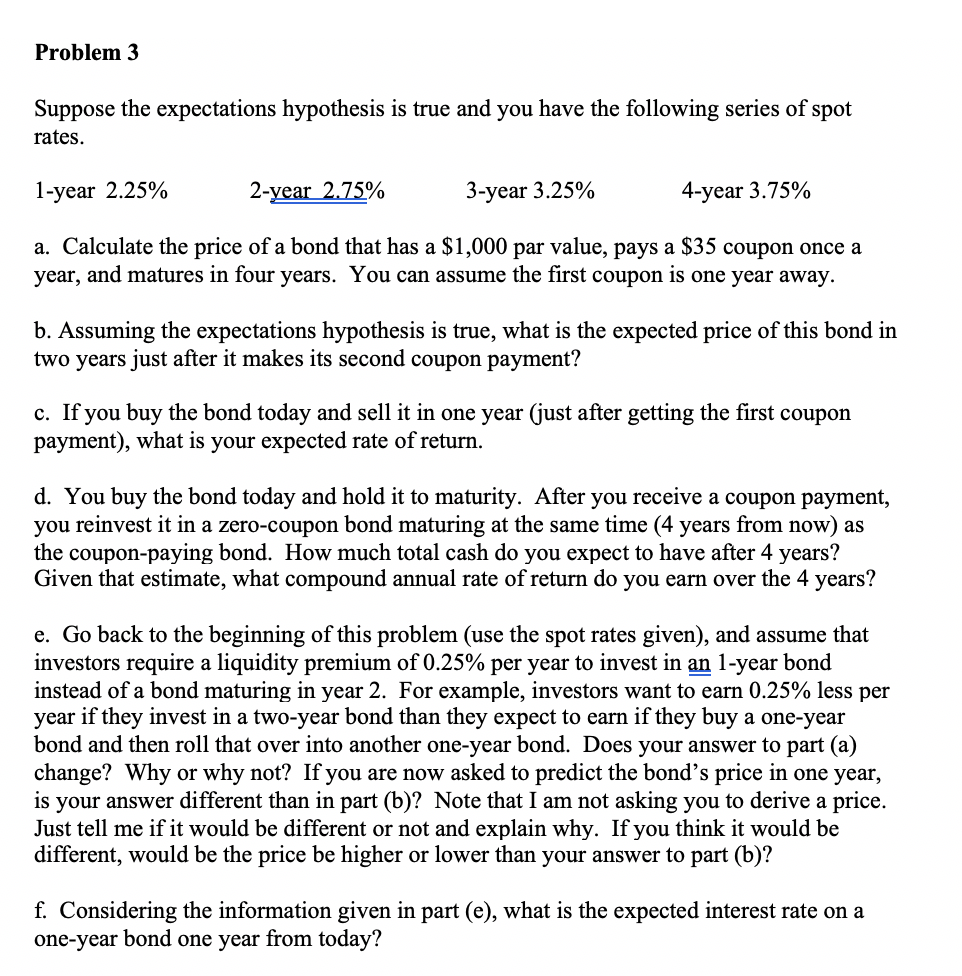
Problem 3 Suppose the expectations hypothesis is true and you have the following series of spot rates 1-year 2.25% 2-year 2.75% 3-year 3.25% 4-year 3.75% a. Calculate the price of a bond that has a $1,000 par value, pays a $35 coupon once a year, and matures in four years. You can assume the first coupon is one year away. b. Assuming the expectations hypothesis is true, what is the expected price of this bond in two years just after it makes its second coupon payment? c. If you buy the bond today and sell it in one year (just after getting the first coupon payment), what is your expected rate of return d. You buy the bond today and hold it to maturity. After you receive a coupon payment, you reinvest it in a zero-coupon bond maturing at the same time (4 years from now) as the coupon-paying bond. How much total cash do you expect to have after 4 years? Given that estimate, what compound annual rate of return do you earn over the 4 years? e. Go back to the beginning of this problem (use the spot rates given), and assume that investors require a liquidity premium of 0.25% per year to invest in an 1-year bond instead of a bond maturing in year 2. For example, investors want to earn 0.25% less per year if they invest in a two-year bond than they expect to earn if they buy a one-year bond and then roll that over into another one-year bond. Does your answer to part (a) change? Why or why not? If you are now asked to predict the bond's price in one year, is your answer different than in part (b)? Note that I am not asking you to derive a price. Just tell me if it would be different or not and explain why. If you think it would be different, would be the price be higher or lower than your answer to part (b)? f. Considering the information given in part (e), what is the expected interest rate on a one-year bond one year from today? Problem 3 Suppose the expectations hypothesis is true and you have the following series of spot rates 1-year 2.25% 2-year 2.75% 3-year 3.25% 4-year 3.75% a. Calculate the price of a bond that has a $1,000 par value, pays a $35 coupon once a year, and matures in four years. You can assume the first coupon is one year away. b. Assuming the expectations hypothesis is true, what is the expected price of this bond in two years just after it makes its second coupon payment? c. If you buy the bond today and sell it in one year (just after getting the first coupon payment), what is your expected rate of return d. You buy the bond today and hold it to maturity. After you receive a coupon payment, you reinvest it in a zero-coupon bond maturing at the same time (4 years from now) as the coupon-paying bond. How much total cash do you expect to have after 4 years? Given that estimate, what compound annual rate of return do you earn over the 4 years? e. Go back to the beginning of this problem (use the spot rates given), and assume that investors require a liquidity premium of 0.25% per year to invest in an 1-year bond instead of a bond maturing in year 2. For example, investors want to earn 0.25% less per year if they invest in a two-year bond than they expect to earn if they buy a one-year bond and then roll that over into another one-year bond. Does your answer to part (a) change? Why or why not? If you are now asked to predict the bond's price in one year, is your answer different than in part (b)? Note that I am not asking you to derive a price. Just tell me if it would be different or not and explain why. If you think it would be different, would be the price be higher or lower than your answer to part (b)? f. Considering the information given in part (e), what is the expected interest rate on a one-year bond one year from today
Step by Step Solution
There are 3 Steps involved in it

Get step-by-step solutions from verified subject matter experts
 Study Help