



Question: Please show work on excel so I can follow the steps, Really appreciate it! Walter Company During the last few years, Walter Company has been
Please show work on excel so I can follow the steps, Really appreciate it!
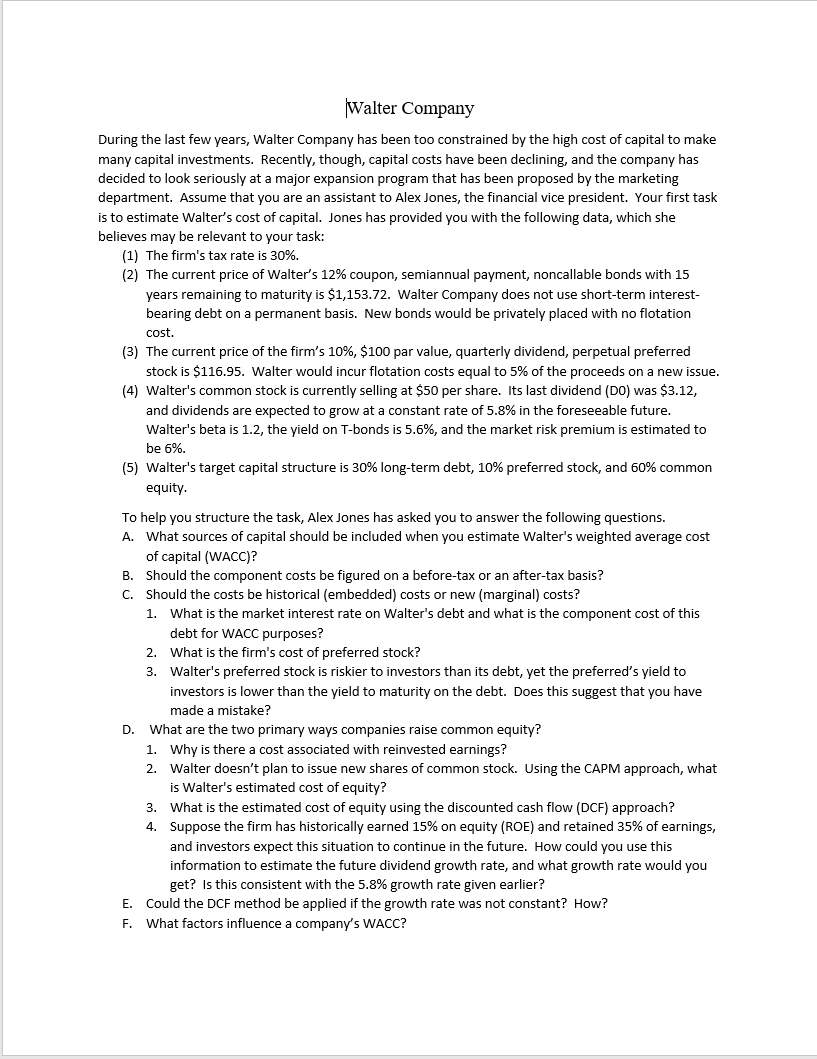
Walter Company During the last few years, Walter Company has been too constrained by the high cost of capital to make many capital investments. Recently, though, capital costs have been declining, and the company has decided to look seriously at a major expansion program that has been proposed by the marketing department. Assume that you are an assistant to Alex Jones, the financial vice president. Your first task is to estimate Walter's cost of capital. Jones has provided you with the following data, which she believes may be relevant to your task: (1) The firm's tax rate is 30%. (2) The current price of Walter's 12% coupon, semiannual payment, noncallable bonds with 15 years remaining to maturity is $1,153.72. Walter Company does not use short-term interest- bearing debt on a permanent basis. New bonds would be privately placed with no flotation cost. (3) The current price of the firm's 10%, $100 par value, quarterly dividend, perpetual preferred stock is $116.95. Walter would incur flotation costs equal to 5% of the proceeds on a new issue. (4) Walter's common stock is currently selling at $50 per share. Its last dividend (DO) was $3.12, and dividends are expected to grow at a constant rate of 5.8% in the foreseeable future. Walter's beta is 1.2, the yield on T-bonds is 5.6%, and the market risk premium is estimated to be 6%. (5) Walter's target capital structure is 30% long-term debt, 10% preferred stock, and 60% common equity. To help you structure the task, Alex Jones has asked you to answer the following questions. A. What sources of capital should be included when you estimate Walter's weighted average cost of capital (WACC)? B. Should the component costs be figured on a before-tax or an after-tax basis? C. Should the costs be historical (embedded) costs or new (marginal) costs? 1. What is the market interest rate on Walter's debt and what is the component cost of this debt for WACC purposes? 2. What is the firm's cost of preferred stock? 3. Walter's preferred stock is riskier to investors than its debt, yet the preferred's yield to investors is lower than the yield to maturity on the debt. Does this suggest that you have made a mistake? D. What are the two primary ways companies raise common equity? 1. Why is there a cost associated with reinvested earnings? 2. Walter doesn't plan to issue new shares of common stock. Using the CAPM approach, what is Walter's estimated cost of equity? 3. What is the estimated cost of equity using the discounted cash flow (DCF) approach? 4. Suppose the firm has historically earned 15% on equity (ROE) and retained 35% of earnings, and investors expect this situation to continue in the future. How could you use this information to estimate the future dividend growth rate, and what growth rate would you get? Is this consistent with the 5.8% growth rate given earlier? E. Could the DCF method be applied if the growth rate was not constant? How? F. What factors influence a company's WACC
Step by Step Solution
There are 3 Steps involved in it

Get step-by-step solutions from verified subject matter experts