







Question: Please show work. Thank you! Problem 9-05 a-b Culver Co. follows the practice of valuing its inventory at the lower-of-cost-or-market. The following information is available

Please show work. Thank you!
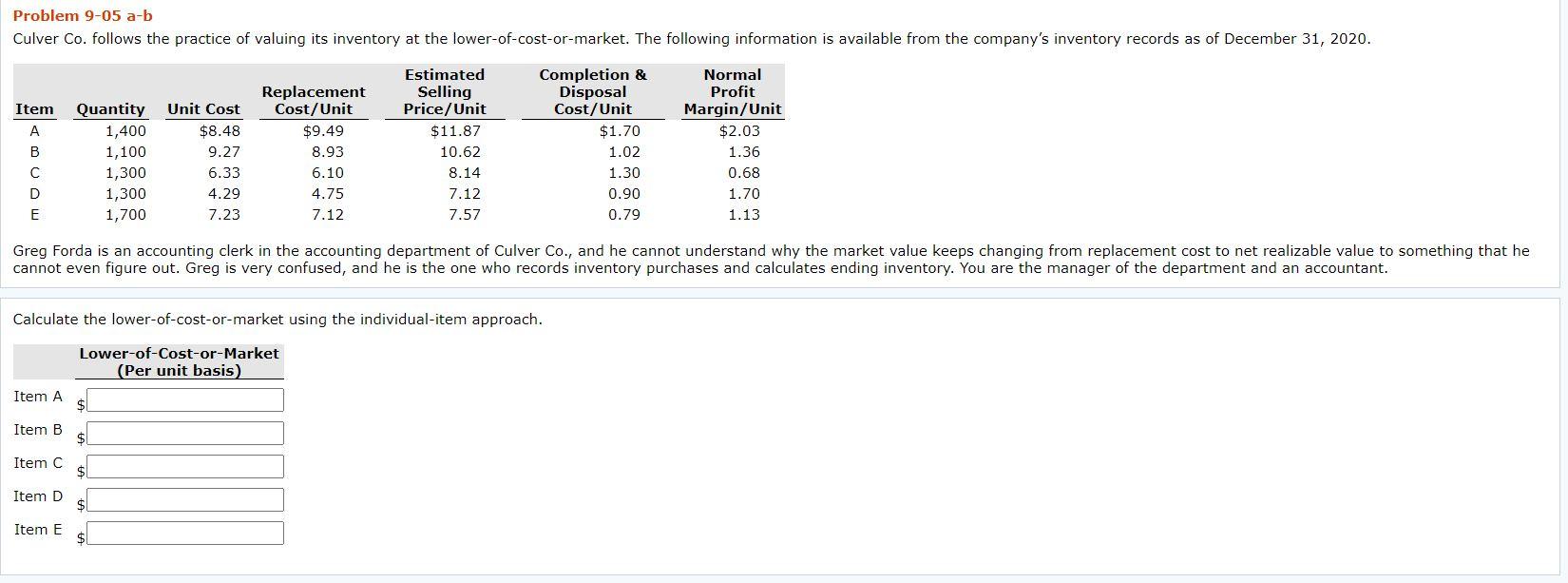
Problem 9-05 a-b Culver Co. follows the practice of valuing its inventory at the lower-of-cost-or-market. The following information is available from the company's inventory records as of December 31, 2020. Item A Quantity 1,400 1,100 1,300 1,300 1,700 Unit Cost $8.48 9.27 6.33 4.29 7.23 B Estimated Selling Price/Unit $11.87 10.62 8.14 7.12 7.57 Replacement Cost/Unit $9.49 8.93 6.10 4.75 7.12 Completion & Disposal Cost/Unit $1.70 1.02 1.30 0.90 0.79 Normal Profit Margin/Unit $2.03 1.36 0.68 1.70 1.13 C D E Greg Forda is an accounting clerk in the accounting department of Culver Co., and he cannot understand why the market value keeps changing from replacement cost to net realizable value to something that he cannot even figure out. Greg is very confused, and he is the one who records inventory purchases and calculates ending inventory. You are the manager of the department and an accountant. Calculate the lower-of-cost-or-market using the individual-item approach. Lower-of-Cost-or-Market (Per unit basis) Item A $1 Item B $ Item C $ Item D $ Item E $ Show the journal entry he will need to make in order to write down the ending inventory from cost to market. (Credit account titles are automatically indented when amount is entered. Do not indent manually. If no entry is required, select "No entry" for the account titles and enter o for the amounts.) Debit Credit Account Titles and Explanation Cost of Goods sold Method: The Loss method
Step by Step Solution
There are 3 Steps involved in it

Get step-by-step solutions from verified subject matter experts
 Study Help