







Question: Please show your work, thank you! Problem 3 A small open economy is described by the following equations: Y =C+I+G+NX C = 48 + (0.76)
 Please show your work, thank you!
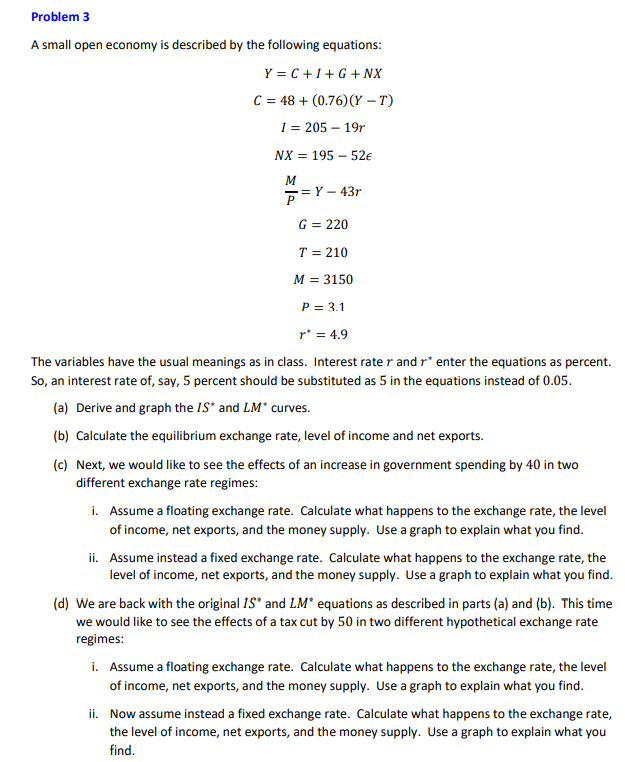
Problem 3 A small open economy is described by the following equations: Y =C+I+G+NX C = 48 + (0.76) (Y - T) I = 205 - 19r NX = 195 - 52 M P=Y - 43r G= 220 T = 210 M = 3150 P= 3.1 r* = 4.9 The variables have the usual meanings as in class. Interest rate r and r* enter the equations as percent. So, an interest rate of, say, 5 percent should be substituted as 5 in the equations instead of 0.05. (a) Derive and graph the IS* and LM* curves. (b) Calculate the equilibrium exchange rate, level of income and net exports. (c) Next, we would like to see the effects of an increase in government spending by 40 in two different exchange rate regimes: i. Assume a floating exchange rate. Calculate what happens to the exchange rate, the level of income, net exports, and the money supply. Use a graph to explain what you find. ii. Assume instead a fixed exchange rate. Calculate what happens to the exchange rate, the level of income, net exports, and the money supply. Use a graph to explain what you find. (d) We are back with the original 1S* and LM* equations as described in parts (a) and (b). This time we would like to see the effects of a tax cut by 50 in two different hypothetical exchange rate regimes: i. Assume a floating exchange rate. Calculate what happens to the exchange rate, the level of income, net exports, and the money supply. Use a graph to explain what you find. ii. Now assume instead a fixed exchange rate. Calculate what happens to the exchange rate, the level of income, net exports, and the money supply. Use a graph to explain what you find. Problem 3 A small open economy is described by the following equations: Y =C+I+G+NX C = 48 + (0.76) (Y - T) I = 205 - 19r NX = 195 - 52 M P=Y - 43r G= 220 T = 210 M = 3150 P= 3.1 r* = 4.9 The variables have the usual meanings as in class. Interest rate r and r* enter the equations as percent. So, an interest rate of, say, 5 percent should be substituted as 5 in the equations instead of 0.05. (a) Derive and graph the IS* and LM* curves. (b) Calculate the equilibrium exchange rate, level of income and net exports. (c) Next, we would like to see the effects of an increase in government spending by 40 in two different exchange rate regimes: i. Assume a floating exchange rate. Calculate what happens to the exchange rate, the level of income, net exports, and the money supply. Use a graph to explain what you find. ii. Assume instead a fixed exchange rate. Calculate what happens to the exchange rate, the level of income, net exports, and the money supply. Use a graph to explain what you find. (d) We are back with the original 1S* and LM* equations as described in parts (a) and (b). This time we would like to see the effects of a tax cut by 50 in two different hypothetical exchange rate regimes: i. Assume a floating exchange rate. Calculate what happens to the exchange rate, the level of income, net exports, and the money supply. Use a graph to explain what you find. ii. Now assume instead a fixed exchange rate. Calculate what happens to the exchange rate, the level of income, net exports, and the money supply. Use a graph to explain what you find
Step by Step Solution
There are 3 Steps involved in it

Get step-by-step solutions from verified subject matter experts
 Study Help