



Question: Please sir, I want a complete and excellent answer, I do not want the answer in handwriting and I do not want it illustrated, I
Please sir, I want a complete and excellent answer, I do not want the answer in handwriting and I do not want it illustrated, I want it in the form of a word file, please, sir.
Assignment 2
Reference Source:
Textbook:-
Colquitt, J. A., LePine, J. A., & Wesson, M. J. (2021). Organizational behaviour: Improving performance and commitment in the workplace (7th ed). Burr Ridge, IL: McGraw-Hill Irwin.
Case Study: -
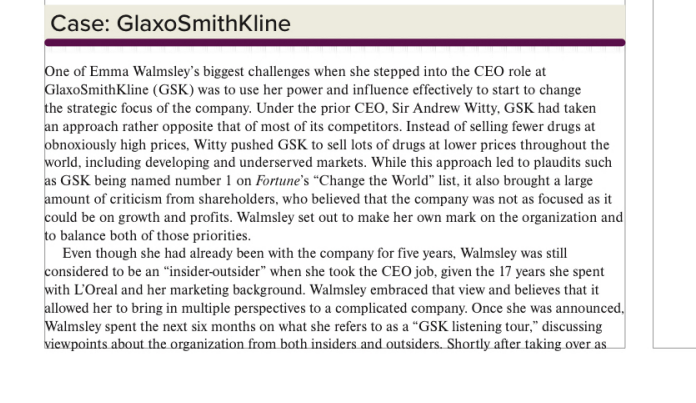
CASE: GLAXOSMITHKLINE
Please read the case GlaxoSmithKline from Chapter 13 Leadership: Power and Negotiation Page: - 433 (Second page) given in your textbook Organizational behaviour: Improving performance and commitment in the workplace (7th ed). by Colquitt, J. A., LePine, J. A., & Wesson, M. J. (2021) and Answer the following Questions:
Assignment Question(s):
1. What types of power do you think are most important for a new CEO, especially if they are considered an outsider? (03 Marks) (Min words 150-200)
2. Although its not uncommon for new CEOs to rebuild their management team, what kind of message do you think it sends to employees? (03 Marks) (Min words 150-200)
3. How can a CEO use power effectively when there are so many competing priorities on their plate at the same time? (03 Marks) (Min words 150- 200)
Part:-2
Discussion questions: - Please read Chapter 13 Leadership: Power and Negotiation carefully and then give your answers on the basis of your understanding.
4. Which forms of power do you consider to be the strongest? Which types of power do you currently have? How could you go about obtaining higher levels of the forms that youre lacking? (02 Marks ) (Min words 200-300)
5. Who is the most influential leader you have come in contact with personally? What forms of power did they have, and which types of influence did they use to accomplish objectives? (02 Marks ) (Min words 200-300)
6. Think about the last serious conflict you had with a co-worker or group member. How was that conflict resolved? Which approach did you take to resolve it? (02 Marks ) (Min words 200-300)
Important Note: -
1. Support your submission with course material concepts, principles, and theories from the textbook and at least three scholarly, peer-reviewed journal articles.
2. References required in the assignment. Use APA style for writing references.
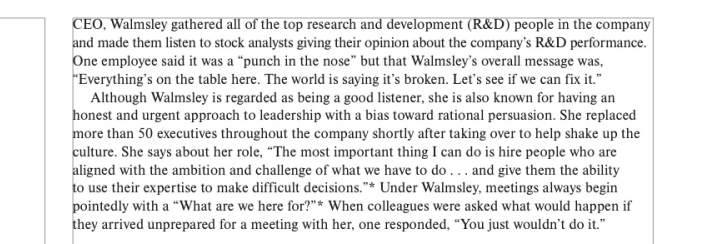
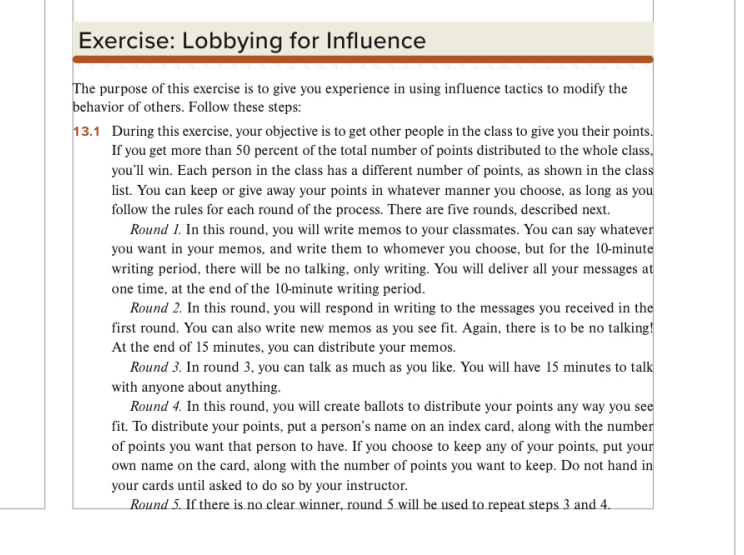
CEO, Walmsley gathered all of the top research and development (R\&D) people in the company and made them listen to stock analysts giving their opinion about the company's R\&D performance. One employee said it was a "punch in the nose" but that Walmsley's overall message was, "Everything's on the table here. The world is saying it's broken. Let's see if we can fix it." Although Walmsley is regarded as being a good listener, she is also known for having an honest and urgent approach to leadership with a bias toward rational persuasion. She replaced more than 50 executives throughout the company shortly after taking over to help shake up the culture. She says about her role, "The most important thing I can do is hire people who are aligned with the ambition and challenge of what we have to do ... and give them the ability to use their expertise to make difficult decisions."* Under Walmsley, meetings always begin pointedly with a "What are we here for?"* When colleagues were asked what would happen if they arrived unprepared for a meeting with her, one responded, "You just wouldn't do it." One of Emma Walmsley's biggest challenges when she stepped into the CEO role at GlaxoSmithKline (GSK) was to use her power and influence effectively to start to change the strategic focus of the company. Under the prior CEO, Sir Andrew Witty, GSK had taken an approach rather opposite that of most of its competitors. Instead of selling fewer drugs at obnoxiously high prices, Witty pushed GSK to sell lots of drugs at lower prices throughout the world, including developing and underserved markets. While this approach led to plaudits such as GSK being named number 1 on Fortune's "Change the World" list, it also brought a large amount of criticism from shareholders, who believed that the company was not as focused as it could be on growth and profits. Walmsley set out to make her own mark on the organization and to balance both of those priorities. Even though she had already been with the company for five years, Walmsley was still considered to be an "insider-outsider" when she took the CEO job, given the 17 years she spent with L'Oreal and her marketing background. Walmsley embraced that view and believes that it allowed her to bring in multiple perspectives to a complicated company. Once she was announced, Walmsley spent the next six months on what she refers to as a "GSK listening tour," discussing viewpoints about the organization from both insiders and outsiders. Shortly after taking over as The purpose of this exercise is to give you experience in using influence tactics to modify the ehavior of others. Follow these steps: 3.1 During this exercise, your objective is to get other people in the class to give you their points. If you get more than 50 percent of the total number of points distributed to the whole class, you'll win. Each person in the class has a different number of points, as shown in the class list. You can keep or give away your points in whatever manner you choose, as long as you follow the rules for each round of the process. There are five rounds, described next. Round 1. In this round, you will write memos to your classmates. You can say whatever you want in your memos, and write them to whomever you choose, but for the 10-minute writing period, there will be no talking, only writing. You will deliver all your messages at one time, at the end of the 10-minute writing period. Round 2. In this round, you will respond in writing to the messages you received in the first round. You can also write new memos as you see fit. Again, there is to be no talking! At the end of 15 minutes, you can distribute your memos. Round 3. In round 3, you can talk as much as you like. You will have 15 minutes to talk with anyone about anything. Round 4. In this round, you will create ballots to distribute your points any way you see fit. To distribute your points, put a person's name on an index card, along with the number of points you want that person to have. If you choose to keep any of your points, put your own name on the card, along with the number of points you want to keep. Do not hand in your cards until asked to do so by your instructor. Round 5 . If there is no clear winner, round 5 will be used to repeat steps 3 and 4
Step by Step Solution
There are 3 Steps involved in it

Get step-by-step solutions from verified subject matter experts