







Question: Please solve 1st Question Only. 1. Is itgenerally truethatlE(l/X) = 1/E(X)? Is it ever true thatE(1/X) = 1/]E(X)? 2. Coupons. Every package of some intrinsically
Please solve 1st Question Only.
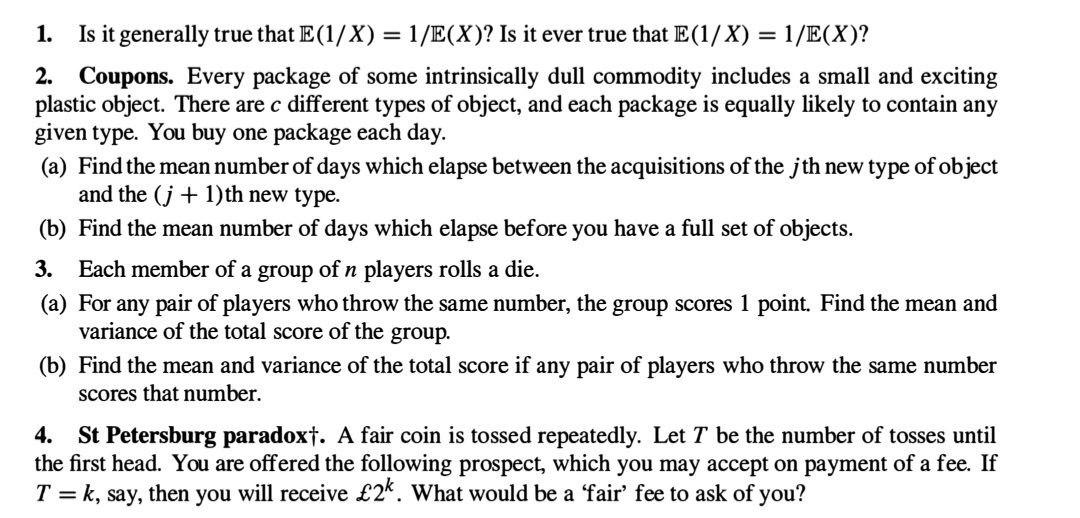
1. Is itgenerally truethatlE(l/X) = 1/E(X)? Is it ever true thatE(1/X) = 1/]E(X)? 2. Coupons. Every package of some intrinsically dull commodity includes a small and exciting plastic object. There are c different types of object, and each package is equally likely to contain any given type. You buy one package each day. (a) Find the mean number of days which elapse between the acquisitions of the j th new type of object and the (j + l)th new type. (b) Find the mean number of days which elapse before you have a full set of objects. 3. Each member of a group of :1 players rolls a die. (a) For any pair of players who throw the same number, the group scores 1 point. Find the mean and variance of the total score of the group. (b) Find the mean and variance of the total score if any pair of players who throw the same number scores that number. 4. St Petersburg paradox'l'. A fair coin is tossed repeatedly. Let T he the number of tosses until the rst head. You are offered the following prospect, which you may accept on payment of a fee. If T = it, say, then you will receive 1:2". What would be a 'fair' fee to ask of you
Step by Step Solution
There are 3 Steps involved in it

Get step-by-step solutions from verified subject matter experts
 Study Help