







Question: PLEASE SOLVE A very important nonlinear equation in science is the Nonlinear Schrodinger equation (NLS) u) 021i! 2 = 1 z + 652 +le 1.!)
PLEASE SOLVE
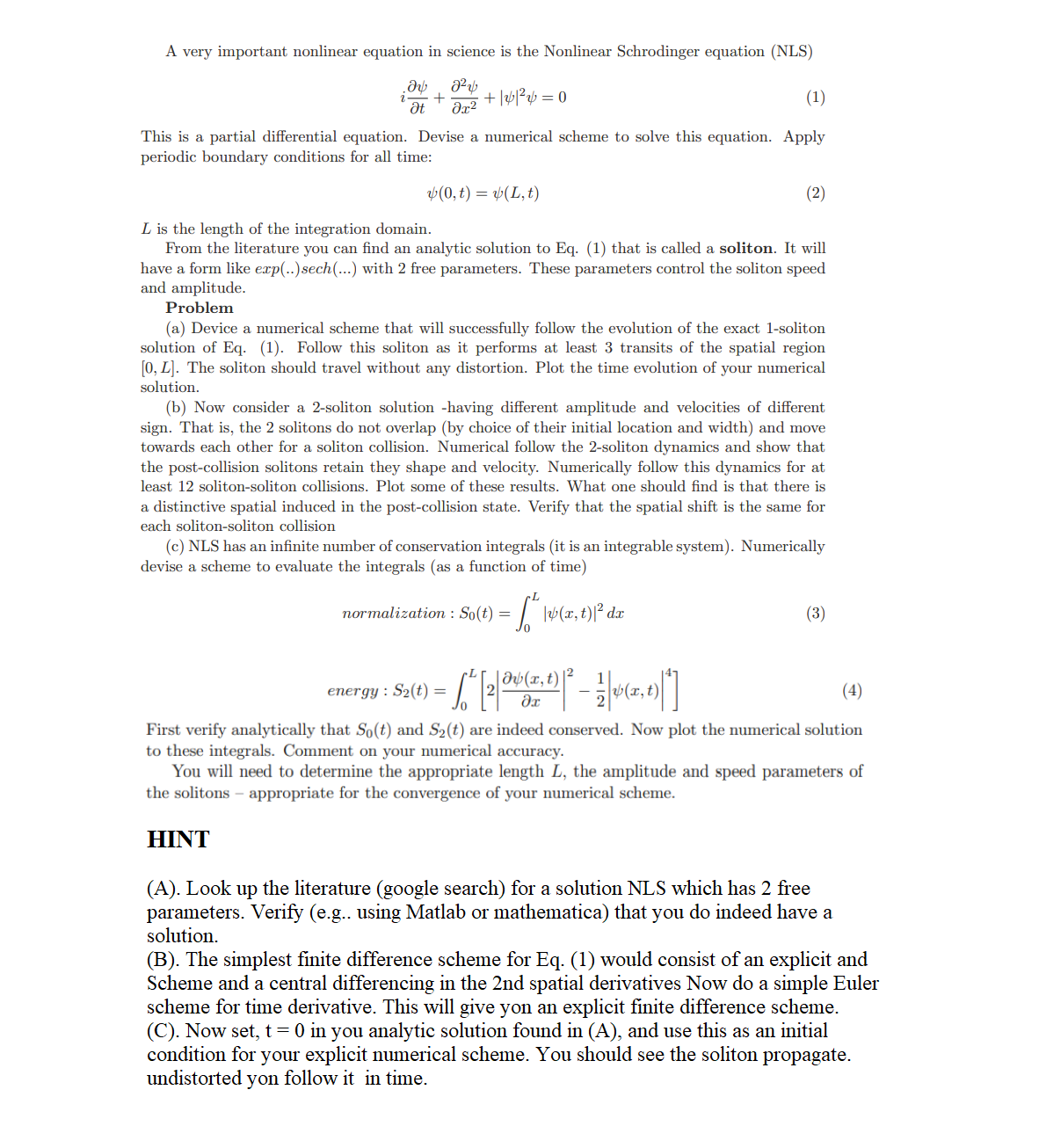
A very important nonlinear equation in science is the Nonlinear Schrodinger equation (NLS) u\") 021i! 2 = 1 z + 652 +le 1.!) 0 ( ) This is a partial differential equation. Devise a numerical scheme to solve this equation. Apply periodic boundary conditions for all time: MO, 3} = "ML: 3) (2) L is the length of the integration domain. From the literature you can nd an analytic solution to Eq. (1) that is called a soliton. It will have a form like emp(..)sech(...) with 2 free parameters. These parameters control the soliton speed and amplitude. Problem (a) Device a numerical scheme that will successfully follow the evolution of the exact 1-soliton solution of Eq. (1). Follow this soliton as it performs at least 3 transits of the spatial region [0, L]. The soliton should travel without any distortion. Plot the time evolution of your numerical solution. (b) Now consider a 2-soliton solution -having different amplitude and velocities of different sign. That is, the 2 solitons do not overlap (by choice of their initial location and width) and move towards each other for a soliton collision. Numerical follow the 2-soliton dynamics and show that the post-collision solitons retain they shape and velocity. Numerically follow this dynamics for at least 12 soliton-soliton collisions. Plot some of these results. What one should nd is that there is a distinctive spatial induced in the post-collision state. Verify that the spatial shift is the same for each soliton-soliton collision (c) NLS has an innite number of conservation integrals (it is an integrable system). Numerically devise a scheme to evaluate the integrals (as a function of time) L normalizatim : 30(t) = /(i |1,I')(r,t)|2d:r (3) Wlxa i) 5:1: energy = 32m = f [2 2 glam. t) 4] (4) First verify analytically that 300) and 3203) are indeed conserved. Now plot the numerical solution to these integrals. Comment on your numerical accuracy. You will need to determine the appropriate length L, the amplitude and speed parameters of the solitons appropriate for the convergence of your numerical scheme. H]NT (A). Look up the literature (google search) for a solution NLS which has 2 free parameters. Verify (e. g.. using Matlab or mathematica) that you do indeed have a solution. (B). The simplest nite difference scheme for Eq. (1) would consist of an explicit and Scheme and a central differencing in the 2nd spatial derivatives Now do a simple Euler scheme for time derivative. This will give yon an explicit nite difference scheme. (C). Now set, t = 0 in you analytic solution found in (A), and use this as an initial condition for your explicit numerical scheme. You should see the soliton propagate. undistorted yon follow it in time
Step by Step Solution
There are 3 Steps involved in it

Get step-by-step solutions from verified subject matter experts
 Study Help