



Question: Please solve all 18 questions!!! Thank you! QUESTION 1 4 points Save Answer Ricardo Gonzalez now faces an operations sequencing problem in his shop. He


Please solve all 18 questions!!! Thank you!
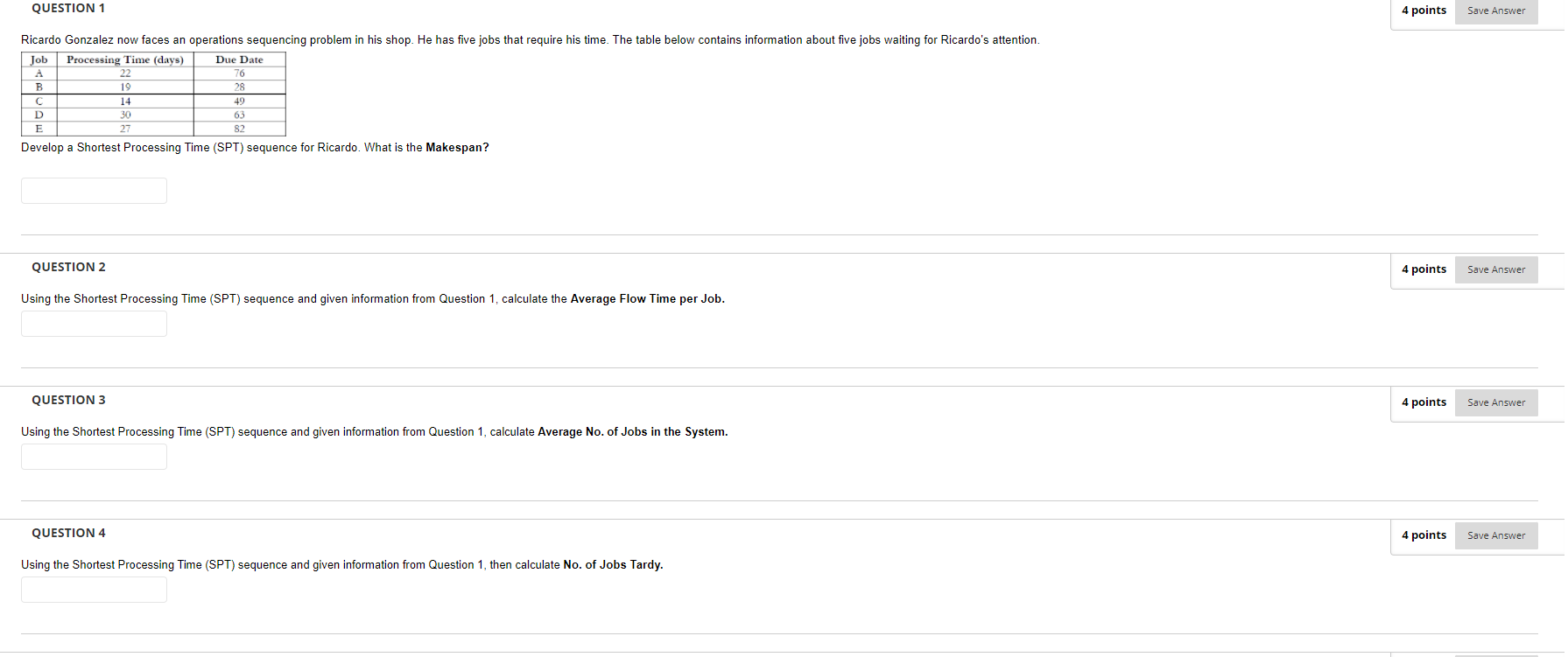
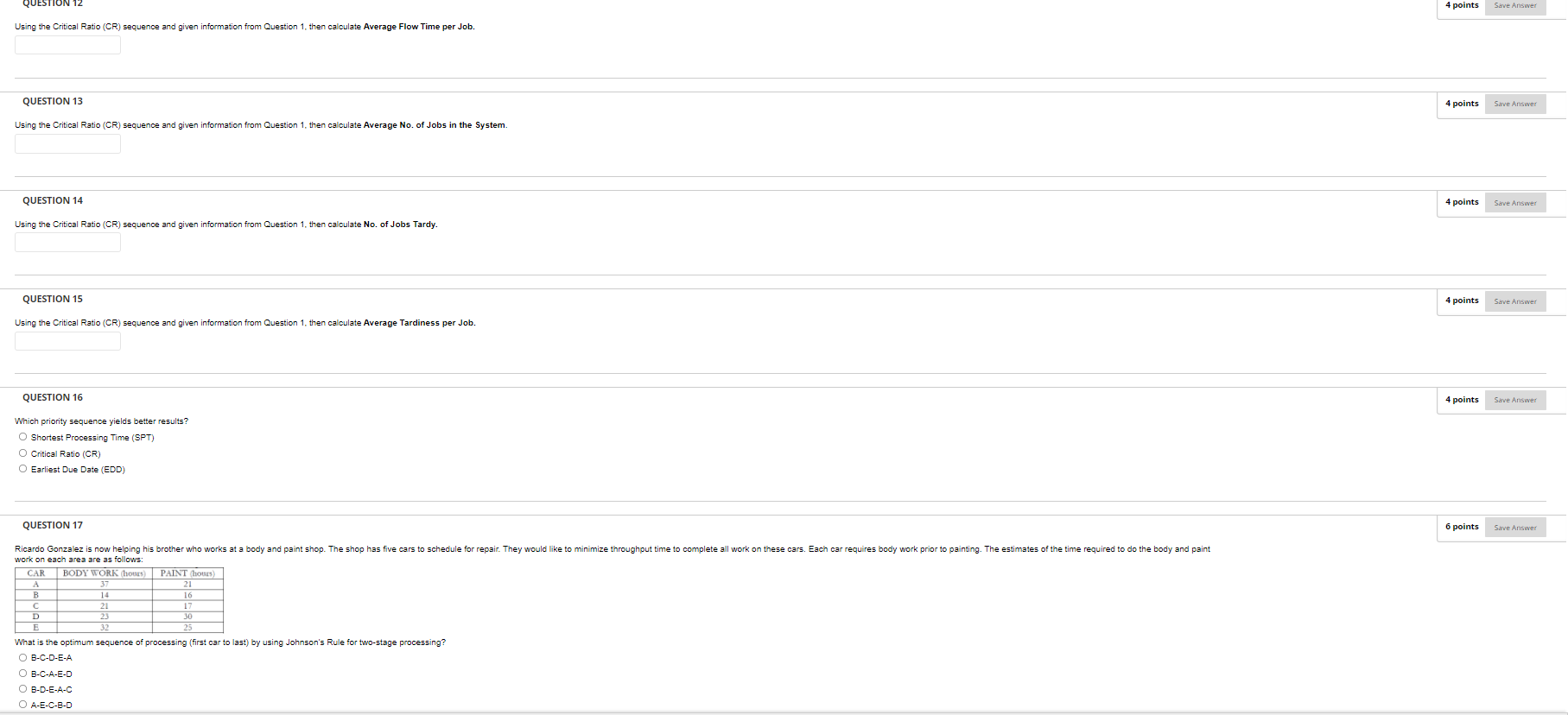
QUESTION 1 4 points Save Answer Ricardo Gonzalez now faces an operations sequencing problem in his shop. He has five jobs that require his time. The table below contains information about five jobs waiting for Ricardo's attention. Job Processing Time (days) Due Date 22 76 B 19 28 14 49 D 30 63 27 82 Develop a Shortest Processing Time (SPT) sequence for Ricardo. What is the Makespan? E QUESTION 2 4 points Save Answer Using the shortest Processing Time (SPT) sequence and given information from Question 1, calculate the Average Flow Time per Job. QUESTION 3 4 points Save Answer Using the shortest Processing Time (SPT) sequence and given information from Question 1, calculate Average No. of Jobs in the System. QUESTION 4 4 points Save Answer Using the shortest Processing Time (SPT) sequence and given information from Question 1, then calculate No. of Jobs Tardy. QUESTION 5 4 points points Save Answer Using the shortest Processing Time (SPT) sequence and given information from Question 1, then calculate Average Tardiness per Job. QUESTION 6 4 points Save Answer Using the information from Question 1. Develop an Earliest Due Date (EDD) sequence for Ricardo. What is the Makespan? QUESTION 7 4 points Save Answer Using the Earliest Due Date (EDD) sequence and given information from Question 1, calculate the Average Flow Time per Job. QUESTION 8 4 points Save Answer Using the Earliest Due Date (EDD) sequence and given information from Question 1, calculate the Average No. of Jobs in the System. QUESTION 9 4 points Save Answer Using the Earliest Due Date (EDD) sequence and given information from Question 1, then calculate No. of Jobs Tardy. QUESTION 10 4 points Save Answer Using the Earliest Due Date (EDD) sequence and given information from Question 1, then calculate Average Tardiness per Job. QUESTION 11 4 points Save Answer Using the information from Question 1, develop a Critical Ratio (CR) sequence for Ricardo. What is the Makespan? QUESTION 12 4 points Save Answer Using the Critical Ratio (CR) sequence and given information from Question 1. then calculate Average Flow Time per Job. QUESTION 13 4 points Save Answer Using the Critical Ratio (CR) sequence and given information from Question 1. then calculate Average No. of Jobs in the System. QUESTION 14 4 points Save Answer Using the Critical Ratio (CR) sequence and given information from Question 1. then calculate No. of Jobs Tardy. QUESTION 15 4 points Save Answer Using the Critical Ratio (CR) sequence and given information from Question 1. then calculate Average Tardiness per Job. QUESTION 16 4 points Save Answer Which priority sequence yields better results? Shortest Processing Time (SPT) O Critical Ratio (CR) O Earliest Due Date (EDD) QUESTION 17 6 points Save Answer Ricardo Gonzalez is now helping his brother who works at a body and paint shop. The shop has five cars to schedule for repair. They would like to minimize throughout time to complete all work on these cars. Each car requires body work prior to painting. The estimates of the time required to do the body and paint work on each area are as follows: CAR BODY WORK hours) PAINT hours) 21 B 14 16 21 17 30 D What is the optimum sequence of processing (first car to last) by using Johnson's Rule for two-stage processing? O B-C-D-E-A O B-C-A-E-D O B-D-E-A-C O A-E-C-8-D QUESTION 18 10 points 10 points Save Answer Develop the schedule both Body Work and Paint Shops and determine the idle time. What is the utilization rate at the Paint Shop? 75.69% 63.35% O 88.78% O 83.48% Click Save and Submit to save and submit. Click Save All Answers to save all answers. Save All Answers Close Window Save and Submit QUESTION 1 4 points Save Answer Ricardo Gonzalez now faces an operations sequencing problem in his shop. He has five jobs that require his time. The table below contains information about five jobs waiting for Ricardo's attention. Job Processing Time (days) Due Date 22 76 B 19 28 14 49 D 30 63 27 82 Develop a Shortest Processing Time (SPT) sequence for Ricardo. What is the Makespan? E QUESTION 2 4 points Save Answer Using the shortest Processing Time (SPT) sequence and given information from Question 1, calculate the Average Flow Time per Job. QUESTION 3 4 points Save Answer Using the shortest Processing Time (SPT) sequence and given information from Question 1, calculate Average No. of Jobs in the System. QUESTION 4 4 points Save Answer Using the shortest Processing Time (SPT) sequence and given information from Question 1, then calculate No. of Jobs Tardy. QUESTION 5 4 points points Save Answer Using the shortest Processing Time (SPT) sequence and given information from Question 1, then calculate Average Tardiness per Job. QUESTION 6 4 points Save Answer Using the information from Question 1. Develop an Earliest Due Date (EDD) sequence for Ricardo. What is the Makespan? QUESTION 7 4 points Save Answer Using the Earliest Due Date (EDD) sequence and given information from Question 1, calculate the Average Flow Time per Job. QUESTION 8 4 points Save Answer Using the Earliest Due Date (EDD) sequence and given information from Question 1, calculate the Average No. of Jobs in the System. QUESTION 9 4 points Save Answer Using the Earliest Due Date (EDD) sequence and given information from Question 1, then calculate No. of Jobs Tardy. QUESTION 10 4 points Save Answer Using the Earliest Due Date (EDD) sequence and given information from Question 1, then calculate Average Tardiness per Job. QUESTION 11 4 points Save Answer Using the information from Question 1, develop a Critical Ratio (CR) sequence for Ricardo. What is the Makespan? QUESTION 12 4 points Save Answer Using the Critical Ratio (CR) sequence and given information from Question 1. then calculate Average Flow Time per Job. QUESTION 13 4 points Save Answer Using the Critical Ratio (CR) sequence and given information from Question 1. then calculate Average No. of Jobs in the System. QUESTION 14 4 points Save Answer Using the Critical Ratio (CR) sequence and given information from Question 1. then calculate No. of Jobs Tardy. QUESTION 15 4 points Save Answer Using the Critical Ratio (CR) sequence and given information from Question 1. then calculate Average Tardiness per Job. QUESTION 16 4 points Save Answer Which priority sequence yields better results? Shortest Processing Time (SPT) O Critical Ratio (CR) O Earliest Due Date (EDD) QUESTION 17 6 points Save Answer Ricardo Gonzalez is now helping his brother who works at a body and paint shop. The shop has five cars to schedule for repair. They would like to minimize throughout time to complete all work on these cars. Each car requires body work prior to painting. The estimates of the time required to do the body and paint work on each area are as follows: CAR BODY WORK hours) PAINT hours) 21 B 14 16 21 17 30 D What is the optimum sequence of processing (first car to last) by using Johnson's Rule for two-stage processing? O B-C-D-E-A O B-C-A-E-D O B-D-E-A-C O A-E-C-8-D QUESTION 18 10 points 10 points Save Answer Develop the schedule both Body Work and Paint Shops and determine the idle time. What is the utilization rate at the Paint Shop? 75.69% 63.35% O 88.78% O 83.48% Click Save and Submit to save and submit. Click Save All Answers to save all answers. Save All Answers Close Window Save and SubmitStep by Step Solution
There are 3 Steps involved in it
1 Expert Approved Answer
Step: 1 Unlock

Question Has Been Solved by an Expert!
Get step-by-step solutions from verified subject matter experts
Step: 2 Unlock
Step: 3 Unlock