







Question: Please solve all Problem 2.1. We showed in class that the average position of an electron in a box is x= L/2 in the ground
Please solve all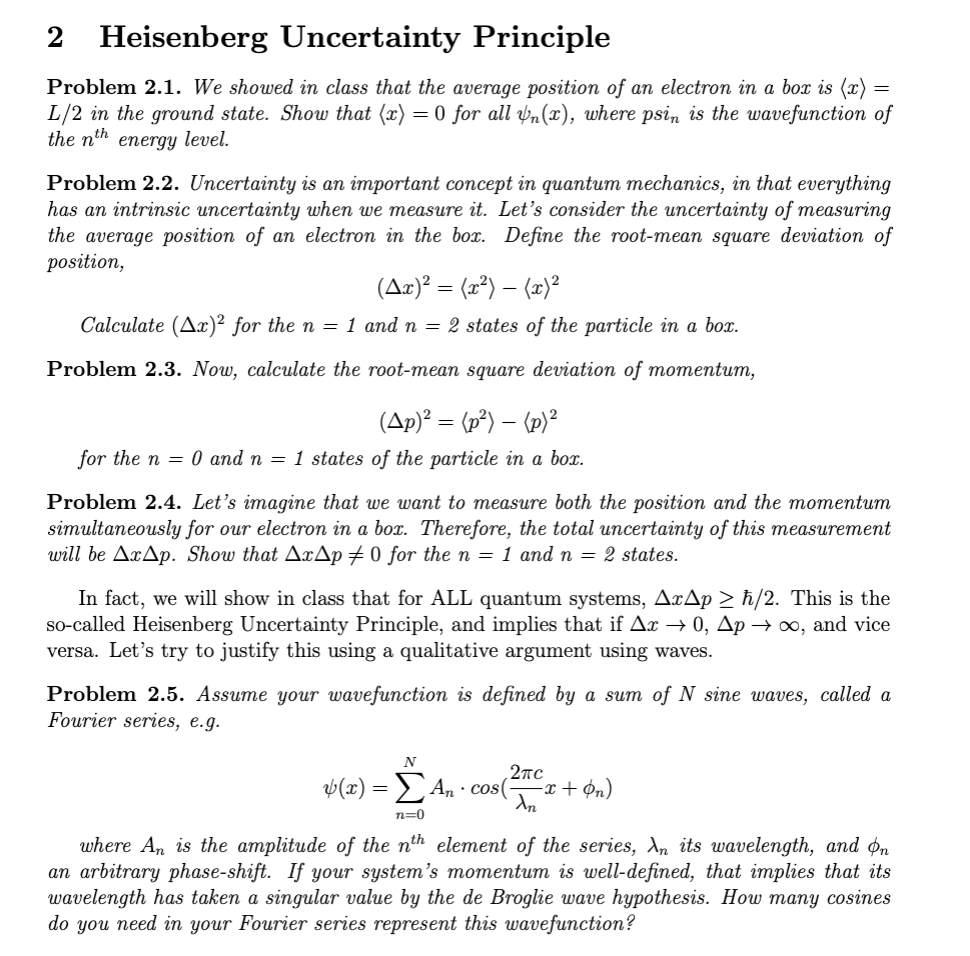

Problem 2.1. We showed in class that the average position of an electron in a box is x= L/2 in the ground state. Show that x=0 for all n(x), where psin is the wavefunction of the nth energy level. Problem 2.2. Uncertainty is an important concept in quantum mechanics, in that everything has an intrinsic uncertainty when we measure it. Let's consider the uncertainty of measuring the average position of an electron in the box. Define the root-mean square deviation of position, (x)2=x2x2 Calculate (x)2 for the n=1 and n=2 states of the particle in a box. Problem 2.3. Now, calculate the root-mean square deviation of momentum, (p)2=p2p2 for the n=0 and n=1 states of the particle in a box. Problem 2.4. Let's imagine that we want to measure both the position and the momentum simultaneously for our electron in a box. Therefore, the total uncertainty of this measurement will be xp. Show that xp=0 for the n=1 and n=2 states. In fact, we will show in class that for ALL quantum systems, xp/2. This is the so-called Heisenberg Uncertainty Principle, and implies that if x0,p, and vice versa. Let's try to justify this using a qualitative argument using waves. Problem 2.5. Assume your wavefunction is defined by a sum of N sine waves, called a Fourier series, e.g. (x)=n=0NAncos(n2cx+n) where An is the amplitude of the nth element of the series, n its wavelength, and n an arbitrary phase-shift. If your system's momentum is well-defined, that implies that its wavelength has taken a singular value by the de Broglie wave hypothesis. How many cosines do you need in your Fourier series represent this wavefunction? Problem 2.6. Now, consider a system that acts like a particle and thus has a well-defined and precisely measured position in space, which we call a wavepacket. Hypothesize (no need to calculate) how many terms in the Fourier series, or individual waves of unique wavelengths, you need to represent this position-localized wavefunction? (Hint: Use the Heisenberg uncertainty principle here to formulate a tentative answer)
Step by Step Solution
There are 3 Steps involved in it

Get step-by-step solutions from verified subject matter experts
 Study Help