







Question: please solve all questions 2) b) impedance (). A col la connected to a 100 80 wwwly and was.com 10 A Cakes a value of
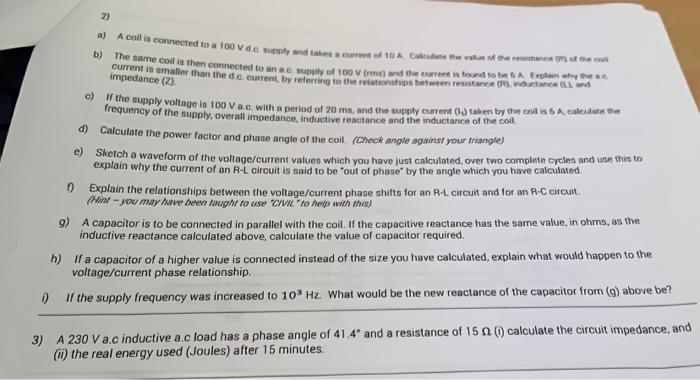
2) b) impedance (). A col la connected to a 100 80 wwwly and was.com 10 A Cakes a value of our rennanen 10. ok on.com The same coll is then connected to an ao gody of 100 (rm) do current is found to train the moprocent to emaker than the decurrent, boy rates for remontin between reace a led the supply voltage in 100 V a 0. with a period of zoma, and the supply current (la taken toy the end in 6 A, caterine the frequency of the supply, overall impedance, inductive reactance and the inductance of the coll d) Calculate the power factor and phase angle of the coll. (Check angle against your triangle) c) Sketch a waveform of the voltage/current values which you have just calculated over two complete cycles and on this to explain why the current of an R-L alrcuit is said to be out of phase by the angle which you have calculated Explain the relationships between the voltage/current phase shifts for an A-L circuit and for an R-Caircut Hint - you may have been fought to use VIL 1o help with the 9) A capacitor is to be connected in parallel with the coit. If the capacitive reactance has the same value, in ohms, as the inductive reactance calculated above, calculate the value of capacitor required. 1) If a capacitor of a higher value is connected instead of the size you have calculated explain what would happen to the voltage/current phase relationship. 0 If the supply frequency was increased to 10% Hz What would be the new reactance of the capacitor from (g) above be? 0 3) A 230 V a.c inductive ac load has a phase angle of 41.4 and a resistance of 15 calculate the circuit impedance, and (m) the real energy used (Joules) after 15 minutes
Step by Step Solution
There are 3 Steps involved in it

Get step-by-step solutions from verified subject matter experts
 Study Help