







Question: PLEASE SOLVE ALL QUESTIONS ( a ) Find the area as a function of q , A c ( q ) , below the marginal
PLEASE SOLVE ALL QUESTIONS
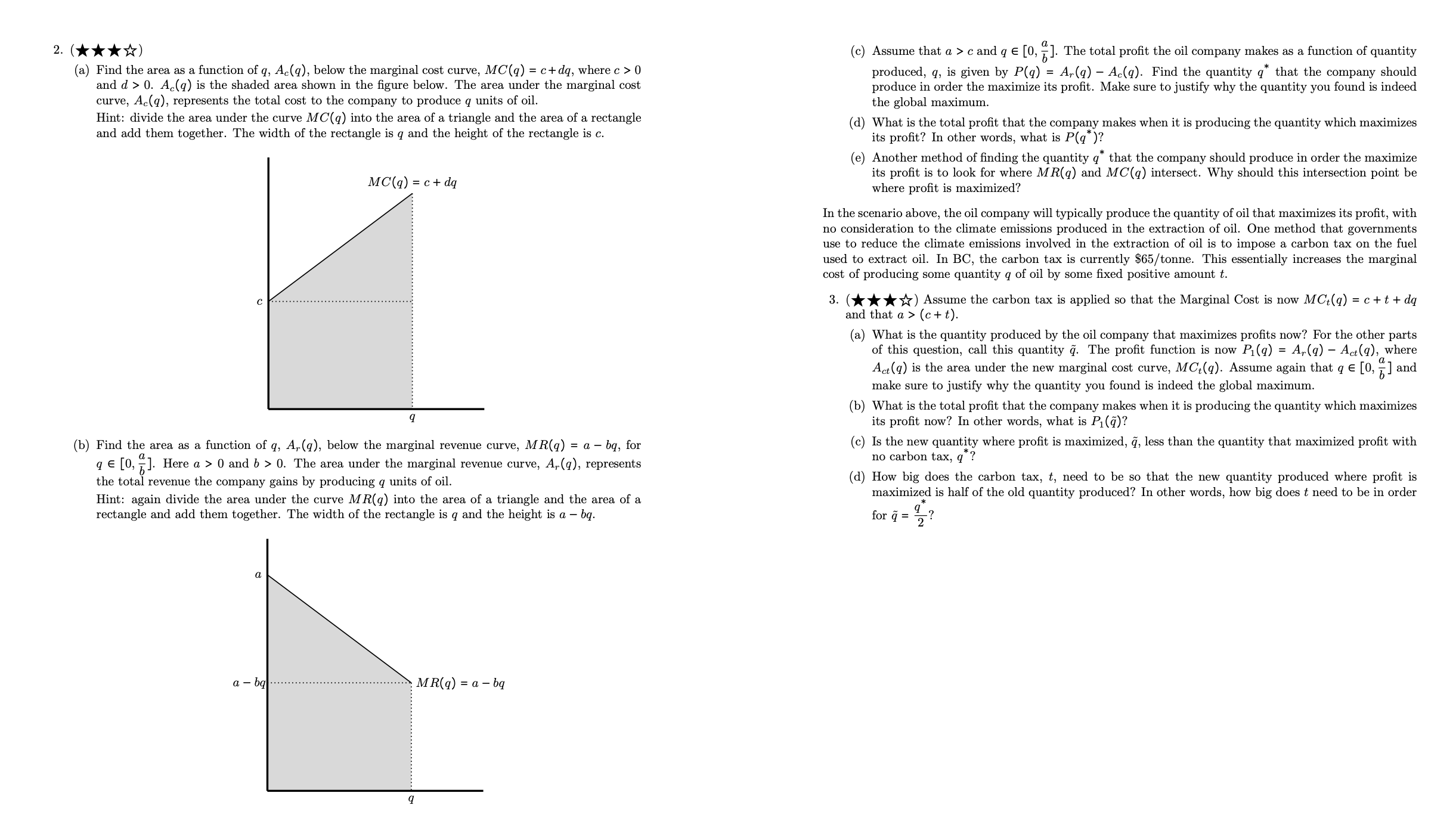
a Find the area as a function of below the marginal cost curve, where
and is the shaded area shown in the figure below. The area under the marginal cost
curve, represents the total cost to the company to produce units of oil.
Hint: divide the area under the curve into the area of a triangle and the area of a rectangle
and add them together. The width of the rectangle is and the height of the rectangle is
b Find the area as a function of below the marginal revenue curve, for
qin Here and The area under the marginal revenue curve, represents
the total revenue the company gains by producing units of oil.
Hint: again divide the area under the curve into the area of a triangle and the area of a
rectangle and add them together. The width of the rectangle is and the height is
c Assume that and qin The total profit the oil company makes as a function of quantity
produced, is given by Find the quantity that the company should
produce in order the maximize its profit. Make sure to justify why the quantity you found is indeed
the global maximum.
d What is the total profit that the company makes when it is producing the quantity which maximizes
its profit? In other words, what is
e Another method of finding the quantity that the company should produce in order the maximize
its profit is to look for where and intersect. Why should this intersection point be
where profit is maximized?
In the scenario above, the oil company will typically produce the quantity of oil that maximizes its profit, with
no consideration to the climate emissions produced in the extraction of oil. One method that governments
use to reduce the climate emissions involved in the extraction of oil is to impose a carbon tax on the fuel
used to extract oil. In BC the carbon tax is currently $ tonne. This essentially increases the marginal
cost of producing some quantity of oil by some fixed positive amount
Assume the carbon tax is applied so that the Marginal Cost is now
and that
a What is the quantity produced by the oil company that maximizes profits now? For the other parts
of this question, call this quantity tilde The profit function is now where
is the area under the new marginal cost curve, Assume again that qin and
make sure to justify why the quantity you found is indeed the global maximum.
b What is the total profit that the company makes when it is producing the quantity which maximizes
its profit now? In other words, what is
c Is the new quantity where profit is maximized, tilde less than the quantity that maximized profit with
no carbon tax,
d How big does the carbon tax, need to be so that the new quantity produced where profit is
maximized is half of the old quantity produced? In other words, how big does need to be in order
for tilde
Step by Step Solution
There are 3 Steps involved in it
1 Expert Approved Answer
Step: 1 Unlock

Question Has Been Solved by an Expert!
Get step-by-step solutions from verified subject matter experts
Step: 2 Unlock
Step: 3 Unlock
 Study Help