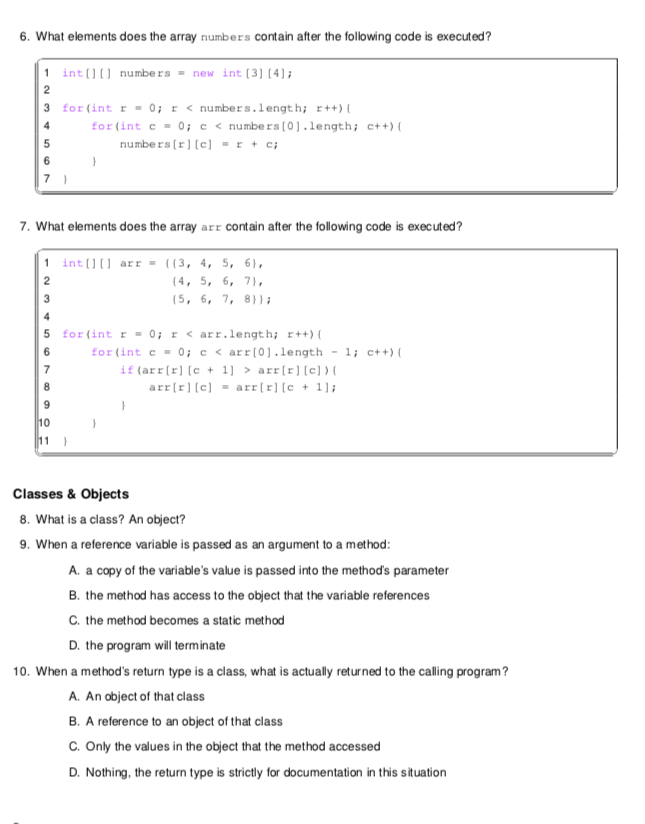
Question: Please Solve Arrays & ArrayLists 1. How is a two-dimensional array different from an array? From an ArrayList? 2. What is the output of the

Please Solve
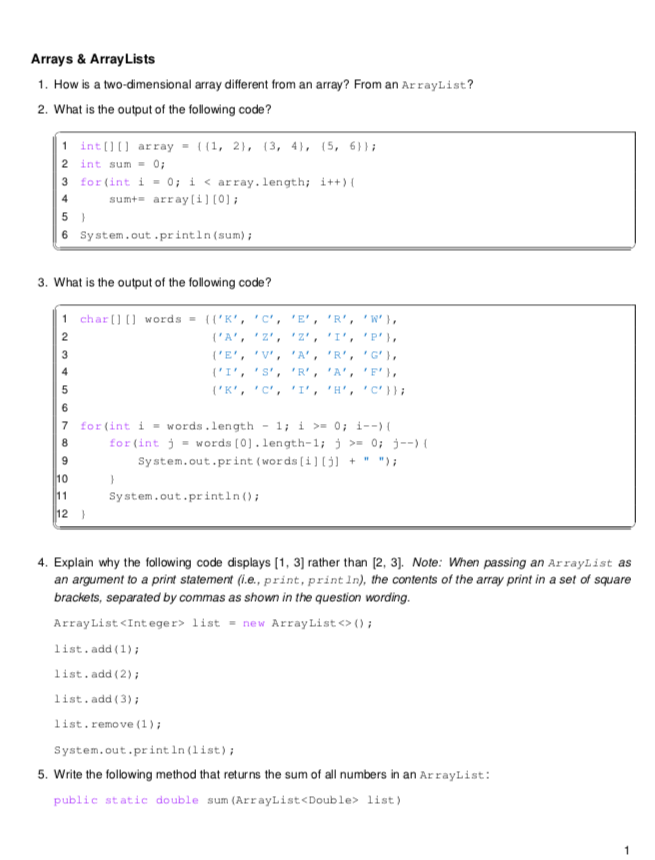
Please Solve Arrays & ArrayLists 1. How is a two-dimensional array differentfrom an array? From an ArrayList? 2. What is the output ofthe following code? 1 int1 array-((1,2, 3, 2 int sum-0 5, 6

Arrays & ArrayLists 1. How is a two-dimensional array different from an array? From an ArrayList? 2. What is the output of the following code? 1 int1 array-((1,2, 3, 2 int sum-0 5, 6 for { int . 0; . 0; i--){ or (int -words (0].length-1;0; System.out print (wor ds [+"" System.out.println 4. Explain why the following code displays [1, 3] rather than [2, 3]. Note: When passing an ArrayList as an argument to a print statement (i.e., print, print In), the contents of the array print in a set of square brackets, separated by commas as shown in the question wording ArrayList listnew ArrayList list.add (1) list.add (2)i list.add (3) list. remove (1) System.out.println (1ist) 5. Write the following method that returns the sum of all numbers in an ArrayList public static double sum (ArrayList list 6. What elements does the array numbers contain after the following code is executed? 1 int numbersnew int [3] [4] 3 for (intr- 0 arrrc]) arr r[c]arrr c+11 Classes & Objects 8. What is a class? An object? 9. When a reference variable is passed as an argument to a method A. a copy of the variable's value is passed into the method's parameter B. the method has access to the object that the variable references C. the method becomes a static method D. the program will terminate 10. When a method's return type is a class, what is actually returned to the calling program? A. An object of that class B. A reference to an object of that class C. Only the values in the object that the method accessed D. Nothing, the return type is strictly for documentation in this situation

Step by Step Solution

There are 3 Steps involved in it

1 Expert Approved Answer
Step: 1 Unlock blur-text-image
Question Has Been Solved by an Expert!

Get step-by-step solutions from verified subject matter experts

Step: 2 Unlock
Step: 3 Unlock

Students Have Also Explored These Related Databases Questions!