







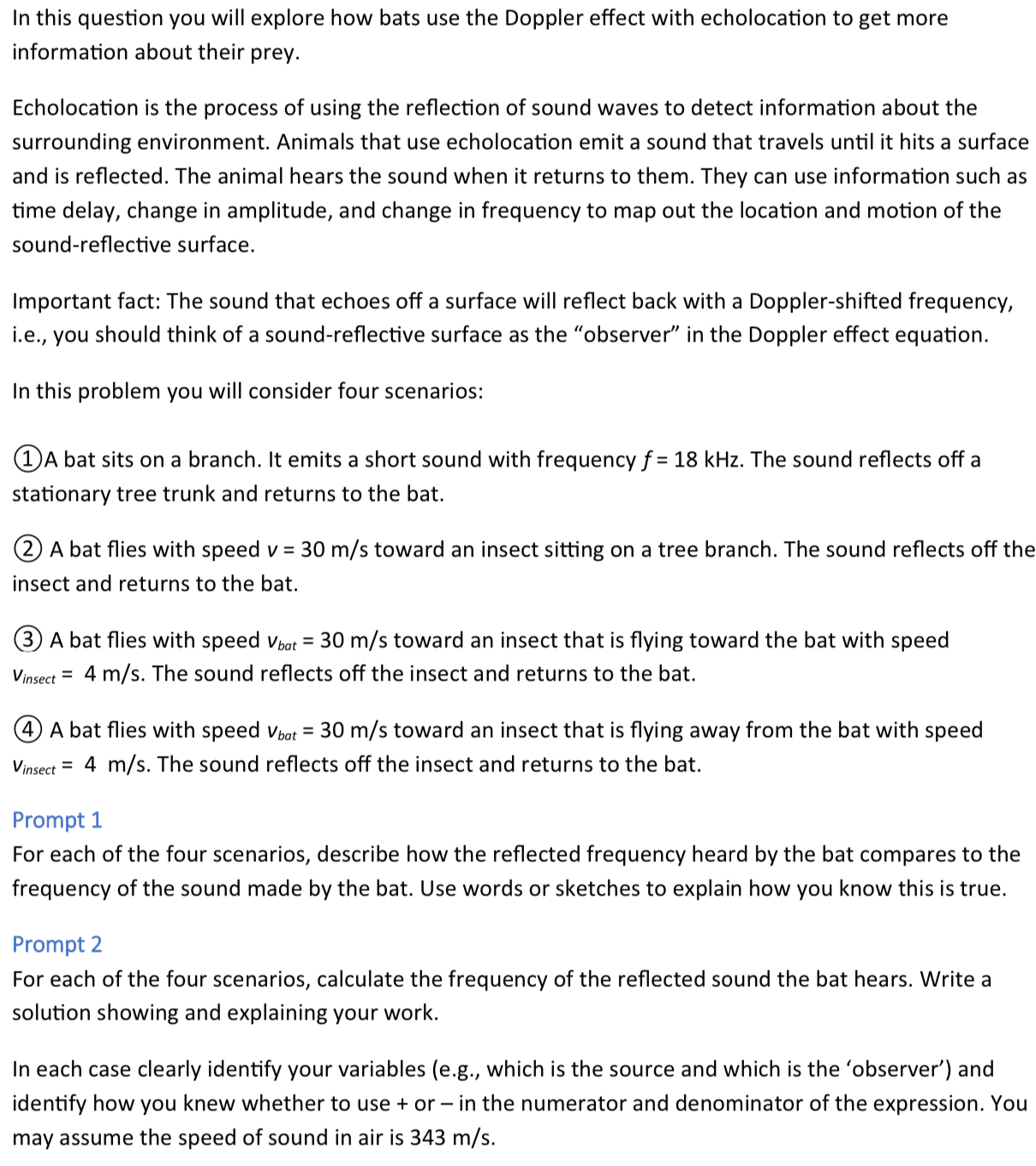
Question: Please solve both prompts. In this question you will explore how bats use the Doppler effect with echolocation to get more information about their prey.
Please solve both prompts.
In this question you will explore how bats use the Doppler effect with echolocation to get more information about their prey.
Echolocation is the process of using the reflection of sound waves to detect information about the surrounding environment. Animals that use echolocation emit a sound that travels until it hits a surface and is reflected. The animal hears the sound when it returns to them. They can use information such as time delay, change in amplitude, and change in frequency to map out the location and motion of the soundreflective surface.
Important fact: The sound that echoes off a surface will reflect back with a Dopplershifted frequency, ie you should think of a soundreflective surface as the "observer" in the Doppler effect equation.
In this problem you will consider four scenarios:
A bat sits on a branch. It emits a short sound with frequency The sound reflects off a stationary tree trunk and returns to the bat.
A bat flies with speed toward an insect sitting on a tree branch. The sound reflects off the insect and returns to the bat.
A bat flies with speed toward an insect that is flying toward the bat with speed The sound reflects off the insect and returns to the bat.
A bat flies with speed toward an insect that is flying away from the bat with speed The sound reflects off the insect and returns to the bat.
Prompt
For each of the four scenarios, describe how the reflected frequency heard by the bat compares to the frequency of the sound made by the bat. Use words or sketches to explain how you know this is true.
Prompt
For each of the four scenarios, calculate the frequency of the reflected sound the bat hears. Write a solution showing and explaining your work.
In each case clearly identify your variables eg which is the source and which is the 'observer' and identify how you knew whether to use or in the numerator and denominator of the expression. You may assume the speed of sound in air is
Step by Step Solution
There are 3 Steps involved in it
1 Expert Approved Answer
Step: 1 Unlock

Question Has Been Solved by an Expert!
Get step-by-step solutions from verified subject matter experts
Step: 2 Unlock
Step: 3 Unlock
 Study Help