







Question: please solve by hand if can i do not understand ... can you please explain as well thank you As Spring semester started on Jan.
please solve by hand if can i do not understand ... can you please explain as well thank you
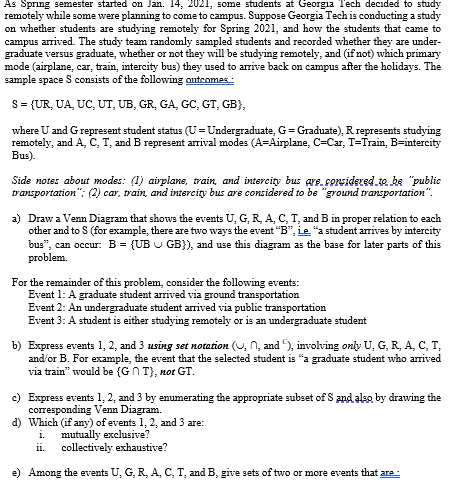
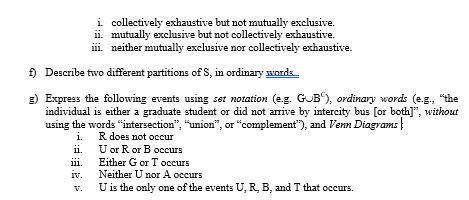
As Spring semester started on Jan. 14, 2021, some students at Georgia Tech decided to study remotely while some were planning to come to campus. Suppose Georgia Tech is conducting a study on whether students are studying remotely for Spring 2021, and how the students that came to campus arrived. The study team randomly sampled students and recorded whether they are under- graduate versus graduate, whether or not they will be studying remotely, and (if not) which primary mode (airplane, car, train, intercity bus) they used to arrive back on campus after the holidays. The sample space consists of the following outcomes S = {UR, UA, UC, UT, UB, GR, GA, GC, GT, GB), where U and Grepresent student status (U = Undergraduate, G = Graduate), R represents studying remotely, and A, C, T, and B represent arrival modes (A=Airplane, C=Car, T=Train, B=intercity Bus). Side notes about modes: (1) airplans, train, and intercity bus are considered to be "public transportation"; (2) cay, train, and intercity bus are considered to be "ground transportation". a) Draw a Venn Diagram that shows the events U, GR, A, C, T, and B in proper relation to each other and to S (for example, there are two ways the event "B", ie "a student arrives inter bus, can occur. B = {UBU GB)), and use this diagram as the base for later parts of this problem. For the remainder of this problem, consider the following events: Event 1: A graduate student arrived via ground transportation Event 2: An undergraduate student arrived via public transportation Event 3: A student is either studying remotely or is an undergraduate student b) Express events 1, 2, and 3 using set notation (, n, and 9), involving only U, G, RA, C, T, and/or B. For example, the event that the selected student is "a graduate student who arrived via train" would be {GN T), nor GT. c) Express events 1, 2 and 3 by enumerating the appropriate subset of S and also by drawing the corresponding Venn Diagram. d) Which (if any) of events 1, 2, and 3 are: mutually exclusive? ii. collectively exhaustive? e) Among the events U, GRACT, and B, give sets of two or more events that are 1. i. collectively exhaustive but not mutually exclusive. ii. mutually exclusive but not collectively exhaustive. ii. neither mutually exclusive nor collectively exhaustive. 1) Describe two different partitions of s, in ordinary words 2) Express the following events using set notation (eg. GUB), ordinary words (eg, "the individual is either a graduate student or did not arrive by intercity bus (or both)", without using the words "intersection", "union", or "complement"), and Venn Diagrams i R does not occur ii. U or R or B occurs Either G or T occurs Neither U nor A occurs U is the only one of the events UR B, and T that occurs. ui. As Spring semester started on Jan. 14, 2021, some students at Georgia Tech decided to study remotely while some were planning to come to campus. Suppose Georgia Tech is conducting a study on whether students are studying remotely for Spring 2021, and how the students that came to campus arrived. The study team randomly sampled students and recorded whether they are under- graduate versus graduate, whether or not they will be studying remotely, and (if not) which primary mode (airplane, car, train, intercity bus) they used to arrive back on campus after the holidays. The sample space consists of the following outcomes S = {UR, UA, UC, UT, UB, GR, GA, GC, GT, GB), where U and Grepresent student status (U = Undergraduate, G = Graduate), R represents studying remotely, and A, C, T, and B represent arrival modes (A=Airplane, C=Car, T=Train, B=intercity Bus). Side notes about modes: (1) airplans, train, and intercity bus are considered to be "public transportation"; (2) cay, train, and intercity bus are considered to be "ground transportation". a) Draw a Venn Diagram that shows the events U, GR, A, C, T, and B in proper relation to each other and to S (for example, there are two ways the event "B", ie "a student arrives inter bus, can occur. B = {UBU GB)), and use this diagram as the base for later parts of this problem. For the remainder of this problem, consider the following events: Event 1: A graduate student arrived via ground transportation Event 2: An undergraduate student arrived via public transportation Event 3: A student is either studying remotely or is an undergraduate student b) Express events 1, 2, and 3 using set notation (, n, and 9), involving only U, G, RA, C, T, and/or B. For example, the event that the selected student is "a graduate student who arrived via train" would be {GN T), nor GT. c) Express events 1, 2 and 3 by enumerating the appropriate subset of S and also by drawing the corresponding Venn Diagram. d) Which (if any) of events 1, 2, and 3 are: mutually exclusive? ii. collectively exhaustive? e) Among the events U, GRACT, and B, give sets of two or more events that are 1. i. collectively exhaustive but not mutually exclusive. ii. mutually exclusive but not collectively exhaustive. ii. neither mutually exclusive nor collectively exhaustive. 1) Describe two different partitions of s, in ordinary words 2) Express the following events using set notation (eg. GUB), ordinary words (eg, "the individual is either a graduate student or did not arrive by intercity bus (or both)", without using the words "intersection", "union", or "complement"), and Venn Diagrams i R does not occur ii. U or R or B occurs Either G or T occurs Neither U nor A occurs U is the only one of the events UR B, and T that occurs. uiStep by Step Solution
There are 3 Steps involved in it
1 Expert Approved Answer
Step: 1 Unlock

Question Has Been Solved by an Expert!
Get step-by-step solutions from verified subject matter experts
Step: 2 Unlock
Step: 3 Unlock
 Study Help