







Question: please solve case 2 and Case 3 QI. What actions do you need to take? What issues do you need to anticipate? Case Study #2
please solve case 2 and Case 3
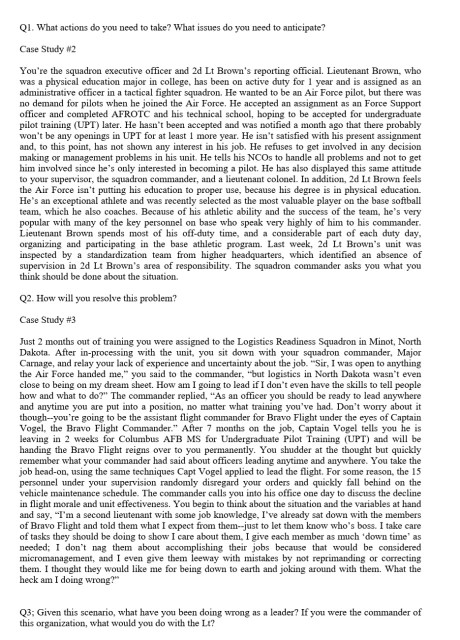
QI. What actions do you need to take? What issues do you need to anticipate? Case Study #2 You're the squadron executive officer and 2d Lt Brown's reporting official. Lieutenant Brown, who was a physical education major in college has been on active duty for 1 year and is assigned as an administrative officer in a tactical fighter squadron. He wanted to be an Air Force pilot, but there was no demand for pilots when he joined the Air Force. He accepted an assignment as an Force Support officer and completed AFROTC and his technical school, hoping to be accepted for undergraduate pilot training (UPT) later. He hasn't been accepted and was notified a month ago that there probably won't be any openings in UPT for at least I more year. He isn't satisfied with his present assignment and, to this point, has not shown any interest in his job. He refuses to get involved in any decision making or management problems in his unit. He tells his NCOs to handle all problems and not to get him involved since he's only interested in becoming a pilot. He has also displayed this same attitude to your supervisor, the squadron commander, and a lieutenant colonel. In addition, 2d Li Brown feels the Air Force isn't putting his education to proper use, because his degree is in physical education He's an exceptional athlete and was recently selected as the most valuable player on the base softball team, which he also coaches. Because of his athletic ability and the success of the team, he's very popular with many of the key personnel on base who speak very highly of him to his commander Lieutenant Brown spends most of his off-duty time, and a considerable part of each duty day, organizing and participating in the base athletic program. Last week, 2d Lt Brown's unit was inspected by a standardization team from higher headquarters, which identified an absence of supervision in 2d Lt Brown's area of responsibility. The squadron commander asks you what you think should be done about the situation. Q2. How will you resolve this problem? Case Study #3 Just 2 months out of training you were assigned to the Logistics Readiness Squadron in Minot, North Dakota. After in-processing with the unit, you sit down with your squadron commander, Major Carnage, and relay your lack of experience and uncertainty about the job. "Sir, I was open to anything the Air Force handed me, you said to the commander, "but logistics in North Dakota wasn't even close to being on my dream sheet. How am I going to lead if I don't even have the skills to tell people how and what to do? The commander replied, "As an officer you should be ready to lead anywhere and anytime you are put into a position, no matter what training you've had. Don't worry about it though you're going to be the assistant flight commander for Bravo Flight under the eyes of Captain Vogel, the Bravo Flight Commander." After 7 months on the job, Captain Vogel tells you he is leaving in 2 weeks for Columbus AFB MS for Undergraduate Pilot Training (UPT) and will be handing the Bravo Flight reigns over to you permanently. You shudder at the thought but quickly remember what your commander had said about officers leading anytime and anywhere. You take the job head-on, using the same techniques Capt Vogel applied to lead the flight. For some reason, the 15 personnel under your supervision randomly disregard your orders and quickly fall behind on the vehicle maintenance schedule. The commander calls you into his office one day to discuss the decline in flight morale and unit effectiveness. You begin to think about the situation and the variables at hand and say. "I'm a second lieutenant with some job knowledge. I've already sat down with the members of Bravo Flight and told them what I expect from them--just to let them know who's boss. I take care of tasks they should be doing to show I care about them. I give each member as much down time as needed; I don't nag them about accomplishing their jobs because that would be considered micromanagement, and I even give them leeway with mistakes by not reprimanding or correcting them. I thought they would like me for being down to earth and joking around with them. What the heck am I doing wrong? Q3: Given this scenario, what have you been doing wrong as a leader? If you were the commander of this organization, what would you do with the LrStep by Step Solution
There are 3 Steps involved in it
1 Expert Approved Answer
Step: 1 Unlock

Question Has Been Solved by an Expert!
Get step-by-step solutions from verified subject matter experts
Step: 2 Unlock
Step: 3 Unlock
 Study Help