







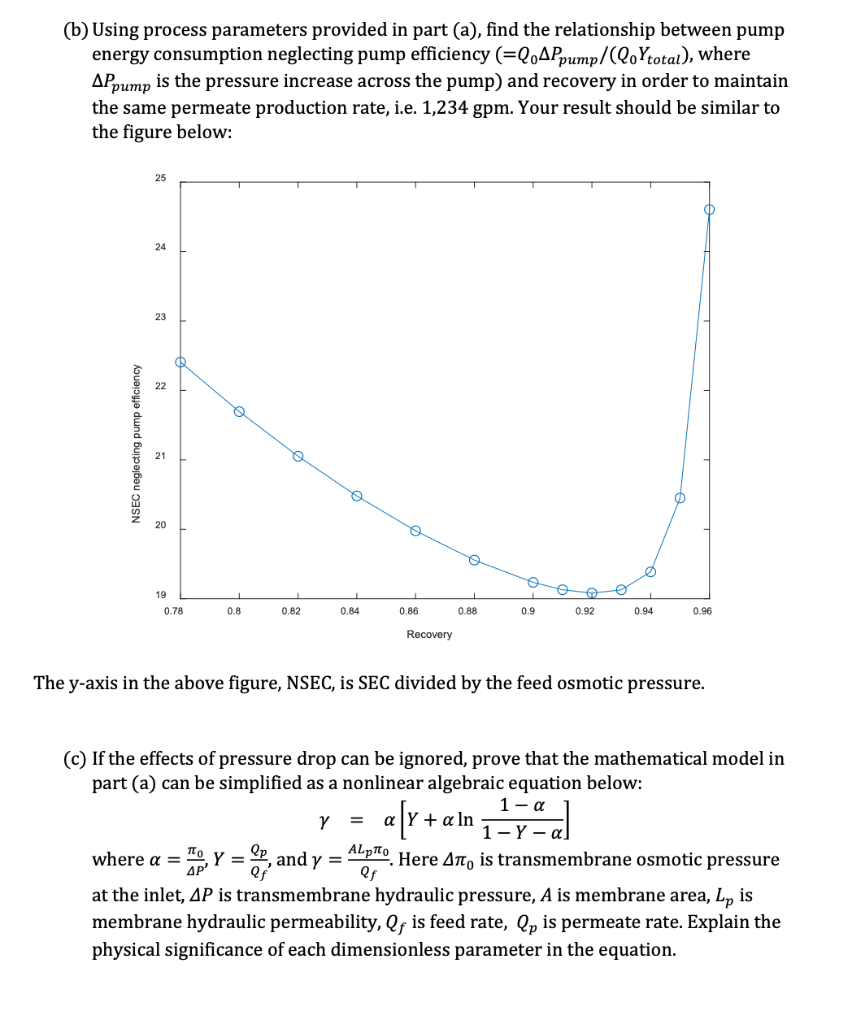
Question: please solve everything thank you (b) Using process parameters provided in part (a), find the relationship between pump energy consumption neglecting pump efficiency (=Q,APpump/(QoYtotal), where
 please solve everything thank you
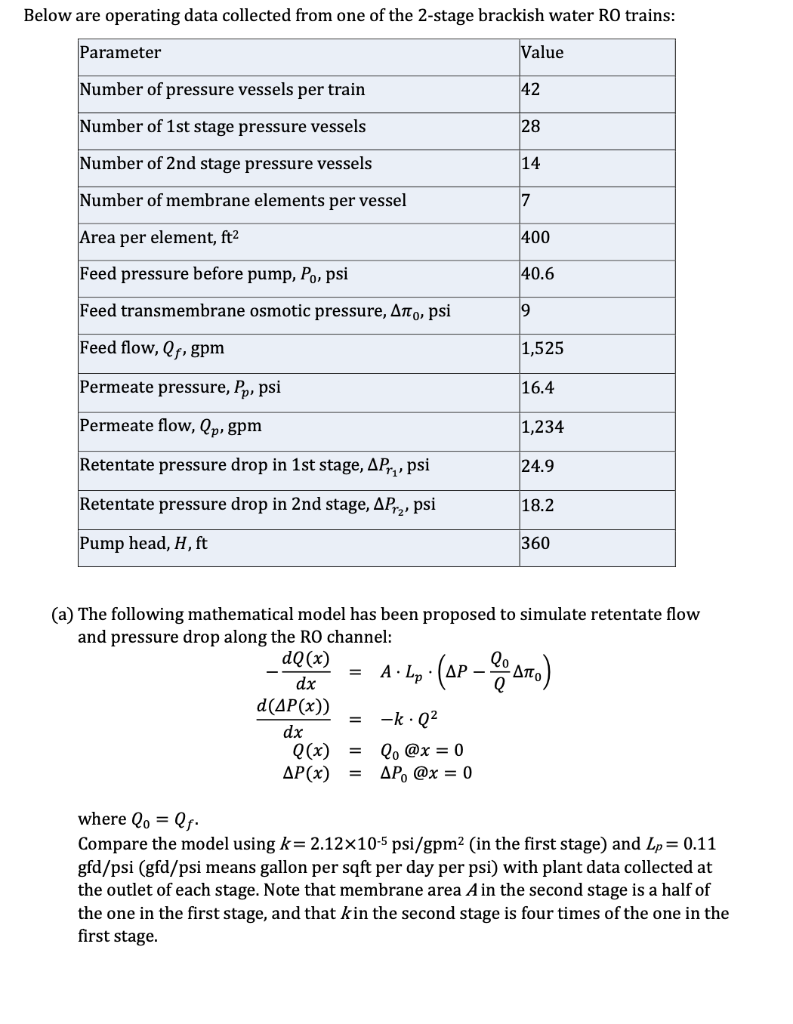
(b) Using process parameters provided in part (a), find the relationship between pump energy consumption neglecting pump efficiency (=Q,APpump/(QoYtotal), where APpump is the pressure increase across the pump) and recovery in order to maintain the same permeate production rate, i.e. 1,234 gpm. Your result should be similar to the figure below: 24 23 22 NSEC neglecting pump efficiency 0 19 0.78 0.8 0.82 0.84 0.86 0.88 0.9 0.92 0.94 0.96 Recovery The y-axis in the above figure, NSEC, is SEC divided by the feed osmotic pressure. (c) If the effects of pressure drop can be ignored, prove that the mathematical model in part (a) can be simplified as a nonlinear algebraic equation below: a r a [v+aln 1-7-a + 1Y-a where a = Y = e, and y = 4670 Here Anto is transmembrane osmotic pressure Of ef at the inlet, AP is transmembrane hydraulic pressure, A is membrane area, Lp is membrane hydraulic permeability, Qf is feed rate, lp is permeate rate. Explain the physical significance of each dimensionless parameter in the equation. = AP' Below are operating data collected from one of the 2-stage brackish water RO trains: Parameter Value Number of pressure vessels per train 42 Number of 1st stage pressure vessels 28 Number of 2nd stage pressure vessels 14 Number of membrane elements per vessel 7 400 Area per element, ft2 Feed pressure before pump, Po, psi Feed transmembrane osmotic pressure, Arto, psi 40.6 9 Feed flow, Qf, gpm 1,525 Permeate pressure, Pp, psi 16.4 Permeate flow, Qp, gpm 1,234 Retentate pressure drop in 1st stage, APr,, psi 24.9 Retentate pressure drop in 2nd stage, APrz, psi 18.2 Pump head, H, ft 360 = (a) The following mathematical model has been proposed to simulate retentate flow and pressure drop along the RO channel: dQ(x) lo dx d(4P(x)) = -k.Q2 dx Q(x) Q. @x = 0 AP(x) AP, @x = 0 A.Ly: (ap Q.10) = where lo = Qf. Compare the model using k= 2.12x10⁻⁵ psi/gpm2 (in the first stage) and Lp= 0.11 gfd/psi (gfd/psi means gallon per sqft per day per psi) with plant data collected at the outlet of each stage. Note that membrane area A in the second stage is a half of the one in the first stage, and that kin the second stage is four times of the one in the first stage. (b) Using process parameters provided in part (a), find the relationship between pump energy consumption neglecting pump efficiency (=Q,APpump/(QoYtotal), where APpump is the pressure increase across the pump) and recovery in order to maintain the same permeate production rate, i.e. 1,234 gpm. Your result should be similar to the figure below: 24 23 22 NSEC neglecting pump efficiency 0 19 0.78 0.8 0.82 0.84 0.86 0.88 0.9 0.92 0.94 0.96 Recovery The y-axis in the above figure, NSEC, is SEC divided by the feed osmotic pressure. (c) If the effects of pressure drop can be ignored, prove that the mathematical model in part (a) can be simplified as a nonlinear algebraic equation below: a r a [v+aln 1-7-a + 1Y-a where a = Y = e, and y = 4670 Here Anto is transmembrane osmotic pressure Of ef at the inlet, AP is transmembrane hydraulic pressure, A is membrane area, Lp is membrane hydraulic permeability, Qf is feed rate, lp is permeate rate. Explain the physical significance of each dimensionless parameter in the equation. = AP' Below are operating data collected from one of the 2-stage brackish water RO trains: Parameter Value Number of pressure vessels per train 42 Number of 1st stage pressure vessels 28 Number of 2nd stage pressure vessels 14 Number of membrane elements per vessel 7 400 Area per element, ft2 Feed pressure before pump, Po, psi Feed transmembrane osmotic pressure, Arto, psi 40.6 9 Feed flow, Qf, gpm 1,525 Permeate pressure, Pp, psi 16.4 Permeate flow, Qp, gpm 1,234 Retentate pressure drop in 1st stage, APr,, psi 24.9 Retentate pressure drop in 2nd stage, APrz, psi 18.2 Pump head, H, ft 360 = (a) The following mathematical model has been proposed to simulate retentate flow and pressure drop along the RO channel: dQ(x) lo dx d(4P(x)) = -k.Q2 dx Q(x) Q. @x = 0 AP(x) AP, @x = 0 A.Ly: (ap Q.10) = where lo = Qf. Compare the model using k= 2.12x10⁻⁵ psi/gpm2 (in the first stage) and Lp= 0.11 gfd/psi (gfd/psi means gallon per sqft per day per psi) with plant data collected at the outlet of each stage. Note that membrane area A in the second stage is a half of the one in the first stage, and that kin the second stage is four times of the one in the first stage
Step by Step Solution
There are 3 Steps involved in it

Get step-by-step solutions from verified subject matter experts
 Study Help