







Question: Please solve from D to H. Mini Case Shrieves Casting Company is considering adding a new line to its product mix, and the capital budgeting
Please solve from D to H.
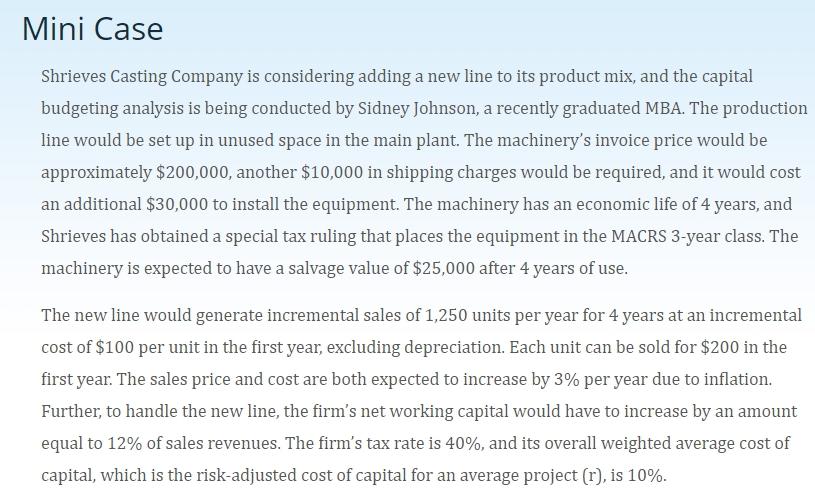
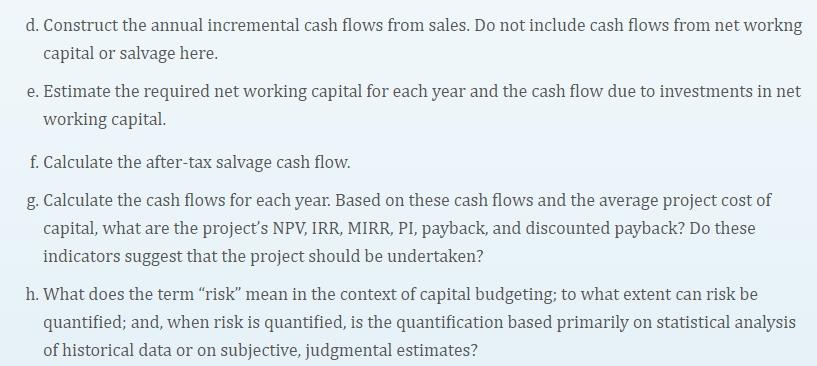
Mini Case Shrieves Casting Company is considering adding a new line to its product mix, and the capital budgeting analysis is being conducted by Sidney Johnson, a recently graduated MBA. The production line would be set up in unused space in the main plant. The machinery's invoice price would be approximately $200,000, another $10,000 in shipping charges would be required, and it would cost an additional $30,000 to install the equipment. The machinery has an economic life of 4 years, and Shrieves has obtained a special tax ruling that places the equipment in the MACRS 3-year class. The machinery is expected to have a salvage value of $25,000 after 4 years of use. The new line would generate incremental sales of 1,250 units per year for 4 years at an incremental cost of $100 per unit in the first year, excluding depreciation. Each unit can be sold for $200 in the first year. The sales price and cost are both expected to increase by 3% per year due to inflation. Further, to handle the new line, the firm's net working capital would have to increase by an amount equal to 12% of sales revenues. The firm's tax rate is 40%, and its overall weighted average cost of capital, which is the risk-adjusted cost of capital for an average project (r), is 10%. d. Construct the annual incremental cash flows from sales. Do not include cash flows from net workng capital or salvage here. e. Estimate the required net working capital for each year and the cash flow due to investments in net working capital f. Calculate the after-tax salvage cash flow. g. Calculate the cash flows for each year. Based on these cash flows and the average project cost of capital, what are the project's NPV, IRR, MIRR, PI, payback, and discounted payback? Do these indicators suggest that the project should be undertaken? h. What does the term "risk mean in the context of capital budgeting; to what extent can risk be quantified; and, when risk is quantified, is the quantification based primarily on statistical analysis of historical data or on subjective, judgmental estimates? Mini Case Shrieves Casting Company is considering adding a new line to its product mix, and the capital budgeting analysis is being conducted by Sidney Johnson, a recently graduated MBA. The production line would be set up in unused space in the main plant. The machinery's invoice price would be approximately $200,000, another $10,000 in shipping charges would be required, and it would cost an additional $30,000 to install the equipment. The machinery has an economic life of 4 years, and Shrieves has obtained a special tax ruling that places the equipment in the MACRS 3-year class. The machinery is expected to have a salvage value of $25,000 after 4 years of use. The new line would generate incremental sales of 1,250 units per year for 4 years at an incremental cost of $100 per unit in the first year, excluding depreciation. Each unit can be sold for $200 in the first year. The sales price and cost are both expected to increase by 3% per year due to inflation. Further, to handle the new line, the firm's net working capital would have to increase by an amount equal to 12% of sales revenues. The firm's tax rate is 40%, and its overall weighted average cost of capital, which is the risk-adjusted cost of capital for an average project (r), is 10%. d. Construct the annual incremental cash flows from sales. Do not include cash flows from net workng capital or salvage here. e. Estimate the required net working capital for each year and the cash flow due to investments in net working capital f. Calculate the after-tax salvage cash flow. g. Calculate the cash flows for each year. Based on these cash flows and the average project cost of capital, what are the project's NPV, IRR, MIRR, PI, payback, and discounted payback? Do these indicators suggest that the project should be undertaken? h. What does the term "risk mean in the context of capital budgeting; to what extent can risk be quantified; and, when risk is quantified, is the quantification based primarily on statistical analysis of historical data or on subjective, judgmental estimates
Step by Step Solution
There are 3 Steps involved in it

Get step-by-step solutions from verified subject matter experts
 Study Help