







Question: PLEASE SOLVE! I will give thumbs up for a good attempt. I WILL REPORT IF THE ANSWER IS UNRELATED TO THIS QUESTION! The elementary, irreversible,
 PLEASE SOLVE! I will give thumbs up for a good attempt. I WILL REPORT IF THE ANSWER IS UNRELATED TO THIS QUESTION!
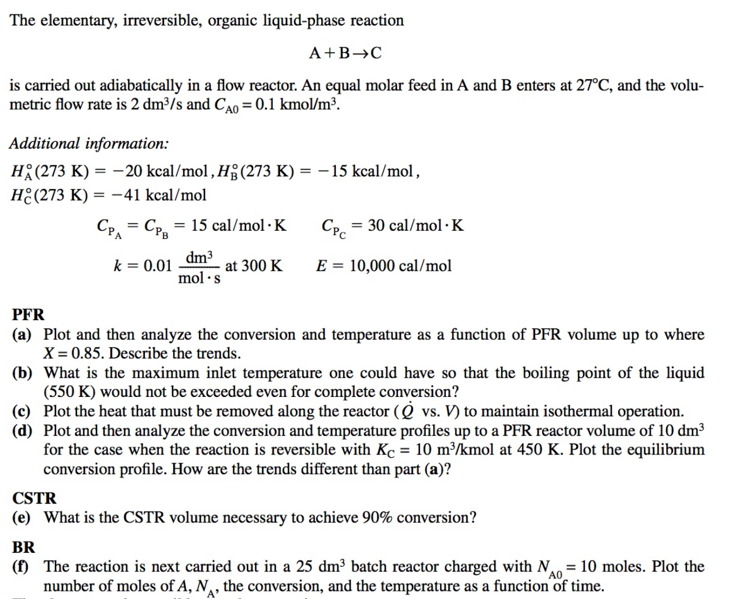
The elementary, irreversible, organic liquid-phase reaction A+BC is carried out adiabatically in a flow reactor. An equal molar feed in A and B enters at 27C, and the volumetric flow rate is 2dm3/s and CA0=0.1kmol/m3. Additional information: HA(273K)=20kcal/mol,HB(273K)=15kcal/mol,HC(273K)=41kcal/molCPA=CPB=15cal/molKCPC=30cal/molKk=0.01molsdm3at300KE=10,000cal/mol PFR (a) Plot and then analyze the conversion and temperature as a function of PFR volume up to where X=0.85. Describe the trends. (b) What is the maximum inlet temperature one could have so that the boiling point of the liquid (550K) would not be exceeded even for complete conversion? (c) Plot the heat that must be removed along the reactor ( Q vs. V ) to maintain isothermal operation. (d) Plot and then analyze the conversion and temperature profiles up to a PFR reactor volume of 10dm3 for the case when the reaction is reversible with KC=10m3/kmol at 450K. Plot the equilibrium conversion profile. How are the trends different than part (a)? CSTR (e) What is the CSTR volume necessary to achieve 90% conversion? BR (f) The reaction is next carried out in a 25dm3 batch reactor charged with NA0=10 moles. Plot the number of moles of A,NA, the conversion, and the temperature as a function of time
Step by Step Solution
There are 3 Steps involved in it

Get step-by-step solutions from verified subject matter experts
 Study Help