







Question: Please solve in python!!! Recall that if n 0 is an integer, then we write n ! to denote the product of all positive integers
Please solve in python!!!
Recall that if is an integer, then we write to denote the product of all positive integers less than or equal to Specifically,
and for
a Write a Python function that accepts a nonnegative integer as input and returns its factorial as output. Print your function's output for and use pltplot to graph these values as isolated points using the option bo
b Use Python to compute the antiderivative of for with constants of integration What integration techniques could you have used to find these results by hand?
c For each of the antiderivatives you found in part b evaluate Use this information to propose a formula for when is arbitrary.
Recall that if is an integer, then we write to denote the product of all positive integers less than or equal to Specifically,
and for
a Write a Python function that accepts a nonnegative integer n as input and returns its factorial as output. Print your function's output for and use pltplot to graph these values as isolated points using the option bo
b Use Python to compute the antiderivative of for with constants of integration What integration techniques could you have used to find these results by hand?
c For each of the antiderivatives you found in part b evaluate Use this information to propose a formula for when is arbitrary.
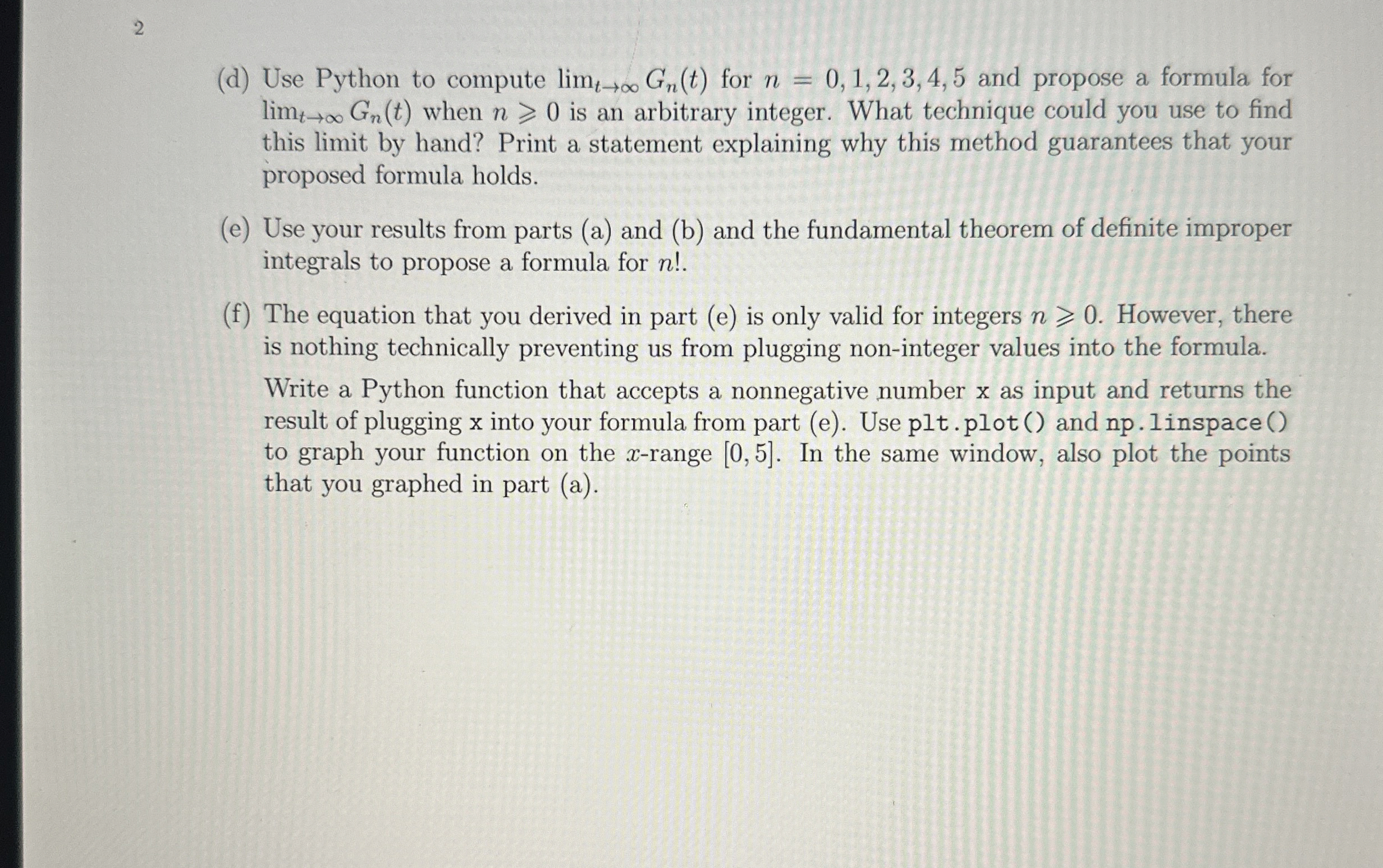
d Use Python to compute for and propose a formula for when is an arbitrary integer. What technique could you use to find this limit by hand? Print a statement explaining why this method guarantees that your proposed formula holds.
e Use your results from parts a and b and the fundamental theorem of definite improper integrals to propose a formula for
f The equation that you derived in part e is only valid for integers However, there is nothing technically preventing us from plugging noninteger values into the formula.
Write a Python function that accepts a nonnegative number x as input and returns the result of plugging into your formula from part e Use pltplot and np linspace to graph your function on the range In the same window, also plot the points that you graphed in part a
d Use Python to compute for and propose a formula for when is an arbitrary integer. What technique could you use to find this limit by hand? Print a statement explaining why this method guarantees that your proposed formula holds.
e Use your results from parts a and b and the fundamental theorem of definite improper integrals to propose a formula for
f The equation that you derived in part e is only valid for integers However, there is nothing technically preventing us from plugging noninteger values into the formula.
Write a Python function that accepts a nonnegative number as input and returns the result of plugging into your formula from part e Use plt plot and np linspace to graph your function on the range In the same window, also plot the points that you graphed in part a
Step by Step Solution
There are 3 Steps involved in it
1 Expert Approved Answer
Step: 1 Unlock

Question Has Been Solved by an Expert!
Get step-by-step solutions from verified subject matter experts
Step: 2 Unlock
Step: 3 Unlock
 Study Help