







Question: Please solve it ill 5:37 60% + Edit 49 X A dvanced Topics in Mathematics - Asymptotic Methods 12 valid throughout the domain of interest
Please solve it
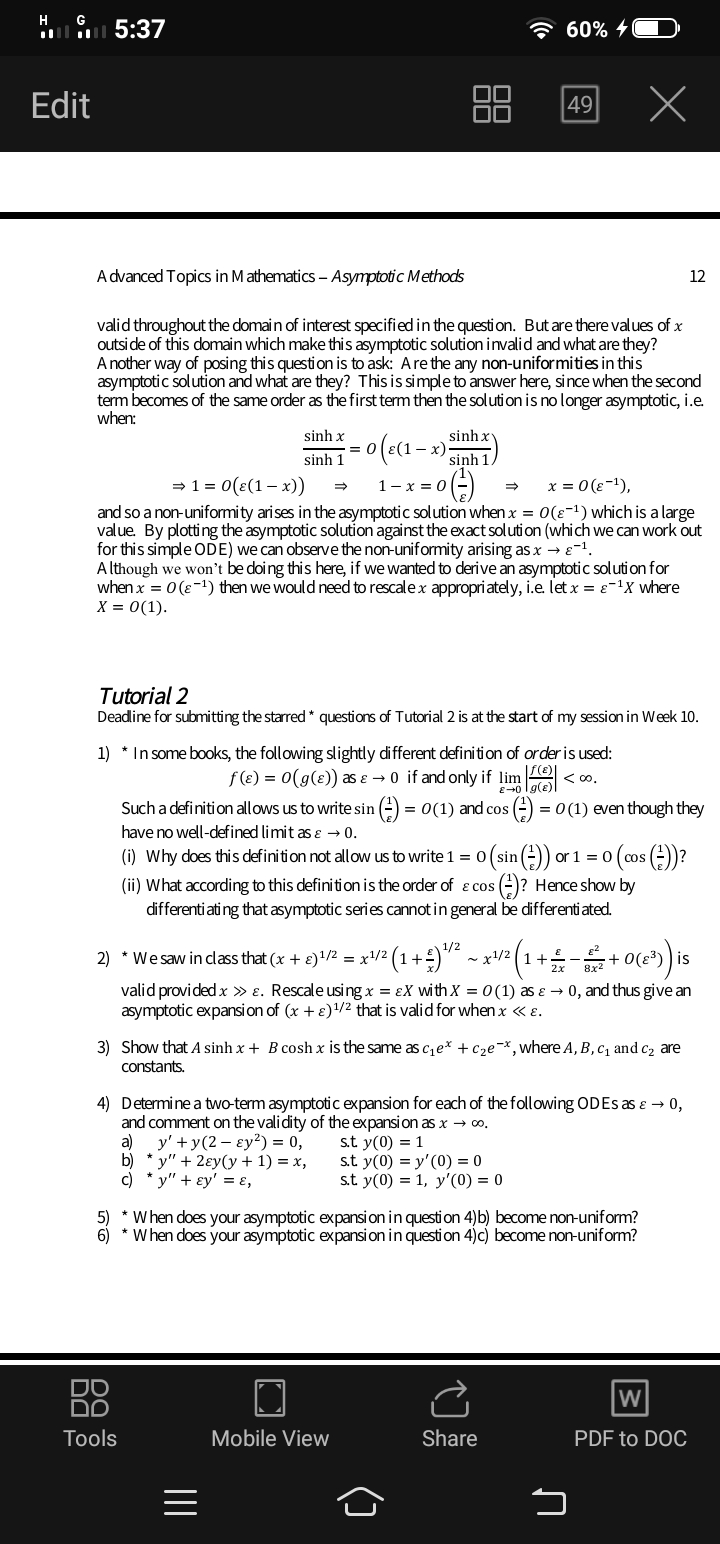
ill 5:37 60% + Edit 49 X A dvanced Topics in Mathematics - Asymptotic Methods 12 valid throughout the domain of interest specified in the question. But are there values of x outside of this domain which make this asymptotic solution invalid and what are they? A nother way of posing this question is to ask: Are the any non-uniformities in this asymptotic solution and what are they? This is simple to answer here, since when the second term becomes of the same order as the first term then the solution is no longer asymptotic, i.e. when: sinh x sinh 1 = 0(2(1 - x) Sinhxy sinh 1 = 1 = 0(=(1 -x)) = 1-x=0(#) = x=0(8-1), and so a non-uniformity arises in the asymptotic solution when x = 0(&-1) which is a large value. By plotting the asymptotic solution against the exact solution (which we can work out for this simple ODE) we can observe the non-uniformity arising as x - &-1. Although we won't be doing this here, if we wanted to derive an asymptotic solution for when x = 0 (&-1) then we would need to rescale x appropriately, i.e. let x = a-1X where X = 0(1). Tutorial 2 Deadline for submitting the starred * questions of Tutorial 2 is at the start of my session in Week 10. 1) * In some books, the following slightly different definition of order is used: f(=) = 0(g(=)) as a - 0 if and only if lim > . Rescale using x = EX with X = 0(1) as & - 0, and thus give an asymptotic expansion of (x + 8) 1/2 that is valid for when x
Step by Step Solution
There are 3 Steps involved in it

Get step-by-step solutions from verified subject matter experts
 Study Help