







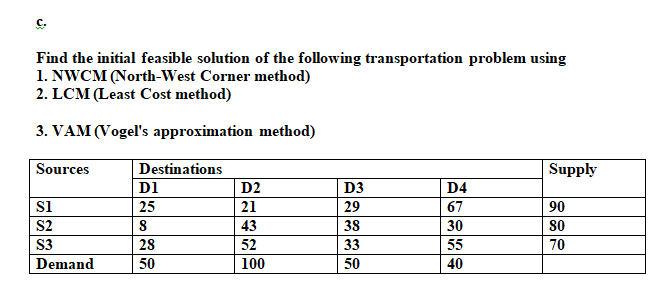
Question: Please solve maximum for a Big Like Find the initial feasible solution of the following transportation problem using 1. NWCM (North-West Corner method) 2. LCM
Please solve maximum for a Big Like
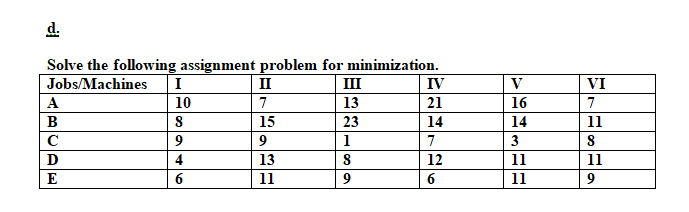
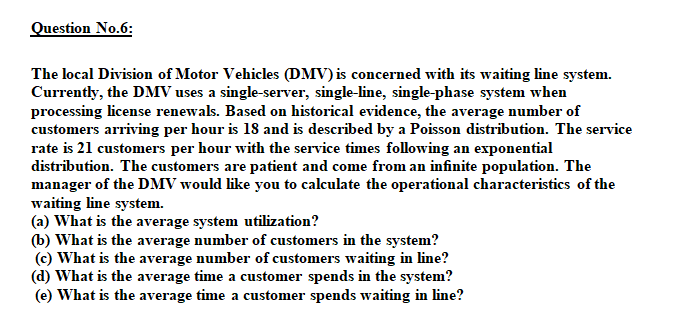
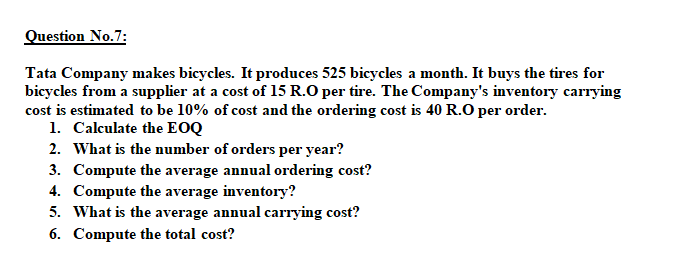
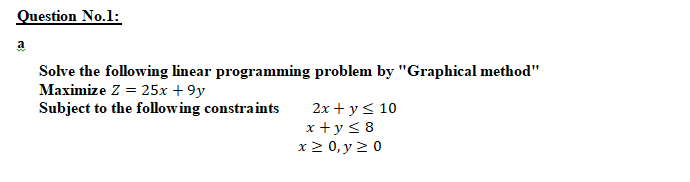
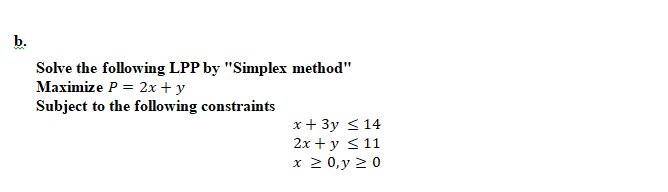
Find the initial feasible solution of the following transportation problem using 1. NWCM (North-West Corner method) 2. LCM (Least Cost method) 3. VAM (Vogel's approximation method) Sources Supply si S2 S3 Demand Destinations DI 25 8 28 50 D2 21 43 52 100 D3 29 38 33 50 D4 67 30 55 40 90 80 70 d. Solve the following assignment problem for minimization. Jobs/ Machines I II III IV A 10 7 13 21 B 8 15 23 14 9 9 1 7 D 4 13 S 12 E 6 11 9 6 V 16 14 3 11 11 VI 7 11 8 11 9 Question No.6: The local Division of Motor Vehicles (DMV) is concerned with its waiting line system. Currently, the DMV uses a single-server, single-line, single-phase system when processing license renewals. Based on historical evidence, the average number of customers arriving per hour is 18 and is described by a Poisson distribution. The service rate is 21 customers per hour with the service times following an exponential distribution. The customers are patient and come from an infinite population. The manager of the DMV would like you to calculate the operational characteristics of the waiting line system. (a) What is the average system utilization? (b) What is the average number of customers in the system? (c) What is the average number of customers waiting in line? (d) What is the average time a customer spends in the system? (e) What is the average time a customer spends waiting in line? Question No.7: Tata Company makes bicycles. It produces 525 bicycles a month. It buys the tires for bicycles from a supplier at a cost of 15 R.O per tire. The Company's inventory carrying cost is estimated to be 10% of cost and the ordering cost is 40 R.O per order. 1. Calculate the EOQ 2. What is the number of orders per year? 3. Compute the average annual ordering cost? 4. Compute the average inventory? 5. What is the average annual carrying cost? 6. Compute the total cost? Question No.1: a Solve the following linear programming problem by "Graphical method" Maximize Z = 25x +9y Subject to the following constraints 2x + y 10 x+y S8 x > 0, y = 0 b. Solve the following LPP by "Simplex method" Maximize P = 2x + y Subject to the following constraints x + 3y = 14 2x + y = 11 x > 0,y > 0Step by Step Solution
There are 3 Steps involved in it
1 Expert Approved Answer
Step: 1 Unlock

Question Has Been Solved by an Expert!
Get step-by-step solutions from verified subject matter experts
Step: 2 Unlock
Step: 3 Unlock
 Study Help