







Question: please solve problem 2.15 and use the crystal from problem 1.25 (second 2 pictures). please show all work. Will like for correctly solution :) 148
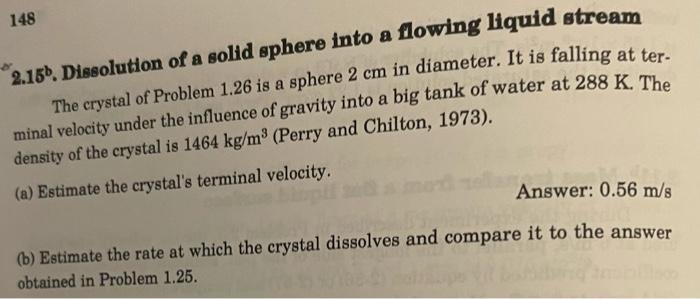
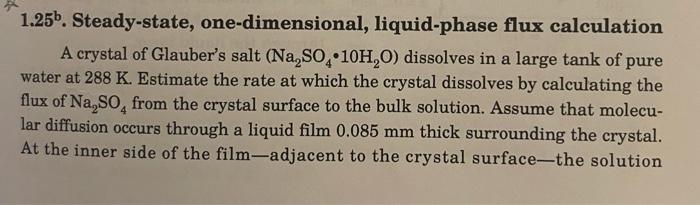
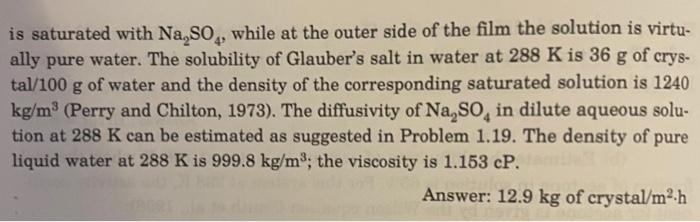
148 2.150. Dissolution of a solid sphere into a flowing liquid stream The crystal of Problem 1.26 is a sphere 2 cm in diameter. It is falling at ter. minal velocity under the influence of gravity into a big tank of water at 288 K. The density of the crystal is 1464 kg/m (Perry and Chilton, 1973). (a) Estimate the crystal's terminal velocity. Answer: 0.56 m/s (b) Estimate the rate at which the crystal dissolves and compare it to the answer obtained in Problem 1.25. 1.25b. Steady-state, one-dimensional, liquid-phase flux calculation A crystal of Glauber's salt (Na,s0, 101,0) dissolves in a large tank of pure water at 288 K. Estimate the rate at which the crystal dissolves by calculating the flux of Na,so, from the crystal surface to the bulk solution. Assume that molecu- lar diffusion occurs through a liquid film 0.085 mm thick surrounding the crystal. At the inner side of the film-adjacent to the crystal surface-the solution 49 is saturated with Na, so,, while at the outer side of the film the solution is virtu- ally pure water. The solubility of Glauber's salt in water at 288 K is 36 g of crys- tal/100 g of water and the density of the corresponding saturated solution is 1240 / kg/m (Perry and Chilton, 1973). The diffusivity of Na, So, in dilute aqueous solu- tion at 288 K can be estimated as suggested in Problem 1.19. The density of pure liquid water at 288 K is 999.8 kg/m3; the viscosity is 1.153 CP. Answer: 12.9 kg of crystal/mah 148 2.150. Dissolution of a solid sphere into a flowing liquid stream The crystal of Problem 1.26 is a sphere 2 cm in diameter. It is falling at ter. minal velocity under the influence of gravity into a big tank of water at 288 K. The density of the crystal is 1464 kg/m (Perry and Chilton, 1973). (a) Estimate the crystal's terminal velocity. Answer: 0.56 m/s (b) Estimate the rate at which the crystal dissolves and compare it to the answer obtained in Problem 1.25. 1.25b. Steady-state, one-dimensional, liquid-phase flux calculation A crystal of Glauber's salt (Na,s0, 101,0) dissolves in a large tank of pure water at 288 K. Estimate the rate at which the crystal dissolves by calculating the flux of Na,so, from the crystal surface to the bulk solution. Assume that molecu- lar diffusion occurs through a liquid film 0.085 mm thick surrounding the crystal. At the inner side of the film-adjacent to the crystal surface-the solution 49 is saturated with Na, so,, while at the outer side of the film the solution is virtu- ally pure water. The solubility of Glauber's salt in water at 288 K is 36 g of crys- tal/100 g of water and the density of the corresponding saturated solution is 1240 / kg/m (Perry and Chilton, 1973). The diffusivity of Na, So, in dilute aqueous solu- tion at 288 K can be estimated as suggested in Problem 1.19. The density of pure liquid water at 288 K is 999.8 kg/m3; the viscosity is 1.153 CP. Answer: 12.9 kg of crystal/mah
Step by Step Solution
There are 3 Steps involved in it

Get step-by-step solutions from verified subject matter experts
 Study Help