







Question: Please solve problem P14.10.4 gets a bit messy.) e subset of the language Paren containing all strings that never have a prefix excess of L's
Please solve problem P14.10.4
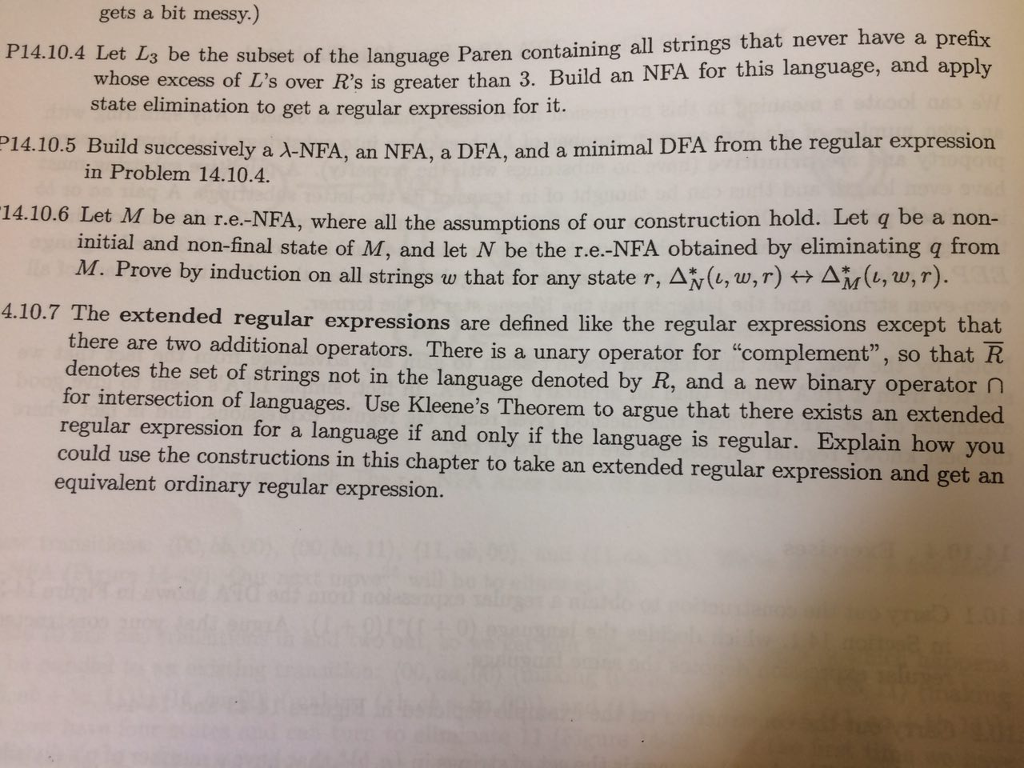
gets a bit messy.) e subset of the language Paren containing all strings that never have a prefix excess of L's over R's is greater than 3. Build an NFA for this language, and apply 4.10.4 Let Ls be th whose state elimination to get a regular expression for it. -14.1 0.5 Build successively a ? NFA, an NFA, a DFA, and a minimal DFA from the regular expression in Problem 14.10.4. Let MM be an re-NEA, where all the assumptions of our construction hold. Let q be a non- initial and non-final state of M, and let N be the r.e.-NFA obtained by eliminating q from 14.10.6 M. Prove by induction on all strings w that for any state r, ??(1,u, r) t? ??r(lu, r). 4.10.7 Th e extended regular expressions are defined like the regular expressions except that there are two additional operators. There is a unary operator for "complement", so that R denotes the set of strings not in the language denoted by R, and a new binary operator n tersection of languages. Use Kleene's Theorem to argue that there exists an extended for in regular expression for a language if and only if the language is plain how you constructions in this chapter to take an extended regular expression and get an ar. d use the equivalent ordinary regular expression gets a bit messy.) e subset of the language Paren containing all strings that never have a prefix excess of L's over R's is greater than 3. Build an NFA for this language, and apply 4.10.4 Let Ls be th whose state elimination to get a regular expression for it. -14.1 0.5 Build successively a ? NFA, an NFA, a DFA, and a minimal DFA from the regular expression in Problem 14.10.4. Let MM be an re-NEA, where all the assumptions of our construction hold. Let q be a non- initial and non-final state of M, and let N be the r.e.-NFA obtained by eliminating q from 14.10.6 M. Prove by induction on all strings w that for any state r, ??(1,u, r) t? ??r(lu, r). 4.10.7 Th e extended regular expressions are defined like the regular expressions except that there are two additional operators. There is a unary operator for "complement", so that R denotes the set of strings not in the language denoted by R, and a new binary operator n tersection of languages. Use Kleene's Theorem to argue that there exists an extended for in regular expression for a language if and only if the language is plain how you constructions in this chapter to take an extended regular expression and get an ar. d use the equivalent ordinary regular expression
Step by Step Solution
There are 3 Steps involved in it

Get step-by-step solutions from verified subject matter experts
 Study Help