







Question: please solve Q3 not question 1 and 2. This question two parts (worth 10pts +10 pts). Please answer all parts (a & b) in the
please solve Q3 not question 1 and 2.
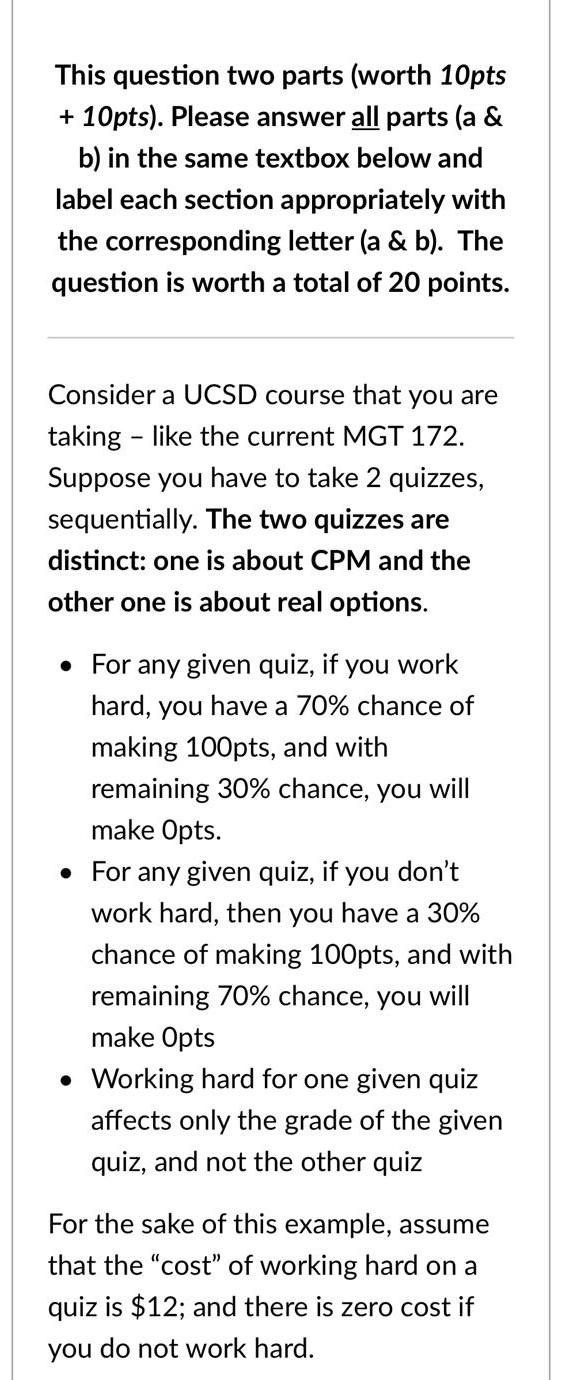
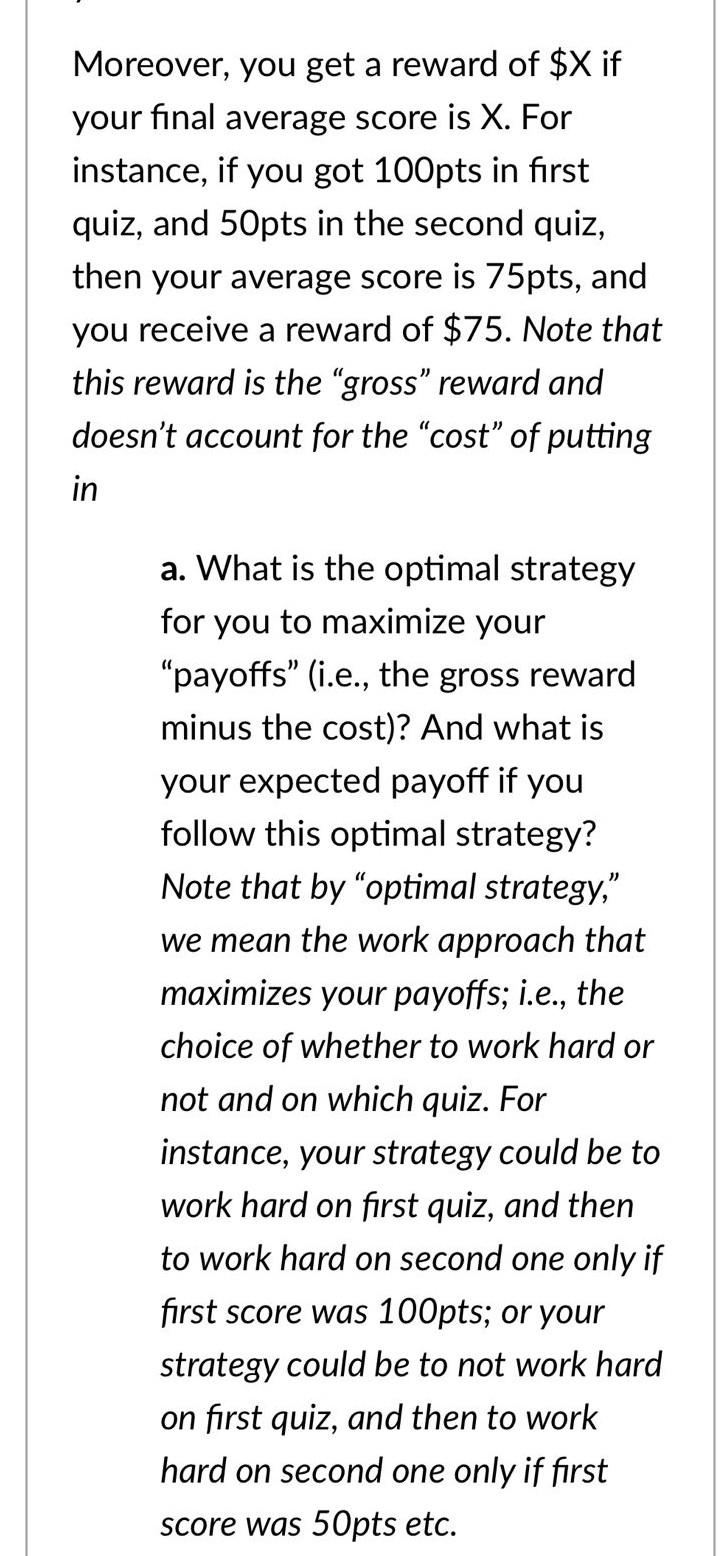
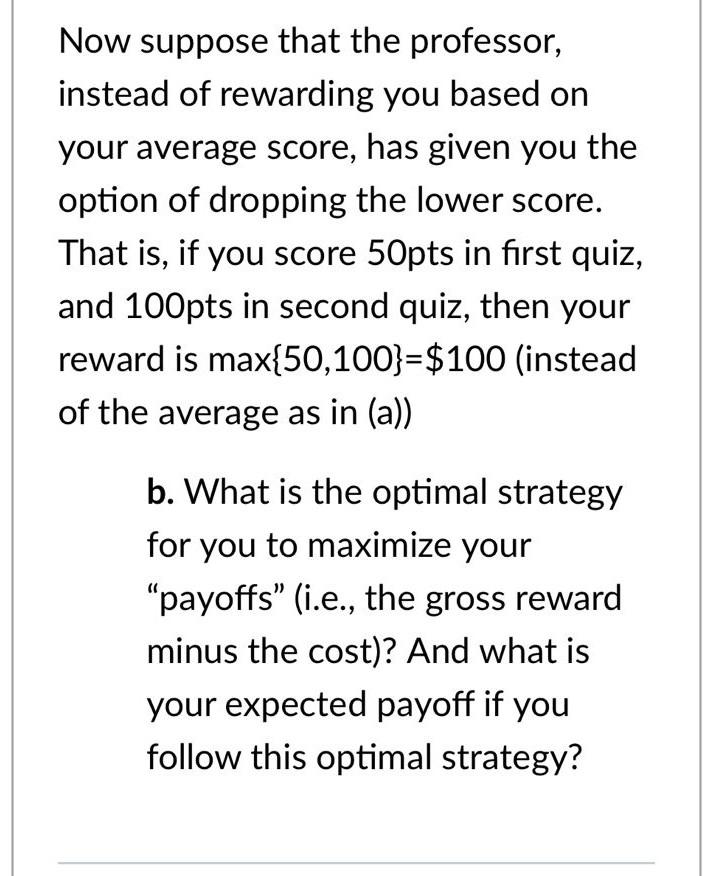
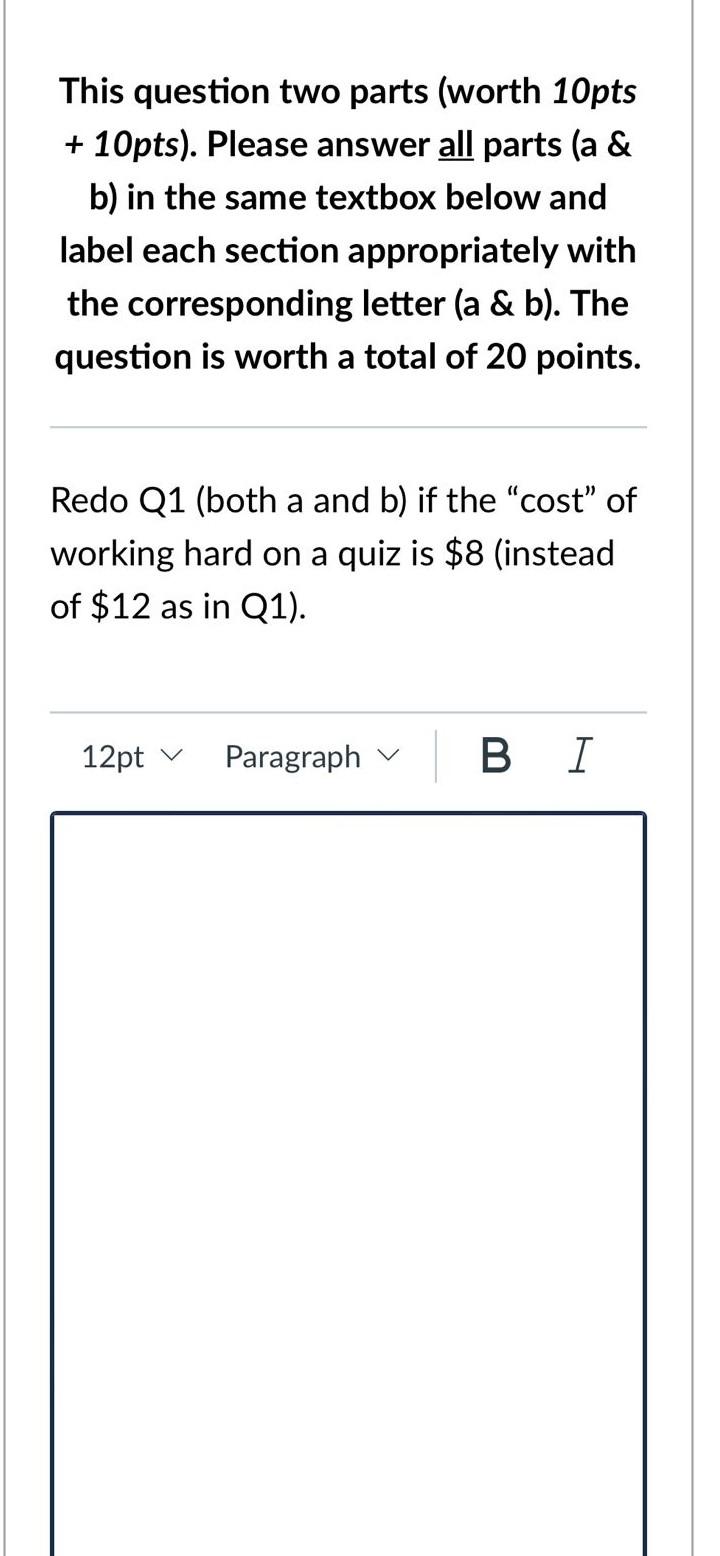
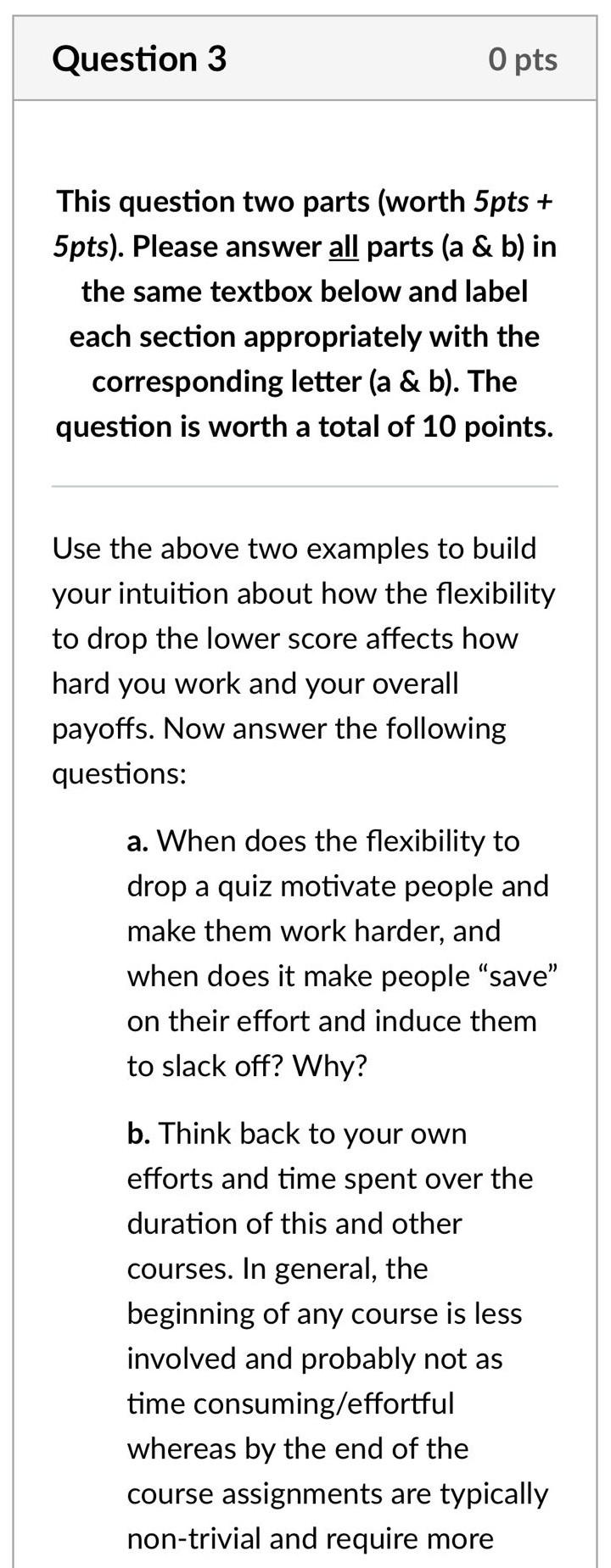
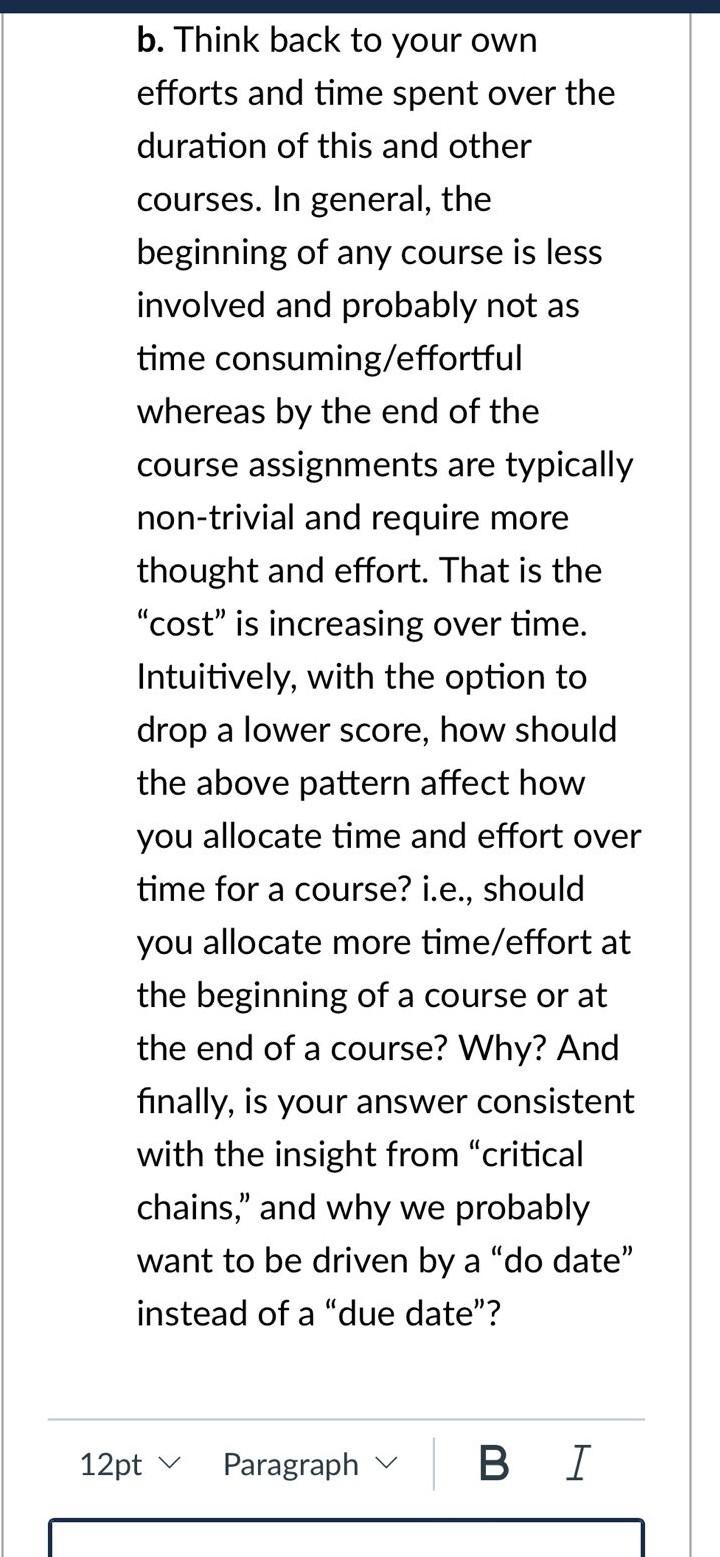
This question two parts (worth 10pts +10 pts). Please answer all parts (a \& b) in the same textbox below and label each section appropriately with the corresponding letter (a&b b). The question is worth a total of 20 points. Consider a UCSD course that you are taking - like the current MGT 172. Suppose you have to take 2 quizzes, sequentially. The two quizzes are distinct: one is about CPM and the other one is about real options. - For any given quiz, if you work hard, you have a 70% chance of making 100pts, and with remaining 30% chance, you will make Opts. - For any given quiz, if you don't work hard, then you have a 30% chance of making 100pts, and with remaining 70% chance, you will make Opts - Working hard for one given quiz affects only the grade of the given quiz, and not the other quiz For the sake of this example, assume that the "cost" of working hard on a quiz is $12; and there is zero cost if you do not work hard. Moreover, you get a reward of $X if your final average score is X. For instance, if you got 100pts in first quiz, and 50pts in the second quiz, then your average score is 75pts, and you receive a reward of $75. Note that this reward is the "gross" reward and doesn't account for the "cost" of putting in a. What is the optimal strategy for you to maximize your "payoffs" (i.e., the gross reward minus the cost)? And what is your expected payoff if you follow this optimal strategy? Note that by "optimal strategy," we mean the work approach that maximizes your payoffs; i.e., the choice of whether to work hard or not and on which quiz. For instance, your strategy could be to work hard on first quiz, and then to work hard on second one only if first score was 100pts; or your strategy could be to not work hard on first quiz, and then to work hard on second one only if first Now suppose that the professor, instead of rewarding you based on your average score, has given you the option of dropping the lower score. That is, if you score 50pts in first quiz, and 100pts in second quiz, then your reward is max{50,100}=$100 (instead of the average as in (a)) b. What is the optimal strategy for you to maximize your "payoffs" (i.e., the gross reward minus the cost)? And what is your expected payoff if you follow this optimal strategy? This question two parts (worth 10pts +10pts ). Please answer all parts (a \& b) in the same textbox below and label each section appropriately with the corresponding letter (a& b). The question is worth a total of 20 points. Redo Q1 (both a and b) if the "cost" of working hard on a quiz is $8 (instead of $12 as in Q1). Question 3 0 pts This question two parts (worth 5pts + 5pts). Please answer all parts (a&b) in the same textbox below and label each section appropriately with the corresponding letter (a&b). The question is worth a total of 10 points. Use the above two examples to build your intuition about how the flexibility to drop the lower score affects how hard you work and your overall payoffs. Now answer the following questions: a. When does the flexibility to drop a quiz motivate people and make them work harder, and when does it make people "save" on their effort and induce them to slack off? Why? b. Think back to your own efforts and time spent over the duration of this and other courses. In general, the beginning of any course is less involved and probably not as time consuming/effortful whereas by the end of the course assignments are typically non-trivial and require more b. Think back to your own efforts and time spent over the duration of this and other courses. In general, the beginning of any course is less involved and probably not as time consuming/effortful whereas by the end of the course assignments are typically non-trivial and require more thought and effort. That is the "cost" is increasing over time. Intuitively, with the option to drop a lower score, how should the above pattern affect how you allocate time and effort over time for a course? i.e., should you allocate more time/effort at the beginning of a course or at the end of a course? Why? And finally, is your answer consistent with the insight from "critical chains," and why we probably want to be driven by a "do date" instead of a "due dateStep by Step Solution
There are 3 Steps involved in it
1 Expert Approved Answer
Step: 1 Unlock

Question Has Been Solved by an Expert!
Get step-by-step solutions from verified subject matter experts
Step: 2 Unlock
Step: 3 Unlock
 Study Help