



Question: Please solve question 1D. (20 points) Redistribution with productivity differences All households have the same preference, where u(c,h)=lnc+2.6lnh. Production only requires labor; labor share is
Please solve question 1D.
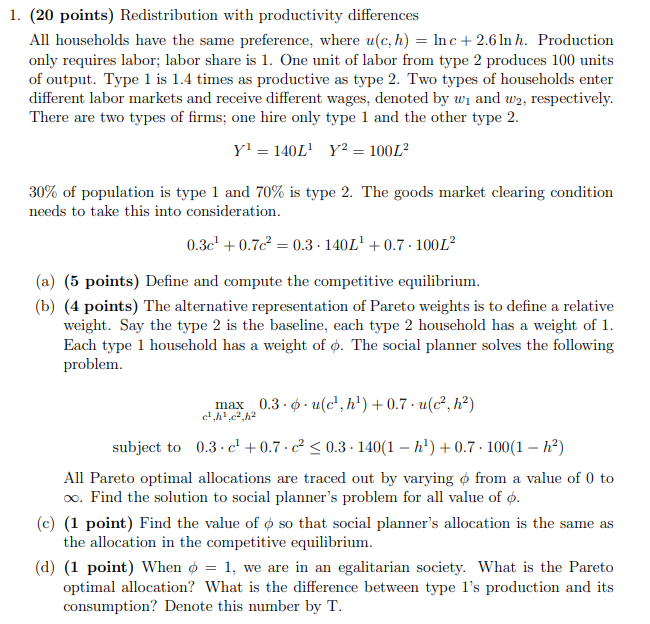
(20 points) Redistribution with productivity differences All households have the same preference, where u(c,h)=lnc+2.6lnh. Production only requires labor; labor share is 1 . One unit of labor from type 2 produces 100 units of output. Type 1 is 1.4 times as productive as type 2 . Two types of households enter different labor markets and receive different wages, denoted by w1 and w2, respectively. There are two types of firms; one hire only type 1 and the other type 2 . Y1=140L1Y2=100L2 30% of population is type 1 and 70% is type 2 . The goods market clearing condition needs to take this into consideration. 0.3c1+0.7c2=0.3140L1+0.7100L2 (a) (5 points) Define and compute the competitive equilibrium. (b) (4 points) The alternative representation of Pareto weights is to define a relative weight. Say the type 2 is the baseline, each type 2 household has a weight of 1 . Each type 1 household has a weight of . The social planner solves the following problem. maxc1,h1,c2,h20.3u(c1,h1)+0.7u(c2,h2) subject to 0.3c1+0.7c20.3140(1h1)+0.7100(1h2) All Pareto optimal allocations are traced out by varying from a value of 0 to . Find the solution to social planner's problem for all value of . (c) (1 point) Find the value of so that social planner's allocation is the same as the allocation in the competitive equilibrium. (d) (1 point) When =1, we are in an egalitarian society. What is the Pareto optimal allocation? What is the difference between type 1's production and its consumption? Denote this number by T. (20 points) Redistribution with productivity differences All households have the same preference, where u(c,h)=lnc+2.6lnh. Production only requires labor; labor share is 1 . One unit of labor from type 2 produces 100 units of output. Type 1 is 1.4 times as productive as type 2 . Two types of households enter different labor markets and receive different wages, denoted by w1 and w2, respectively. There are two types of firms; one hire only type 1 and the other type 2 . Y1=140L1Y2=100L2 30% of population is type 1 and 70% is type 2 . The goods market clearing condition needs to take this into consideration. 0.3c1+0.7c2=0.3140L1+0.7100L2 (a) (5 points) Define and compute the competitive equilibrium. (b) (4 points) The alternative representation of Pareto weights is to define a relative weight. Say the type 2 is the baseline, each type 2 household has a weight of 1 . Each type 1 household has a weight of . The social planner solves the following problem. maxc1,h1,c2,h20.3u(c1,h1)+0.7u(c2,h2) subject to 0.3c1+0.7c20.3140(1h1)+0.7100(1h2) All Pareto optimal allocations are traced out by varying from a value of 0 to . Find the solution to social planner's problem for all value of . (c) (1 point) Find the value of so that social planner's allocation is the same as the allocation in the competitive equilibrium. (d) (1 point) When =1, we are in an egalitarian society. What is the Pareto optimal allocation? What is the difference between type 1's production and its consumption? Denote this number by T
Step by Step Solution
There are 3 Steps involved in it

Get step-by-step solutions from verified subject matter experts