



Question: Please solve question 2 after reviewing supplementation in sec 4.5 example. sec 4.5 example: 1. Read carefully (and check the D3 calculations) the example at
Please solve question 2 after reviewing supplementation in sec 4.5 example.
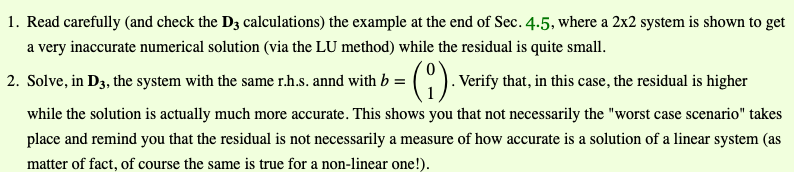
sec 4.5 example:
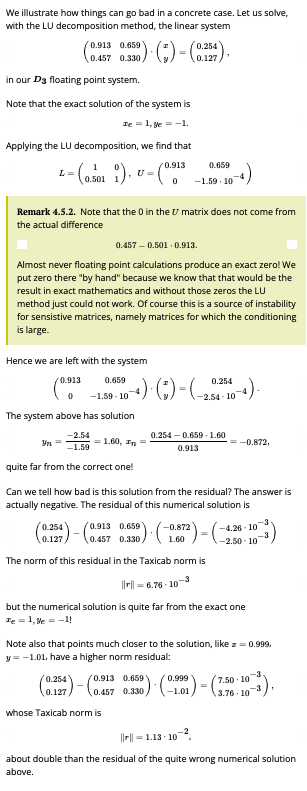
1. Read carefully (and check the D3 calculations) the example at the end of Sec.45, where a 22 system is shown to get a very inaccurate numerical solution (via the LU method) while the residual is quite small. 2. Solve, in D3, the system with the same r.h.s. annd with b=(01). Verify that, in this case, the residual is higher while the solution is actually much more accurate. This shows you that not necessarily the "worst case scenario" takes place and remind you that the residual is not necessarily a measure of how accurate is a solution of a linear system (as matter of fact, of course the same is true for a non-linear one!). We illustrate how things can go bad in a concrete case. Let us solve, with the LU decomposition method, the linear system (0.9130.4570.6590.330)(xy)=(0.2540.127), in our D3 floating point system. Note that the exact solution of the system is xe=1,ze=1. Applying the LU decomposition, we find that L=(10.50101),U=(0.91300.6591.59104) Remark 4.5.2. Note that the 0 in the U matrix does not come from the actual difference 0.4570.5010.913 Almost never floating point calculations produce an exact zero! We put zero there "by hand" because we know that that would be the result in exact mathematics and without those zeros the LU method just could not work. Of course this is a source of instability for sensistive matrices, namely matrices for which the conditioning is large. Hence we are left with the system (0.91300.6591.59104)(xy)=(0.2542.54104). The system above has solution yn=1.592.54=1.60,xn=0.9130.2540.6591.60=0.872, quite far from the correct one! Can we tell how bad is this solution from the residual? The answer is actually negative. The residual of this numerical solution is (0.2540.127)(0.9130.4570.6590.330)(0.8721.60)=(4.261032.50103) The norm of this residual in the Taxicab norm is r=6.76103 but the numerical solution is quite far from the exact one xe=1,ye=1! Note also that points much closer to the solution, like z=0.999. y=1.01, have a higher norm residual: (0.2540.127)(0.9130.4570.6590.330)(0.9991.01)=(7.501033.76103), whose Taxicab norm is r=1.13102, about double than the residual of the quite wrong numerical solution above
Step by Step Solution
There are 3 Steps involved in it

Get step-by-step solutions from verified subject matter experts