







Question: Please solve question 2-9 scripts identifying the chemical species have been dropped for simplicity.) This result, which is valid instantaneously and locally, is equivalent to
Please solve question 2-9
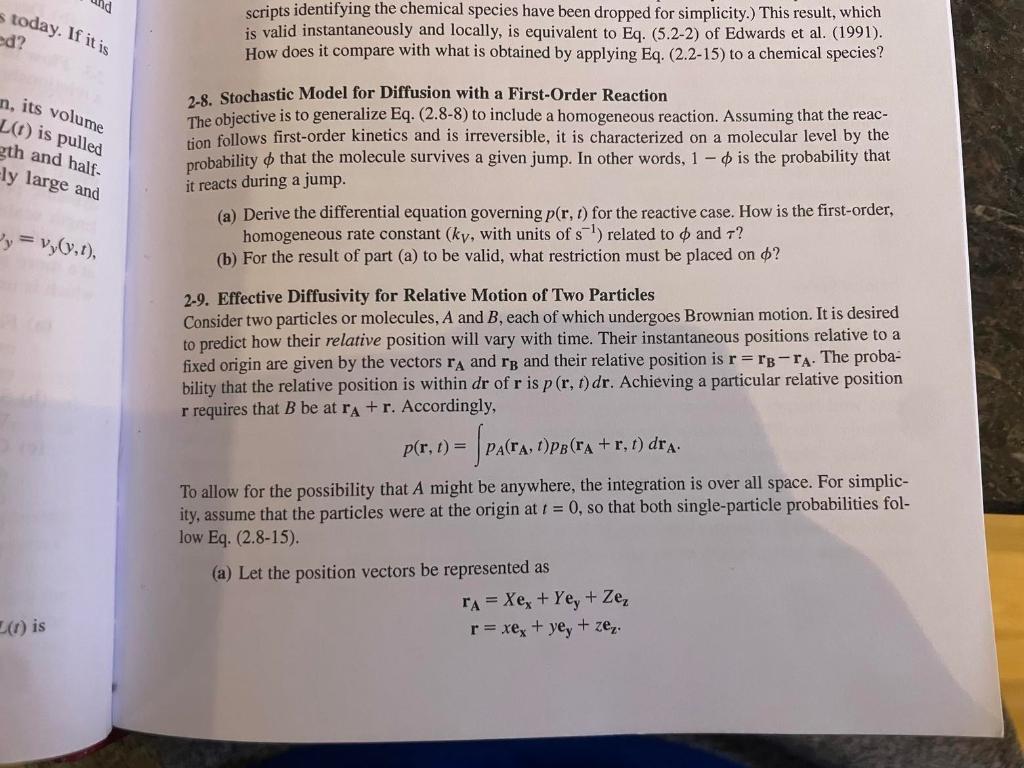
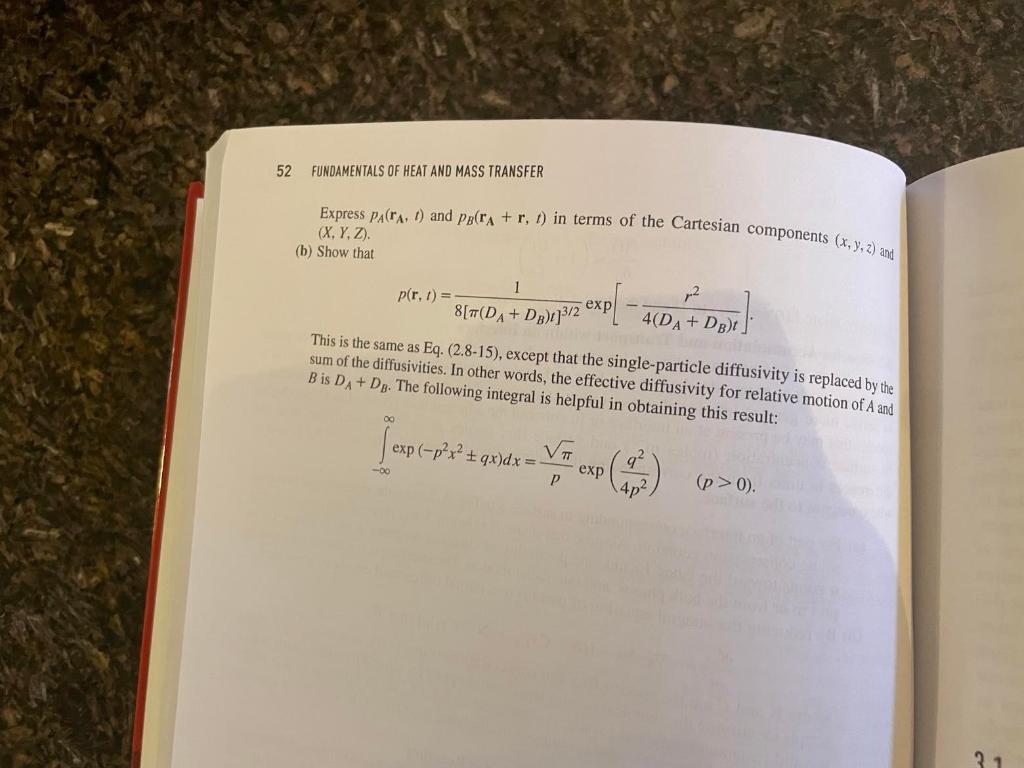
scripts identifying the chemical species have been dropped for simplicity.) This result, which is valid instantaneously and locally, is equivalent to Eq. (5.2-2) of Edwards et al. (1991). How does it compare with what is obtained by applying Eq. (2.2-15) to a chemical species? 2-8. Stochastic Model for Diffusion with a First-Order Reaction The objective is to generalize Eq. (2.8-8) to include a homogeneous reaction. Assuming that the reaction follows first-order kinetics and is irreversible, it is characterized on a molecular level by the probability that the molecule survives a given jump. In other words, 1 is the probability that it reacts during a jump. (a) Derive the differential equation governing p(r,t) for the reactive case. How is the first-order, homogeneous rate constant (kV, with units of s1) related to and ? (b) For the result of part (a) to be valid, what restriction must be placed on ? 2-9. Effective Diffusivity for Relative Motion of Two Particles Consider two particles or molecules, A and B, each of which undergoes Brownian motion. It is desired to predict how their relative position will vary with time. Their instantaneous positions relative to a fixed origin are given by the vectors rA and rB and their relative position is r=rBrA. The probability that the relative position is within dr of r is p(r,t)dr. Achieving a particular relative position r requires that B be at rA+r. Accordingly, p(r,t)=pA(rA,t)pB(rA+r,t)drA. To allow for the possibility that A might be anywhere, the integration is over all space. For simplicity, assume that the particles were at the origin at t=0, so that both single-particle probabilities follow Eq. (2.8-15). (a) Let the position vectors be represented as L(t) is rAr=Xex+Yey+Zez=xex+yey+zez Express pA(rA,t) and pB(rA+r,t) in terms of the Cartesian components (x,y,z) and (X,Y,Z). (b) Show that p(r,t)=8[(DA+DB)t]3/21exp[4(DA+DB)tr2] This is the same as Eq. (2.8-15), except that the single-particle diffusivity is replaced by the sum of the diffusivities. In other words, the effective diffusivity for relative motion of A and B is DA+DB. The following integral is helpful in obtaining this result: exp(p2x2qx)dx=pexp(4p2q2)(p>0)
Step by Step Solution
There are 3 Steps involved in it

Get step-by-step solutions from verified subject matter experts
 Study Help