Question: please solve step by step Problem 6. (Markov Chains) (Choosing Balls from an Urn) An urn contains two unpainted balls at present. We choose a
please solve step by step
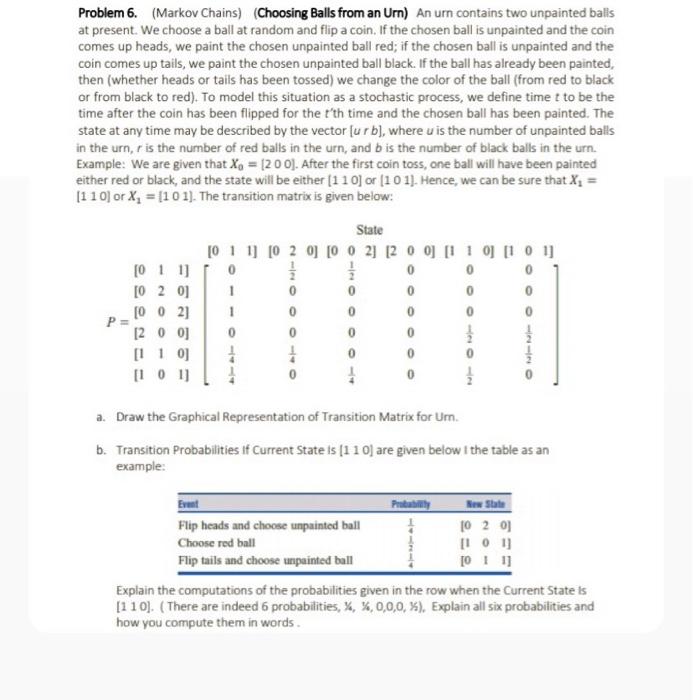
Problem 6. (Markov Chains) (Choosing Balls from an Urn) An urn contains two unpainted balls at present. We choose a ball at random and flip a coin. If the chosen ball is unpainted and the coin comes up heads, we paint the chosen unpainted ball red; if the chosen ball is unpainted and the coin comes up tails, we paint the chosen unpainted ball black. If the ball has already been painted, then (whether heads or tails has been tossed) we change the color of the ball (from red to black or from black to red). To model this situation as a stochastic process, we define time t to be the time after the coin has been flipped for the t'th time and the chosen ball has been painted. The state at any time may be described by the vector (urb), where u is the number of unpainted balls in the urn, r is the number of red balls in the urn, and b is the number of black balls in the urn. Example: We are given that Xo = [200]. After the first coin toss, one ball will have been painted either red or black, and the state will be either (110] or [101]. Hence, we can be sure that X; = [110 or X, = [101]. The transition matrix is given below: State 0 0 0 1 0 0 0 0 0 1 1 10 2 0 0 0 21 12 0 1 1 0 1 0 1 10 1 1 0 [O 20 [002] P= [200] [1 1 0 110 11 1 0 0 0 0 0 0 0 0 0 0 O a. Draw the Graphical Representation of Transition Matrix for Um. b. Transition Probabilities of Current state is [110] are given below I the table as an example: New State Flip heads and choose unpainted ball Choose red ball 10 2 O [101] LOI 11 Flip tails and choose unpainted ball Explain the computations of the probabilities given in the row when the Current State is [110]. (There are indeed 6 probabilities, %, %,0,0,0,%). Explain all six probabilities and how you compute them in words. Problem 6. (Markov Chains) (Choosing Balls from an Urn) An urn contains two unpainted balls at present. We choose a ball at random and flip a coin. If the chosen ball is unpainted and the coin comes up heads, we paint the chosen unpainted ball red; if the chosen ball is unpainted and the coin comes up tails, we paint the chosen unpainted ball black. If the ball has already been painted, then (whether heads or tails has been tossed) we change the color of the ball (from red to black or from black to red). To model this situation as a stochastic process, we define time t to be the time after the coin has been flipped for the t'th time and the chosen ball has been painted. The state at any time may be described by the vector (urb), where u is the number of unpainted balls in the urn, r is the number of red balls in the urn, and b is the number of black balls in the urn. Example: We are given that Xo = [200]. After the first coin toss, one ball will have been painted either red or black, and the state will be either (110] or [101]. Hence, we can be sure that X; = [110 or X, = [101]. The transition matrix is given below: State 0 0 0 1 0 0 0 0 0 1 1 10 2 0 0 0 21 12 0 1 1 0 1 0 1 10 1 1 0 [O 20 [002] P= [200] [1 1 0 110 11 1 0 0 0 0 0 0 0 0 0 0 O a. Draw the Graphical Representation of Transition Matrix for Um. b. Transition Probabilities of Current state is [110] are given below I the table as an example: New State Flip heads and choose unpainted ball Choose red ball 10 2 O [101] LOI 11 Flip tails and choose unpainted ball Explain the computations of the probabilities given in the row when the Current State is [110]. (There are indeed 6 probabilities, %, %,0,0,0,%). Explain all six probabilities and how you compute them in words









 Study Help