







Question: please solve step by step, thanks in advance. i will report it and spam if you post something unrelated. Question 1. (15 marks) In this
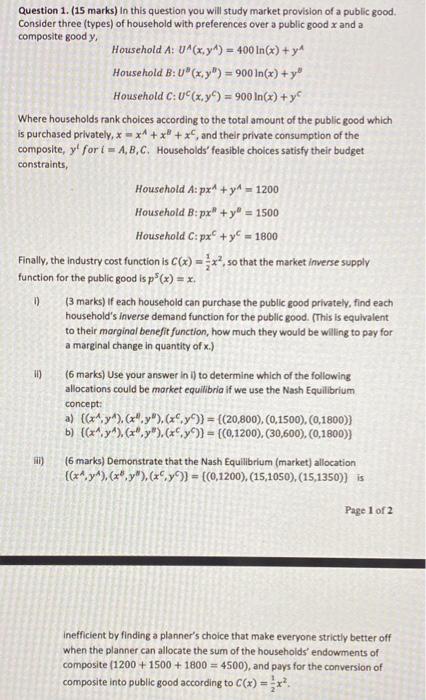
Question 1. (15 marks) In this question you will study market provision of a public good. Consider three (types) of household with preferences over a public good x and a composite good y Household A: U^(x,y) - 400 in(x) + ya Household B:V"(x,y) = 900In(x) + y Household C: U(x,y) = 900 In(x) + yo Where households rank choices according to the total amount of the public good which is purchased privately, * =** + x + x, and their private consumption of the composite, y' for i=1,B,C. Households' feasible choices satisfy their budget constraints, Household A: px + y = 1200 Household B:px" + y = 1500 Household C: px + y = 1800 Finally, the Industry cost function is C(x) = **, so that the market inverse supply function for the public good is p'(x) = x. (3 marks) If each household can purchase the public good privately, find each household's inverse demand function for the public good. (This is equivalent to their marginal benefit function, how much they would be willing to pay for a marginal change in quantity of x.) HI) (6 marks) Use your answer in i) to determine which of the following allocations could be market equilibria if we use the Nash Equilibrium concept: a) [(*y),(x,y").(z.y)} = {(20,800),(0,1500),(0,1800)} b) (x,y),(x",y").(x,y)) = (0,1200). (30,600),(0,1800)) ) (6 marks) Demonstrate that the Nash Equilibrium (market) allocation [(x*,y),(x",y"), (x,y) = ((0,1200). (15,1050). (15,1350)) is D Page 1 of 2 inefficient by finding a planner's choice that make everyone strictly better off when the planner can allocate the sum of the households' endowments of composite (1200 + 1500 + 1800 = 4500), and pays for the conversion of composite into public good according to C(x) =***. Question 1. (15 marks) In this question you will study market provision of a public good. Consider three (types) of household with preferences over a public good x and a composite good y Household A: U^(x,y) - 400 in(x) + ya Household B:V"(x,y) = 900In(x) + y Household C: U(x,y) = 900 In(x) + yo Where households rank choices according to the total amount of the public good which is purchased privately, * =** + x + x, and their private consumption of the composite, y' for i=1,B,C. Households' feasible choices satisfy their budget constraints, Household A: px + y = 1200 Household B:px" + y = 1500 Household C: px + y = 1800 Finally, the Industry cost function is C(x) = **, so that the market inverse supply function for the public good is p'(x) = x. (3 marks) If each household can purchase the public good privately, find each household's inverse demand function for the public good. (This is equivalent to their marginal benefit function, how much they would be willing to pay for a marginal change in quantity of x.) HI) (6 marks) Use your answer in i) to determine which of the following allocations could be market equilibria if we use the Nash Equilibrium concept: a) [(*y),(x,y").(z.y)} = {(20,800),(0,1500),(0,1800)} b) (x,y),(x",y").(x,y)) = (0,1200). (30,600),(0,1800)) ) (6 marks) Demonstrate that the Nash Equilibrium (market) allocation [(x*,y),(x",y"), (x,y) = ((0,1200). (15,1050). (15,1350)) is D Page 1 of 2 inefficient by finding a planner's choice that make everyone strictly better off when the planner can allocate the sum of the households' endowments of composite (1200 + 1500 + 1800 = 4500), and pays for the conversion of composite into public good according to C(x) =***
Step by Step Solution
There are 3 Steps involved in it

Get step-by-step solutions from verified subject matter experts
 Study Help