







Question: PLEASE SOLVE THE 5 -> 10 FOR ME ^^ NE RIEN INSCRIRE DANS CE CADRE Exercise (14 points) Consider a country operating under fixed exchange
PLEASE SOLVE THE 5 -> 10 FOR ME ^^
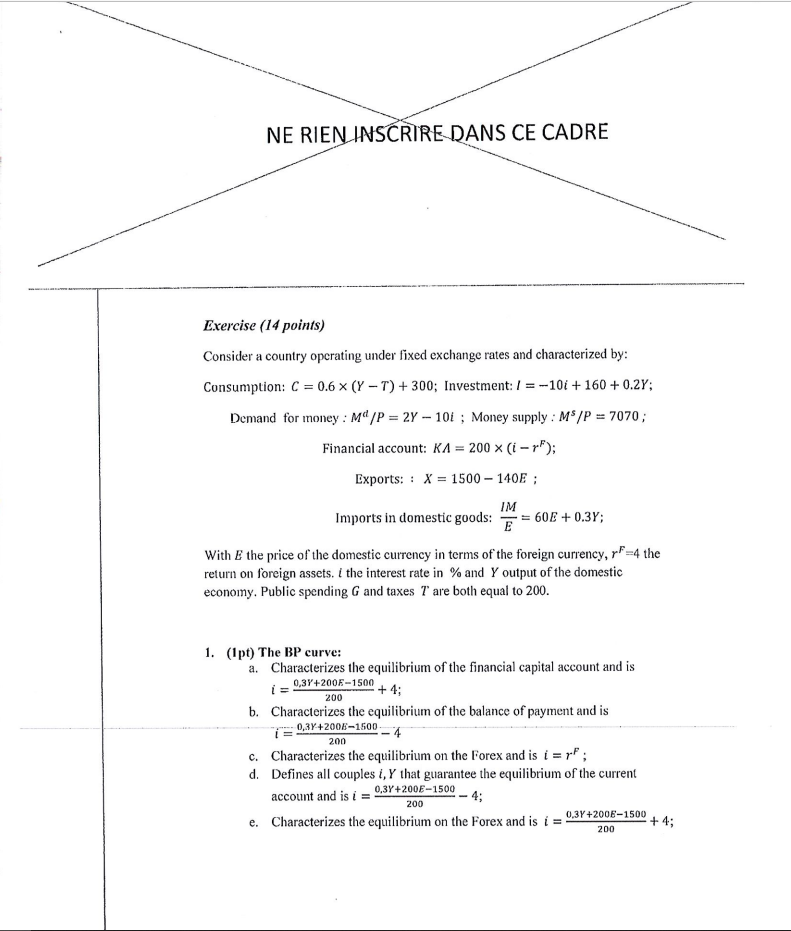
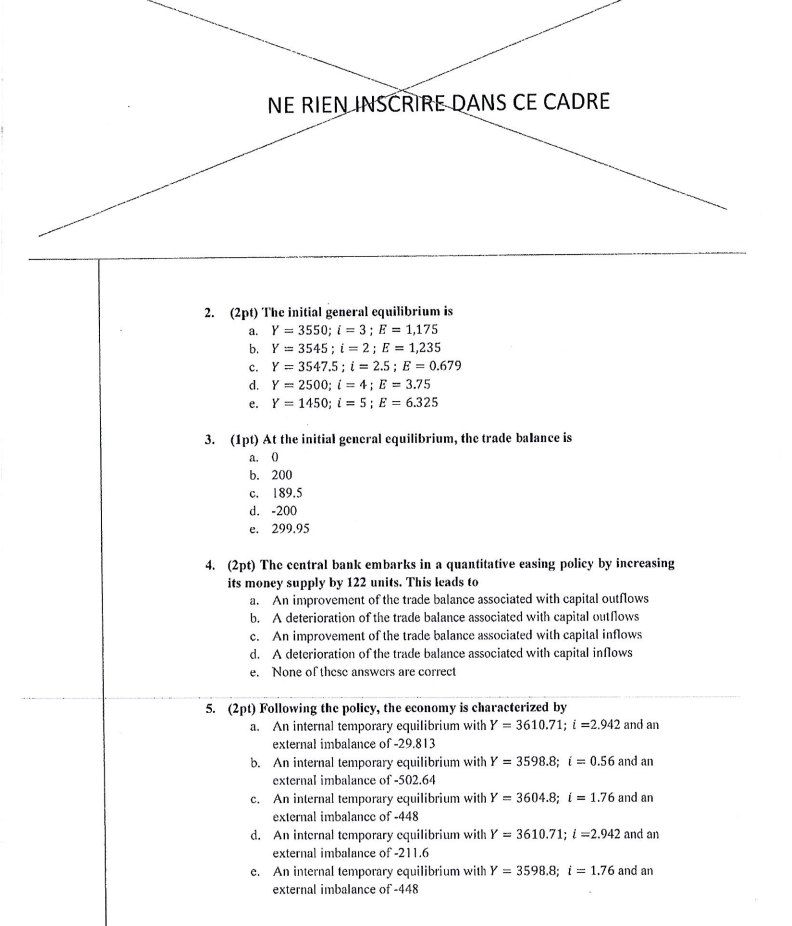
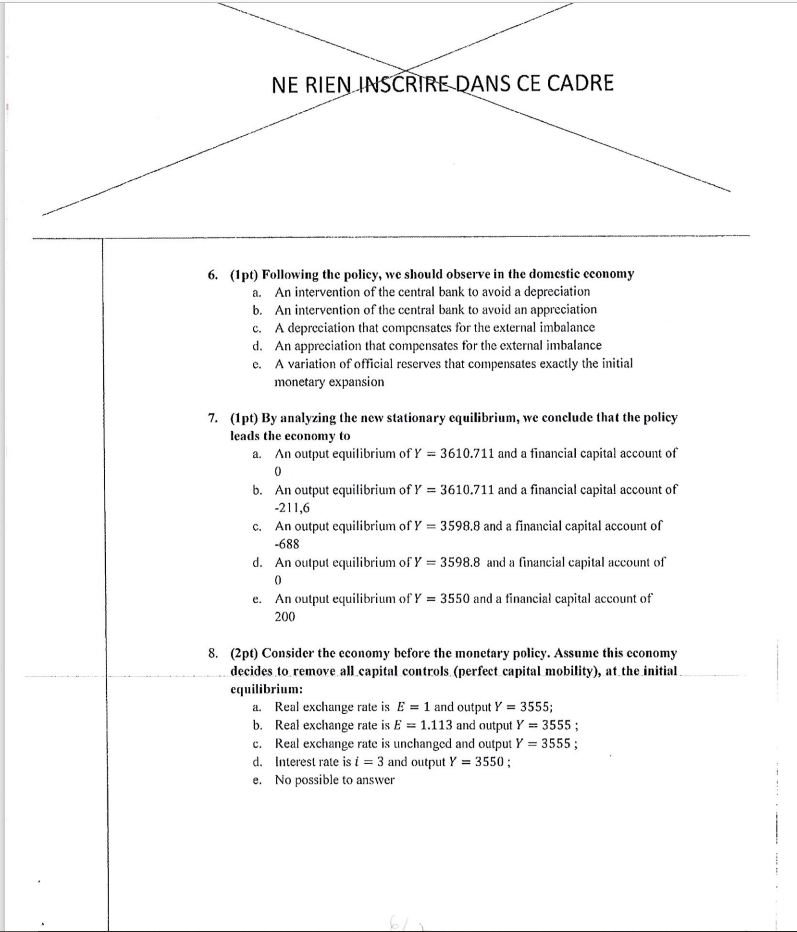
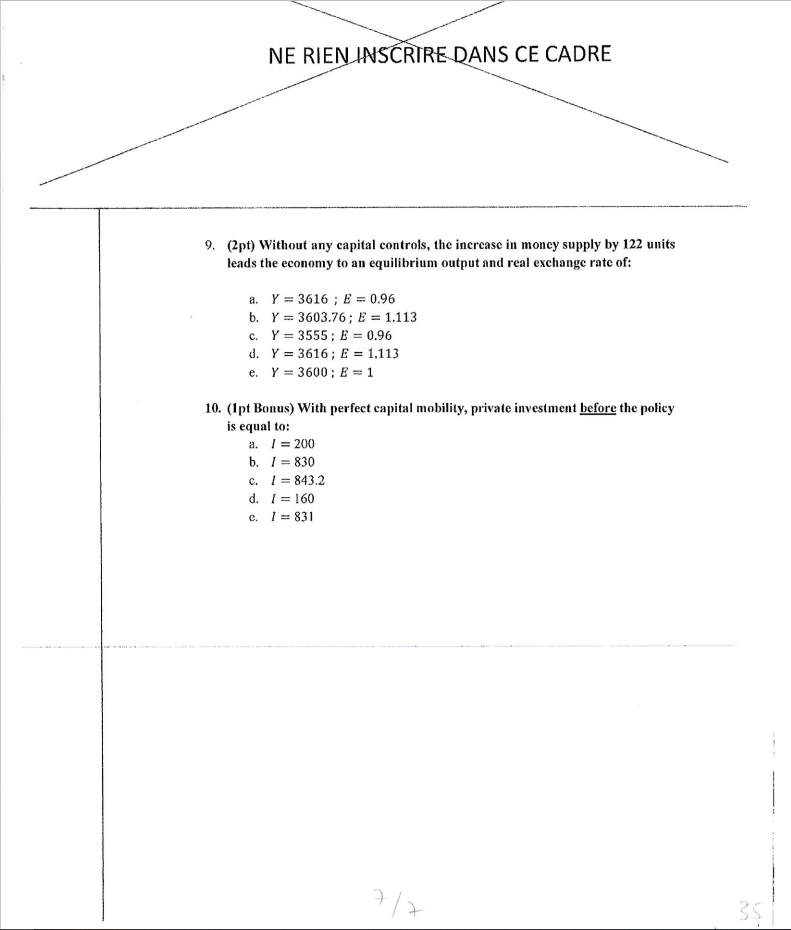
NE RIEN INSCRIRE DANS CE CADRE Exercise (14 points) Consider a country operating under fixed exchange rates and characterized by: Consumption: C = 0.6 x (Y - T) + 300; Investment: / = -101 +160+ 0.27; Demand for money : "/P = 2Y - 101: Money supply: M$ /P = 7070; Financial account: KA = 200 X (i - r"); Exports: : X = 1500 - 140E ; Imports in domestic goods: IM = 60E+0.3Y; E With the price of the domestic currency in terms of the foreign currency, p=4 the return on foreign assets. the interest rate in % and Youtput of the domestic economy. Public spending and taxes 7' are both equal to 200. 1. (pt) The BP curve: a. Characterizes the equilibrium of the financial capital account and is 0,3Y+200-1500 4; b. Characterizes the equilibrium of the balance of payment and is T = 0,38+20081500 200 200 c. Characterizes the equilibrium on the l'orex and is i = r; d. Defines all couples i,Y that guarantee the equilibrium of the current account and is i = 0,3Y+200-1500 200 e. Characterizes the equilibrium on the Forex and is i = 0,38 +20081500 + 4; 200 NE RIEN INSCRIRE DANS CE CADRE 2. (2p) The initial general equilibrium is a. Y = 3550; i = 3; E = 1,175 b. Y = 3545; i = 2; E = 1,235 c. Y= 3547.5; i = 2.5; E = 0.679 d. Y = 2500; ( = 4; E = 3.75 e. Y = 1450; i = 5; E = 6.325 3. (1 pt) At the initial general equilibrium, the trade balance a. O b. 200 c. 189.5 d. -200 e. 299.95 4. (2pt) The central bank embarks in a quantitative easing policy by increasing its money supply by 122 units. This leads to a. An improvement of the trade balance associated with capital outflows b. A deterioration of the trade balance associated with capital outflows c. An improvement of the trade balance associated with capital inflows d. A deterioration of the trade balance associated with capital inflows e. None of these answers are correct 5. (2pt) Following the policy, the economy is characterized by a. An internal temporary equilibrium with Y = 3610.71; i =2.942 and an external imbalance of -29.813 b. An internal temporary equilibrium with Y = 3598.8; i = 0.56 and an external imbalance of -502.64 c. An internal temporary equilibrium with Y = 3604.8; i = 1.76 and an external imbalance of -448 d. An internal temporary equilibrium with Y = 3610.71; i =2.942 and an external imbalance of -2116 e. An internal temporary equilibrium with Y = 3598.8; i = 1.76 and an external imbalance of-448 NE RIEN INSCRIRE DANS CE CADRE 6. (1pt) Following the policy, we should observe in the domestic economy a. An intervention of the central bank to avoid a depreciation b. An intervention of the central bank to avoid an appreciation c. A depreciation that compensates for the external imbalance d. An appreciation that compensates for the external imbalance e. A variation of official reserves that compensates exactly the initial monetary expansion 7. (1pt) By analyzing the new stationary equilibrium, we conclude that the policy leads the economy to An output equilibrium of Y = 3610.711 and a financial capital account of a. 0 b. An output equilibrium of Y = 3610.711 and a financial capital account of -211,6 c. An output equilibrium of Y = 3598.8 and a financial capital account of -688 d. An output equilibrium of Y = 3598.8 and a financial capital account of 0 e. An output equilibrium of Y = 3550 and a financial capital account of 200 8. (2pt) Consider the economy before the monetary policy. Assume this economy decides to remove all capital controls (perfect capital mobility), at the initial equilibrium: a. Real exchange rate is E = 1 and output Y = 3555; b. Real exchange rate is E = 1.113 and output Y = 3555 ; c. Real exchange rate is unchanged and output Y = 3555; d. Interest rate is i = 3 and output Y = 3550 ; e. No possible to answer NE RIEN INSCRIRE DANS CE CADRE 9. (2pt) Without any capital controls, the increase in money supply by 122 units leads the economy to an equilibrium output and real exchange rate of: a. Y = 3616; B = 0.96 b. Y = 3603.76; E = 1.113 c. Y = 3555; E = 0.96 d. Y = 3616; E = 1.113 e. Y = 3600; E = 1 10. (1pt Bonus) With perfect capital mobility, private investment before the policy is equal to: a. 1 = 200 b. 1 = 830 c. 1 = 843.2 d. 1 = 160 e. 1 = 831 7/7 35 NE RIEN INSCRIRE DANS CE CADRE Exercise (14 points) Consider a country operating under fixed exchange rates and characterized by: Consumption: C = 0.6 x (Y - T) + 300; Investment: / = -101 +160+ 0.27; Demand for money : "/P = 2Y - 101: Money supply: M$ /P = 7070; Financial account: KA = 200 X (i - r"); Exports: : X = 1500 - 140E ; Imports in domestic goods: IM = 60E+0.3Y; E With the price of the domestic currency in terms of the foreign currency, p=4 the return on foreign assets. the interest rate in % and Youtput of the domestic economy. Public spending and taxes 7' are both equal to 200. 1. (pt) The BP curve: a. Characterizes the equilibrium of the financial capital account and is 0,3Y+200-1500 4; b. Characterizes the equilibrium of the balance of payment and is T = 0,38+20081500 200 200 c. Characterizes the equilibrium on the l'orex and is i = r; d. Defines all couples i,Y that guarantee the equilibrium of the current account and is i = 0,3Y+200-1500 200 e. Characterizes the equilibrium on the Forex and is i = 0,38 +20081500 + 4; 200 NE RIEN INSCRIRE DANS CE CADRE 2. (2p) The initial general equilibrium is a. Y = 3550; i = 3; E = 1,175 b. Y = 3545; i = 2; E = 1,235 c. Y= 3547.5; i = 2.5; E = 0.679 d. Y = 2500; ( = 4; E = 3.75 e. Y = 1450; i = 5; E = 6.325 3. (1 pt) At the initial general equilibrium, the trade balance a. O b. 200 c. 189.5 d. -200 e. 299.95 4. (2pt) The central bank embarks in a quantitative easing policy by increasing its money supply by 122 units. This leads to a. An improvement of the trade balance associated with capital outflows b. A deterioration of the trade balance associated with capital outflows c. An improvement of the trade balance associated with capital inflows d. A deterioration of the trade balance associated with capital inflows e. None of these answers are correct 5. (2pt) Following the policy, the economy is characterized by a. An internal temporary equilibrium with Y = 3610.71; i =2.942 and an external imbalance of -29.813 b. An internal temporary equilibrium with Y = 3598.8; i = 0.56 and an external imbalance of -502.64 c. An internal temporary equilibrium with Y = 3604.8; i = 1.76 and an external imbalance of -448 d. An internal temporary equilibrium with Y = 3610.71; i =2.942 and an external imbalance of -2116 e. An internal temporary equilibrium with Y = 3598.8; i = 1.76 and an external imbalance of-448 NE RIEN INSCRIRE DANS CE CADRE 6. (1pt) Following the policy, we should observe in the domestic economy a. An intervention of the central bank to avoid a depreciation b. An intervention of the central bank to avoid an appreciation c. A depreciation that compensates for the external imbalance d. An appreciation that compensates for the external imbalance e. A variation of official reserves that compensates exactly the initial monetary expansion 7. (1pt) By analyzing the new stationary equilibrium, we conclude that the policy leads the economy to An output equilibrium of Y = 3610.711 and a financial capital account of a. 0 b. An output equilibrium of Y = 3610.711 and a financial capital account of -211,6 c. An output equilibrium of Y = 3598.8 and a financial capital account of -688 d. An output equilibrium of Y = 3598.8 and a financial capital account of 0 e. An output equilibrium of Y = 3550 and a financial capital account of 200 8. (2pt) Consider the economy before the monetary policy. Assume this economy decides to remove all capital controls (perfect capital mobility), at the initial equilibrium: a. Real exchange rate is E = 1 and output Y = 3555; b. Real exchange rate is E = 1.113 and output Y = 3555 ; c. Real exchange rate is unchanged and output Y = 3555; d. Interest rate is i = 3 and output Y = 3550 ; e. No possible to answer NE RIEN INSCRIRE DANS CE CADRE 9. (2pt) Without any capital controls, the increase in money supply by 122 units leads the economy to an equilibrium output and real exchange rate of: a. Y = 3616; B = 0.96 b. Y = 3603.76; E = 1.113 c. Y = 3555; E = 0.96 d. Y = 3616; E = 1.113 e. Y = 3600; E = 1 10. (1pt Bonus) With perfect capital mobility, private investment before the policy is equal to: a. 1 = 200 b. 1 = 830 c. 1 = 843.2 d. 1 = 160 e. 1 = 831 7/7 35
Step by Step Solution
There are 3 Steps involved in it

Get step-by-step solutions from verified subject matter experts
 Study Help