







Question: Please solve the case study Google Started in the late 1990s, Google grew rapidly to become one of the leading companies in the wo rld.
Please solve the case study
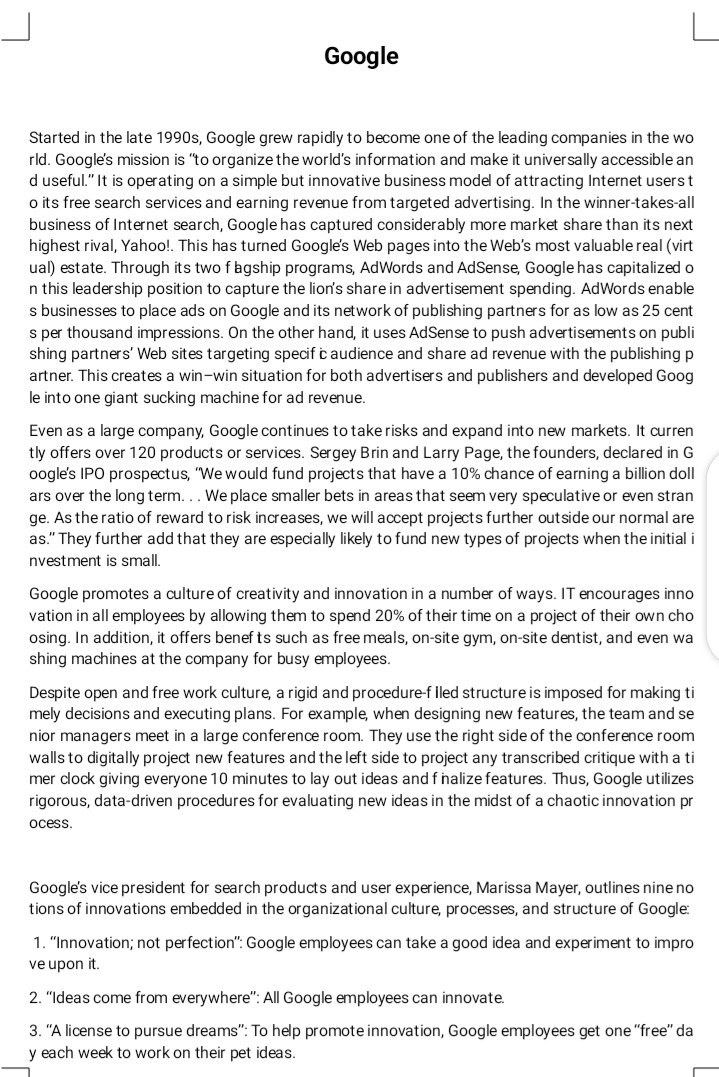
Google Started in the late 1990s, Google grew rapidly to become one of the leading companies in the wo rld. Google's mission is "to organize the world's information and make it universally accessible an d useful." It is operating on a simple but innovative business model of attracting Internet userst o its free search services and earning revenue from targeted advertising. In the winner-takes-all business of Internet search, Google has captured considerably more market share than its next highest rival, Yahoo!. This has turned Google's Web pages into the Web's most valuable real (virt ual) estate. Through its two fagship programs, AdWords and AdSense, Google has capitalized o In this leadership position to capture the lion's share in advertisement spending. AdWords enable s businesses to place ads on Google and its network of publishing partners for as low as 25 cent s per thousand impressions. On the other hand, it uses AdSense to push advertisements on publi shing partners' Web sites targeting specif c audience and share ad revenue with the publishing p artner. This creates a win-win situation for both advertisers and publishers and developed Goog le into one giant sucking machine for ad revenue. Even as a large company, Google continues to take risks and expand into new markets. It curren tly offers over 120 products or services. Sergey Brin and Larry Page, the founders, declared in G oogle's IPO prospectus, 'We would fund projects that have a 10% chance of earning a billion doll ars over the long term... We place smaller bets in areas that seem very speculative or even stran ge. As the ratio of reward to risk increases, we will accept projects further outside our normal are as." They further add that they are especially likely to fund new types of projects when the initial i nvestment is small. Google promotes a culture of creativity and innovation in a number of ways. IT encourages inno vation in all employees by allowing them to spend 20% of their time on a project of their own cho osing. In addition, it offers benef ts such as free meals, on-site gym, on-site dentist, and even wa shing machines at the company for busy employees. Despite open and free work culture, a rigid and procedure-filed structure is imposed for making ti mely decisions and executing plans. For example, when designing new features, the team and se nior managers meet in a large conference room. They use the right side of the conference room walls to digitally project new features and the left side to project any transcribed critique with a ti mer clock giving everyone 10 minutes to lay out ideas and finalize features. Thus, Google utilizes rigorous, data-driven procedures for evaluating new ideas in the midst of a chaotic innovation pr ocess. Google's vice president for search products and user experience, Marissa Mayer, outlines nine no tions of innovations embedded in the organizational culture, processes, and structure of Google: 1. "Innovation; not perfection": Google employees can take a good idea and experiment to impro ve upon it. 2. "Ideas come from everywhere": All Google employees can innovate. 3. "A license to pursue dreams: To help promote innovation, Google employees get one "free" da y each week to work on their pet ideasStep by Step Solution
There are 3 Steps involved in it
1 Expert Approved Answer
Step: 1 Unlock

Question Has Been Solved by an Expert!
Get step-by-step solutions from verified subject matter experts
Step: 2 Unlock
Step: 3 Unlock
 Study Help