







Question: ## Please solve the question 2 in solver and show me all functions thank you!!! In December 2007, Sanjay Gupta and his management team were
## Please solve the question 2 in solver and show me all functions thank you!!!
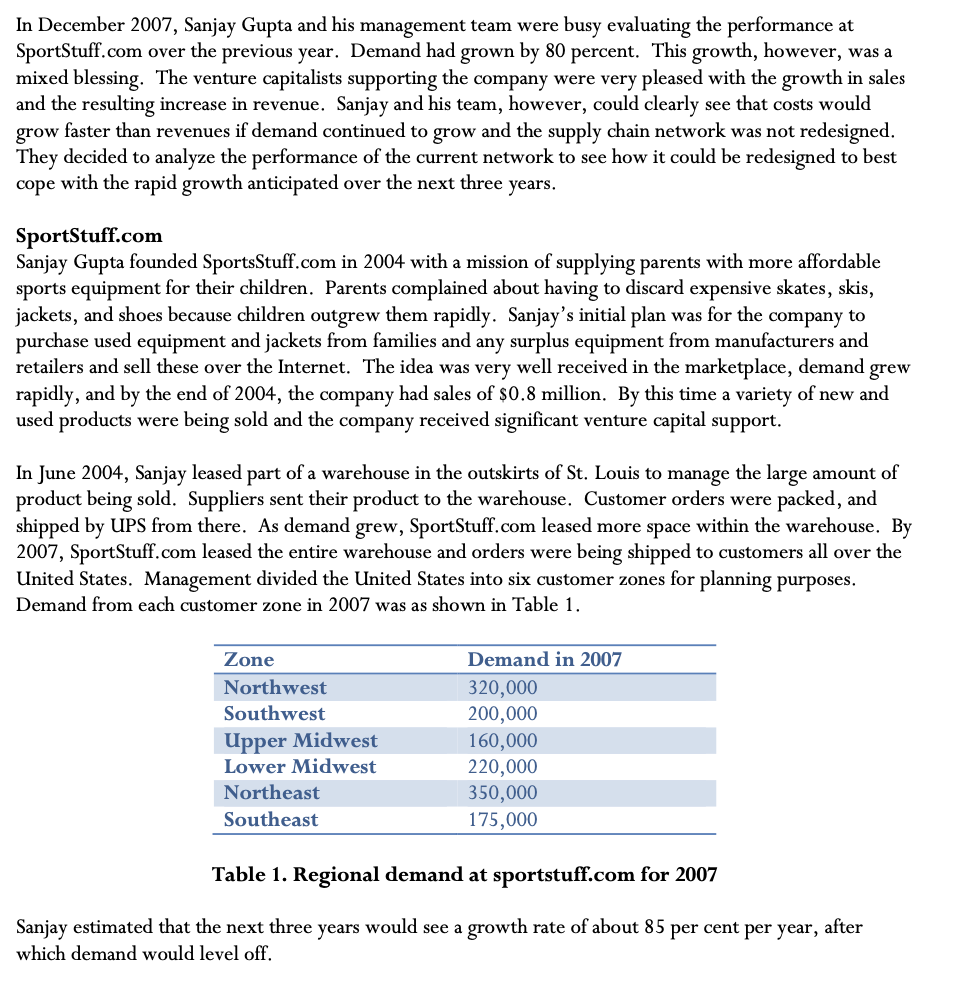
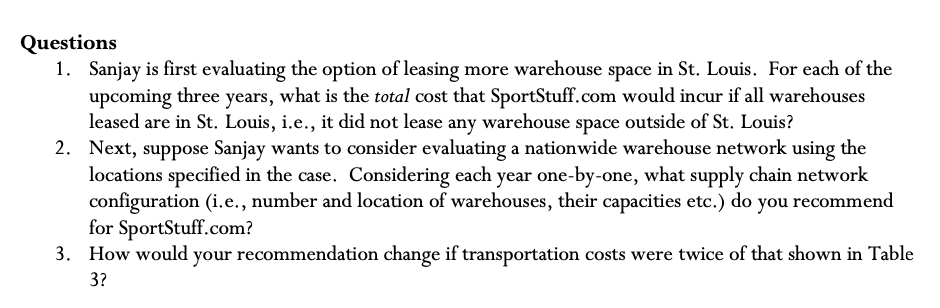
In December 2007, Sanjay Gupta and his management team were busy evaluating the performance at SportStuff.com over the previous year. Demand had grown by 80 percent. This growth, however, was a mixed blessing. The venture capitalists supporting the company were very pleased with the growth in sales and the resulting increase in revenue. Sanjay and his team, however, could clearly see that costs would grow faster than revenues if demand continued to grow and the supply chain network was not redesigned. They decided to analyze the performance of the current network to see how it could be redesigned to best cope with the rapid growth anticipated over the next three years. SportStuff.com Sanjay Gupta founded SportsStuff.com in 2004 with a mission of supplying parents with more affordable sports equipment for their children. Parents complained about having to discard expensive skates, skis, jackets, and shoes because children outgrew them rapidly. Sanjay's initial plan was for the company to purchase used equipment and jackets from families and any surplus equipment from manufacturers and retailers and sell these over the Internet. The idea was very well received in the marketplace, demand grew rapidly, and by the end of 2004, the company had sales of $0.8 million. By this time a variety of new and used products were being sold and the company received significant venture capital support. In June 2004, Sanjay leased part of a warehouse in the outskirts of St. Louis to manage the large amount of product being sold. Suppliers sent their product to the warehouse. Customer orders were packed, and shipped by UPS from there. As demand grew, SportStuff.com leased more space within the warehouse. By 2007, SportStuff.com leased the entire warehouse and orders were being shipped to customers all over the United States. Management divided the United States into six customer zones for planning purposes. Demand from each customer zone in 2007 was as shown in Table 1. Table 1. Regional demand at sportstuff.com for 2007 Sanjay estimated that the next three years would see a growth rate of about 85 per cent per year, after which demand would level off. Questions 1. Sanjay is first evaluating the option of leasing more warehouse space in St. Louis. For each of the upcoming three years, what is the total cost that SportStuff.com would incur if all warehouses leased are in St. Louis, i.e., it did not lease any warehouse space outside of St. Louis? 2. Next, suppose Sanjay wants to consider evaluating a nationwide warehouse network using the locations specified in the case. Considering each year one-by-one, what supply chain network configuration (i.e., number and location of warehouses, their capacities etc.) do you recommend for SportStuff.com? 3. How would your recommendation change if transportation costs were twice of that shown in Table 3 ? In December 2007, Sanjay Gupta and his management team were busy evaluating the performance at SportStuff.com over the previous year. Demand had grown by 80 percent. This growth, however, was a mixed blessing. The venture capitalists supporting the company were very pleased with the growth in sales and the resulting increase in revenue. Sanjay and his team, however, could clearly see that costs would grow faster than revenues if demand continued to grow and the supply chain network was not redesigned. They decided to analyze the performance of the current network to see how it could be redesigned to best cope with the rapid growth anticipated over the next three years. SportStuff.com Sanjay Gupta founded SportsStuff.com in 2004 with a mission of supplying parents with more affordable sports equipment for their children. Parents complained about having to discard expensive skates, skis, jackets, and shoes because children outgrew them rapidly. Sanjay's initial plan was for the company to purchase used equipment and jackets from families and any surplus equipment from manufacturers and retailers and sell these over the Internet. The idea was very well received in the marketplace, demand grew rapidly, and by the end of 2004, the company had sales of $0.8 million. By this time a variety of new and used products were being sold and the company received significant venture capital support. In June 2004, Sanjay leased part of a warehouse in the outskirts of St. Louis to manage the large amount of product being sold. Suppliers sent their product to the warehouse. Customer orders were packed, and shipped by UPS from there. As demand grew, SportStuff.com leased more space within the warehouse. By 2007, SportStuff.com leased the entire warehouse and orders were being shipped to customers all over the United States. Management divided the United States into six customer zones for planning purposes. Demand from each customer zone in 2007 was as shown in Table 1. Table 1. Regional demand at sportstuff.com for 2007 Sanjay estimated that the next three years would see a growth rate of about 85 per cent per year, after which demand would level off. Questions 1. Sanjay is first evaluating the option of leasing more warehouse space in St. Louis. For each of the upcoming three years, what is the total cost that SportStuff.com would incur if all warehouses leased are in St. Louis, i.e., it did not lease any warehouse space outside of St. Louis? 2. Next, suppose Sanjay wants to consider evaluating a nationwide warehouse network using the locations specified in the case. Considering each year one-by-one, what supply chain network configuration (i.e., number and location of warehouses, their capacities etc.) do you recommend for SportStuff.com? 3. How would your recommendation change if transportation costs were twice of that shown in Table 3
Step by Step Solution
There are 3 Steps involved in it

Get step-by-step solutions from verified subject matter experts
 Study Help