







Question: Please solve the question like in the example. 12.4-5. Equilibrium in Ion Exchange of NH for H+. For the case where the cation NHZ (A)
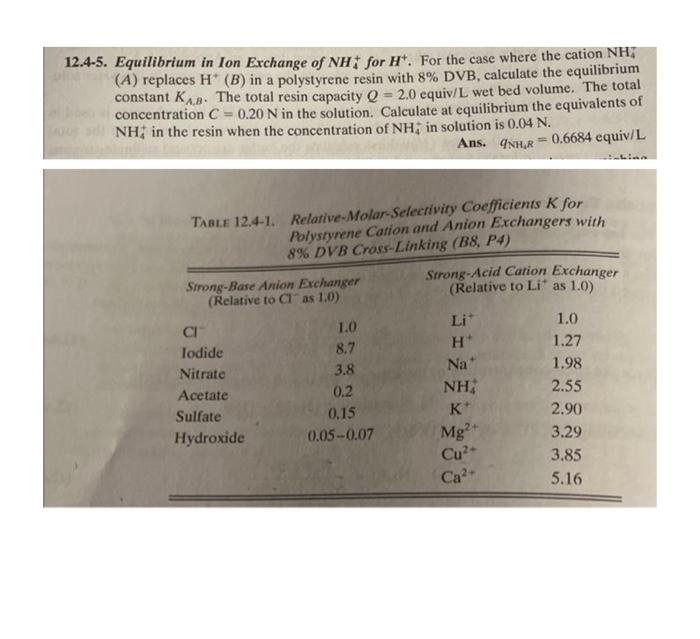
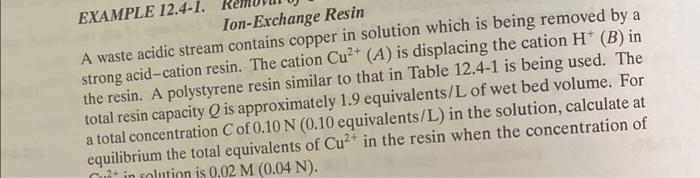
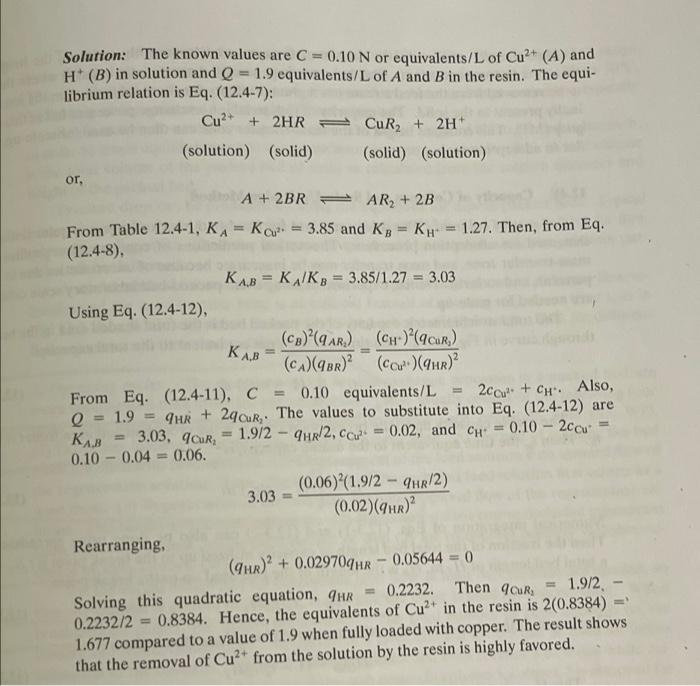
12.4-5. Equilibrium in Ion Exchange of NH for H+. For the case where the cation NHZ (A) replaces H" (B) in a polystyrene resin with 8% DVB, calculate the equilibrium constant KAB. The total resin capacity Q = 2.0 equiv/L wet bed volume. The total concentration C = 0.20 N in the solution. Calculate at equilibrium the equivalents of NH, in the resin when the concentration of NH; in solution is 0.04 N. Ans. OnuR = 0.6684 equiv/L TABLE 12.4-1. Relative Molar Selectivity Coefficients K for Polystyrene Cation and Anion Exchangers with 8% DVB Cross-Linking (B8, P4) Strong-Base Anion Exchanger (Relative to C as 1.0) Strong-Acid Cation Exchanger (Relative to Li' as 1.0) Lit H CI Todide Nitrate Acetate Sulfate Hydroxide 1.0 8.7 3.8 0.2 0.15 0.05 -0.07 Na , K Mg? Cu? Ca?- 1.0 1.27 1.98 2.55 2.90 3.29 3.85 5.16 EXAMPLE 12.4-1. Ion-Exchange Resin A waste acidic stream contains copper in solution which is being removed by a strong acid-cation resin. The cation Cu+ (A) is displacing the cation H+ (B) in the resin. A polystyrene resin similar to that in Table 12.4-1 is being used. The total resin capacity Q is approximately 1.9 equivalents/L of wet bed volume. For a total concentration C of 0.10 N (0.10 equivalents/L) in the solution, calculate at equilibrium the total equivalents of Cu2+ in the resin when the concentration of in solution is 0,02 M (0.04 N). Solution: The known values are C = 0.10 N or equivalents/L of Cu2+ (A) and H (B) in solution and Q = 1.9 equivalents/L of A and B in the resin. The equi- librium relation is Eq. (12.4-7): Cu+ + 2HR CUR + 2H (solution) (solid) (solid) (solution) or, A + 2BRAR2 + 2B From Table 12.4-1, KA = K = 3.85 and Kg = K = 1.27. Then, from Eq. (12.4-8). KAB = K/K3 = 3.85/1.27 = 3.03 Using Eq. (12.4-12), (cp)'lqar) (CH-) (qourg) (c)(br) (cov(ur) From Eq. (12.4-11), C = 0.10 equivalents/L 2ccut + Ch. Also, = 9HR + 2qcur,. The values to substitute into Eq. (12.4-12) are 3.03, 9cuR KAB 1.9/2 - CHR/2Cc 0.02, and CH 0.10 - 2ccu 0.10 - 0.04 = 0.06. (0.06) (1.9/2 - Chr/2) 3.03 (0.02)(ur) KAB Q = 1.9 Rearranging, (fur)2 + 0.02970qur 0.05644 = 0 Solving this quadratic equation, 9HR = 0.2232. 0.2232. Then your 1.9/2 0.2232/2 = 0.8384. Hence, the equivalents of Cut in the resin is 2(0.8384) = 1.677 compared to a value of 1.9 when fully loaded with copper. The result shows that the removal of Cu+ from the solution by the resin is highly favored
Step by Step Solution
There are 3 Steps involved in it

Get step-by-step solutions from verified subject matter experts
 Study Help