







Question: Please solve the question step by step, so I can properly understand the topic. :) A perceptron is a very simple 1-layer neural network. It
Please solve the question step by step, so I can properly understand the topic. :)
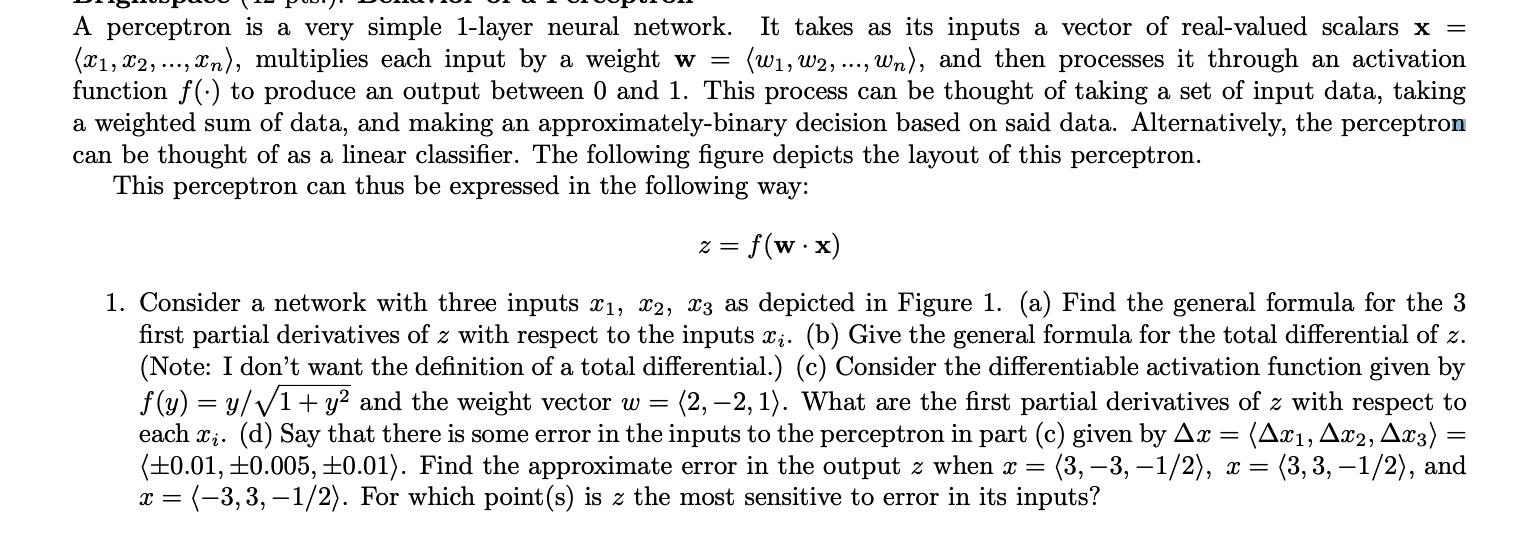
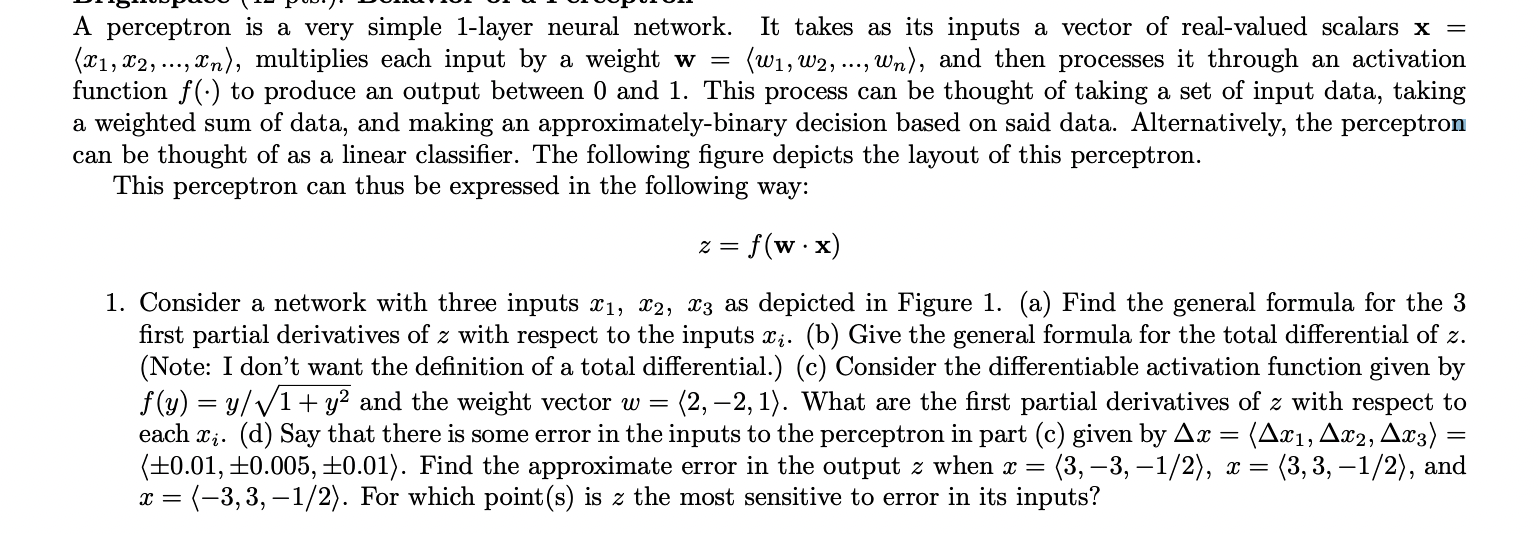
A perceptron is a very simple 1-layer neural network. It takes as its inputs a vector of real-valued scalars x = (1, X2, ..., n), multiplies each input by a weight w = (W1, w2, ..., Wn), and then processes it through an activation function f() to produce an output between 0 and 1. This process can be thought of taking a set of input data, taking a weighted sum of data, and making an approximately-binary decision based on said data. Alternatively, the perceptron can be thought of as a linear classifier. The following figure depicts the layout of this perceptron. This perceptron can thus be expressed in the following way: z =f(W .x) 1. Consider a network with three inputs X1, 22, 23 as depicted in Figure 1. (a) Find the general formula for the 3 first partial derivatives of z with respect to the inputs xi. (b) Give the general formula for the total differential of z. (Note: I don't want the definition of a total differential.) (c) Consider the differentiable activation function given by f(y) = y/v1 + y2 and the weight vector w = (2, -2, 1). What are the first partial derivatives of z with respect to each xi. (d) Say that there is some error in the inputs to the perceptron in part (c) given by Ax = (Ax1, Ax2, Ax3) = (+0.01, +0.005, +0.01). Find the approximate error in the output z when x = (3, -3, -1/2), x = (3,3, -1/2), and x = (-3,3, -1/2). For which point(s) is z the most sensitive to error in its inputs
Step by Step Solution
There are 3 Steps involved in it

Get step-by-step solutions from verified subject matter experts
 Study Help