Question: please solve the question using a quotation 1.7 CASE STUDY: TATA NANO-ENVIRONMENTAL ANALYSIS In 1868, Tata Gamsi founded Tata group. It is the largest conglomerate
please solve the question using a quotation
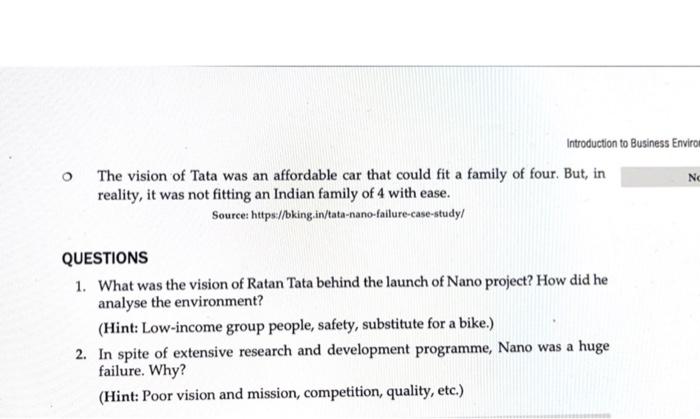
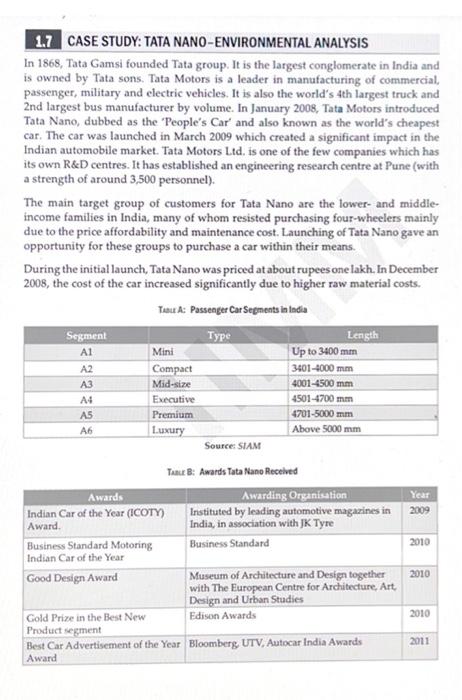
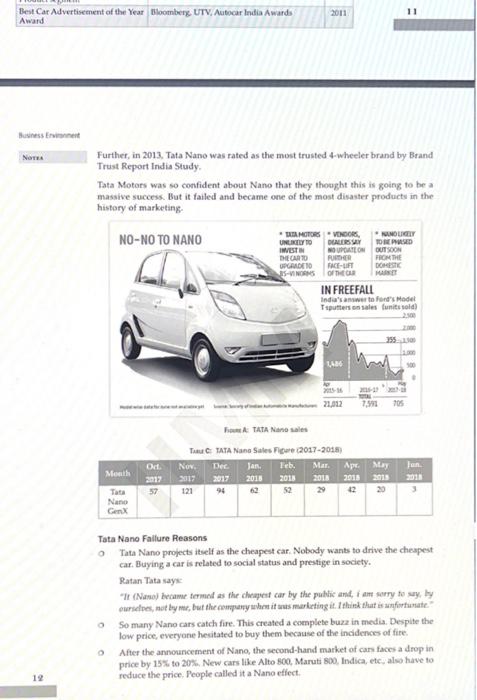
1.7 CASE STUDY: TATA NANO-ENVIRONMENTAL ANALYSIS In 1868, Tata Gamsi founded Tata group. It is the largest conglomerate in India and is owned by Tata sons. Tata Motors is a leader in manufacturing of commercial, passenger, military and electric vehicles. It is also the world's 4th largest truck and 2nd largest bus manufacturer by volume. In January 2008, Tata Motors introduced Tata Nano, dubbed as the 'People's Car' and also known as the world's cheapest car. The car was launched in March 2009 which created a significant impact in the Indian automobile market. Tata Motors Ltd. is one of the few companies which has its own R&D centres. It has established an engineering research centre at Pune (with a strength of around 3,500 personnel). The main target group of customers for Tata Nano are the lower- and middle- income families in India, many of whom resisted purchasing four-wheelers mainly due to the price affordability and maintenance cost. Launching of Tata Nano gave an opportunity for these groups to purchase a car within their means. During the initial launch, Tata Nano was priced at about rupees one lakh. In December 2008, the cost of the car increased significantly due to higher raw material costs. TABLE A: Passenger Car Segments in India Segment Type Length A1 Mini A2 Compact A3 Mid-size A4 Executive A5 Premium A6 Luxury Up to 3400 mm 3401-4000 mm 4001-4500 mm 4501-4700 mm 4701-5000 mm Above 5000 mm Awards Indian Car of the Year (ICOTY) Award. Awarding Organisation Instituted by leading automotive magazines in India, in association with JK Tyre Business Standard Business Standard Motoring Indian Car of the Year Good Design Award Museum of Architecture and Design together with The European Centre for Architecture, Art, Design and Urban Studies Gold Prize in the Best New Edison Awards Product segment Best Car Advertisement of the Year Bloomberg, UTV, Autocar India Awards Award Source: SIAM TABLE B: Awards Tata Nano Received Year 2009 2010 2010 2010 2011 Best Car Advertisement of the Year Bloomberg, UTV, Autocar India Awards Award Business Environment NOTEA 2011 11 Further, in 2013, Tata Nano was rated as the most trusted 4-wheeler brand by Brand Trust Report India Study. Tata Motors was so confident about Nano that they thought this is going to be a massive success. But it failed and became one of the most disaster products in the history of marketing. NO-NO TO NANO TATA MOTORS UNLIKELY TO INVEST IN THE CARTO VENDORS, DEALERS SAY NO UPDATE ON FURTHER FACE-LIFT NAND LIKELY TO BE PHASED OUTSOON FROM THE UPGRADE TO 5-NORMS DOMESTIC OF THE CAR MARKET IN FREEFALL India's answer to ford's Model Tsputters on sales (units sold) 3551300 $1.000 1,486 TOTAL 21,012 705 FA: TATA Nano sales Tu C TATA Nano Sales Figure (2017-2018) Oct. Nov. Dec. Jan. Feb. Mar. Apr May Jan. Month 2017 2017 2017 2018 2018 2018 2018 2015 Tata 57 121 94 52 29 42 20 Nano GenX Tata Nano Failure Reasons O Tata Nano projects itself as the cheapest car. Nobody wants to drive the cheapest car. Buying a car is related to social status and prestige in society. Ratan Tata says: "It (Nano) became termed as the cheapest car by the public and, i am sorry to say, by ourselves, not by me, but the company when it was marketing it. I think that is unfortunate So many Nano cars catch fire. This created a complete buzz in media. Despite the low price, everyone hesitated to buy them because of the incidences of fire. O O After the announcement of Nano, the second-hand market of cars faces a drop in price by 15% to 20%. New cars like Alto 800, Maruti 800, Indica, etc, also have to reduce the price. People called it a Nano effect. 2016-17 Introduction to Business Envirom No O The vision of Tata was an affordable car that could fit a family of four. But, in reality, it was not fitting an Indian family of 4 with ease. Source: https://bking.in/tata-nano-failure-case-study/ QUESTIONS 1. What was the vision of Ratan Tata behind the launch of Nano project? How did he analyse the environment? (Hint: Low-income group people, safety, substitute for a bike.) 2. In spite of extensive research and development programme, Nano was a huge failure. Why? (Hint: Poor vision and mission, competition, quality, etc.)









 Study Help