







Question: Please solve them quick and show working Using the centered three-point formula (given below) for the approximation of first derivative and the function f defined
Please solve them quick and show working
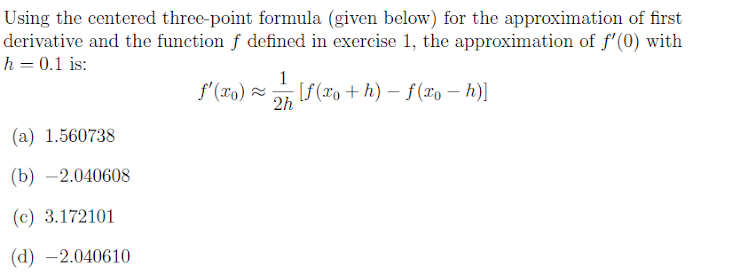

![is: f'(IO) ~ 2h If(roth) - f(To - h)] (a) 1.560738 (b)](https://dsd5zvtm8ll6.cloudfront.net/si.experts.images/questions/2024/10/670a1ef20da5e_529670a1ef1d9aa0.jpg)
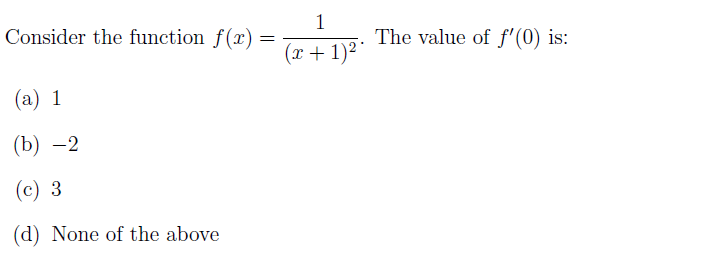
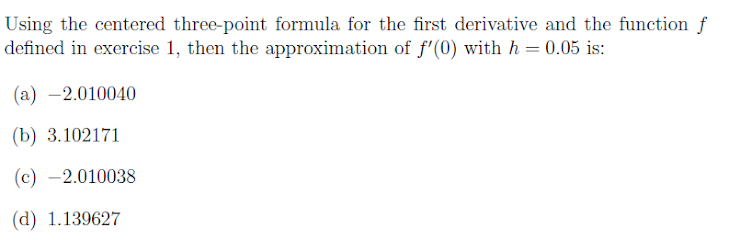
Using the centered three-point formula (given below) for the approximation of first derivative and the function f defined in exercise 1, the approximation of f'(0) with h = 0.1 is: f'(IO) ~ 2h If(roth) - f(To - h)] (a) 1.560738 (b) -2.040608 (c) 3.172101 (d) -2.040610Using the centered three-point formula for the first derivative and the function f defined in exercise 1, then the approximation of f'(0) with h = 0.05 is: (a) -2.010040 (b) 3.102171 (c) -2.010038 (d) 1.139627Suppose the following data points are generated by a smooth function f(x): X 0 1/6 1/3 1/2 2/3 5/6 f(x) 0.8415 0.8339 0.8105 0.7692 0.7075 0.6229 0.5144 Find the best approximation of of(x) dx using the composite Simpson's rule.dx Consider the integral I = The approximation of I by using the V5 - 72 composite Trapezoidal rule with n = 4 subintervals is: (a) 0.6527 (b) 0.6522 (c) 0.6322 (d) 0.5527Consider the function f(r) = ( 2 + 1 ) 2 ' The value of f'(0) is: (a) 1 (b) -2 (c) 3 (d) None of the above
Step by Step Solution
There are 3 Steps involved in it

Get step-by-step solutions from verified subject matter experts
 Study Help