







Question: Please solve this case study about Supply Chain Strategies. CASE STUDY Netflix NETFLIX, now 20 years old, has more than 94 million sub. scribers worldwide
Please solve this case study about Supply Chain Strategies. 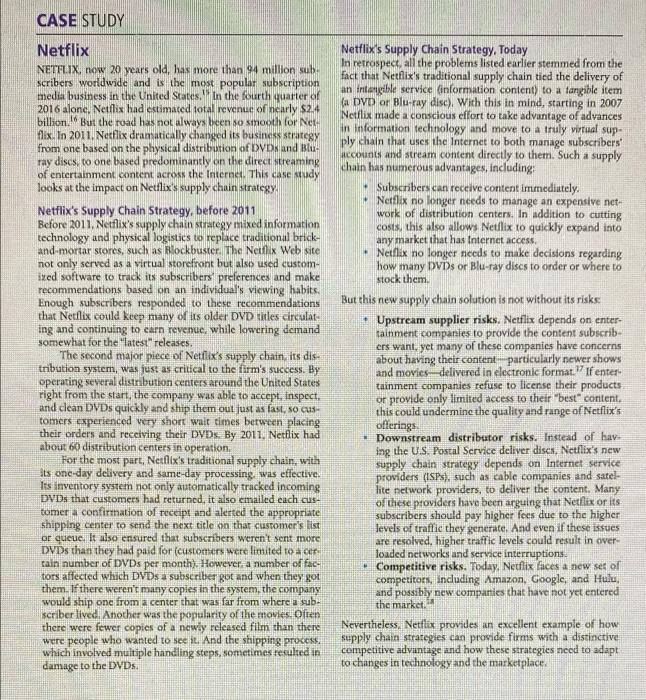
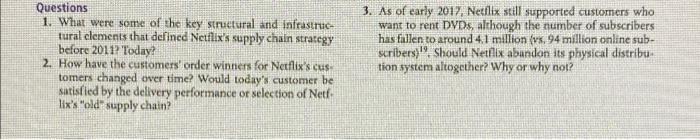
CASE STUDY Netflix NETFLIX, now 20 years old, has more than 94 million sub. scribers worldwide and is the most popular subscription media business in the United States. In the fourth quarter of 2016 alone. Netflix had estimated total revenue of nearly $2.4 billion. But the road has not always been so smooth for Net flix. In 2011. Netflix dramatically changed its business strategy from one based on the physical distribution of DVDK and Blu- ray discs, to one based predominantly on the direct streaming of entertainment content across the Internet. This case study looks at the impact on Netflix's supply chain strategy Netflix's Supply Chain Strategy, before 2011 Before 2011, Netflix's supply chain strategy mixed information technology and physical logistics to replace traditional brick- and-mortar stores, such as Blockbuster. The Netflix Web site not only served as a virtual storefront but also used custom- ixed software to track its subscribers preferences and make recommendations based on an individual's viewing habits. Enough subscribers responded to these recommendations that Netflix could keep many of its older DVD titles circulat- ing and continuing to carn revenue, while lowering demand somewhat for the latest releases The second major piece of Netflix's supply chain its dis- tributioa system, was just as critical to the firm's success. By operating several distribution centers around the United States right from the start, the company was able to accept, inspect, and clean DVDs quickly and ship them out just as fast, so cus- tomers experienced very short wait times between placing their orders and receiving their DVD By 2011. Netflix had about 60 distribution centers in operation For the most part, Netflix's traditional supply chain, with its one-day delivery and same-day processing, was effective. Iis inventory system not only automatically tracked incoming DVDs that customers had returned, it also emailed each cus- tomer a confirmation of receipt and alerted the appropriate shipping center to send the next title on that customer's list or queue. It also ensured that subscribers weren't sent more DVDs than they had paid for customers were limited to a cer tain number of DVDs per month). However, a number of fac- tors affected which DVDs a subscriber got and when they got them. If there weren't many copies in the system, the company would ship one from a center that was far from where a sub- scriber lived. Another was the popularity of the movies. Often there were fewer copies of a newly released film than there were people who wanted to see it. And the shipping process. which involved multiple handling steps, sometimes resulted in damage to the DVDs. Netflix's Supply Chain Strategy. Today In retrospect, all the problems listed earlier stemmed from the fact that Netflix's traditional supply chain tied the delivery of an inte ble service information content to a tangible item (a DVD or Blu-ray disc). With this in mind, starting in 2007 Netflix made a conscious effort to take advantage of advances in information technology and move to a truly virtual sup- ply chain that uses the Internet to both manage subscribers accounts and stream content directly to them. Such a supply chain has numerous advantages, including: Subscribers can receive content immediately. Netflix no longer needs to manage an expensive net work of distribution centers. In addition to cutting costs, this also allows Netflix to quickly expand into any market that has Internet access Netflix no longer needs to make decisions regarding how many DVDs or Blu-ray discs to order or where to stock them, But this new supply chain solution is not without its risks * Upstream supplier risks. Netflix depends on enter- tainment companies to provide the content subscrib- ers want, yet many of these companies have concerns about having their content particularly newer shows and movies delivered in clectronic format. fenter 17 tainment companies refuse to license their products or provide only limited access to their best content this could undermine the quality and range of Netflix's offerings Downstream distributor risks. Instead of hav ing the U.S. Postal Service deliver dises, Netflix's new supply chain strategy depends on Internet service providers (ISPs), such as cable companies and satel lite network providers, to deliver the content. Many of these providers have been arguing that Netflix or its subscribers should pay higher fees due to the higher levels of traffic they generate. And even if these issues are resolved, higher traffic levels could result in over- loaded networks and service interruptions. Competitive risks. Today, Netflix faces a new set of competitors, including Amazon, Google, and Hulu, and possibly new companies that have not yet entered the market. Nevertheless, Netflix provides an excellent example of how supply chain strategies can provide firms with a distinctive competitive advantage and how these strategies need to adapt to changes in technology and the marketplace. Questions 1. What were some of the key structural and infrastruc- tural clements that defined Netflix's supply chain strategy before 2011 Today? 2. How have the customers' order winners for Netflix's.cus. tomers changed over time? Would today's customer be satisfied by the delivery performance or selection of Netf Hix's "old" supply chain? 3. As of early 2017, Netilix still supported customers who want to rent DVDs, although the number of subscribers has fallen to around 4,1 million vs. 94 million online sub- scribers". Should Netflix abandon its physical distribu tion system altogether? Why or why not Step by Step Solution
There are 3 Steps involved in it
1 Expert Approved Answer
Step: 1 Unlock

Question Has Been Solved by an Expert!
Get step-by-step solutions from verified subject matter experts
Step: 2 Unlock
Step: 3 Unlock
 Study Help